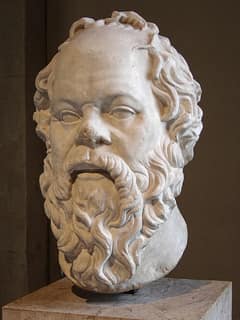
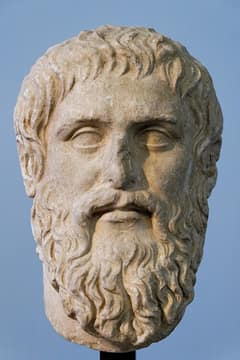
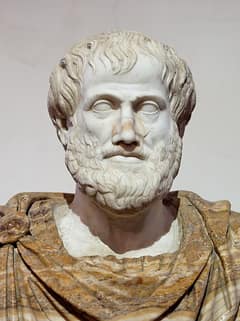
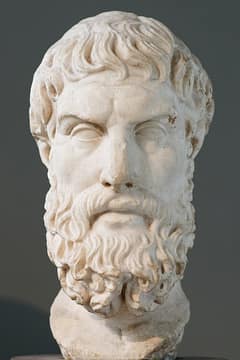
Socrates seeks the one character by which all pious acts are pious and uses it as a standard for judging cases. Aristotle reports that he sought universal definitions but did not make universals separate; separation was the step his successors took.
Another reading. R. E. Allen (1970) reads the Euthyphro's form as an early version of the theory of Forms, existing independently of its instances.
Contested readingAristotle's testimony (Metaphysics M.4, M.9); Plato, early dialogues (Euthyphro)eidos, idea, ti esti, ousia, pathosDraft — not yet reviewed
The Euthyphro alone leaves open where the form exists; this coding rests on Aristotle's testimony, which developmentalists accept and agnostics about the historical Socrates do not.
Wherever many things are called by one name there is one Form, which exists by itself, apart from the particulars and from our minds; particulars have their character by participating in it, as beautiful things are beautiful by the Beautiful. The Parmenides presses hard on how participation can work and rejects the suggestion that Forms are thoughts in minds (132b–c), yet concludes that without Forms thought and discourse would be impossible.
Scholarly consensusmiddle dialogues (speaker Socrates); tested in the late-middle Parmenides (Parmenides questioning the young Socrates)eidos, methexis, mimesis, paradeigma, auto kath' hautoDraft — not yet reviewed
Forms are not just universals: they are perfect paradigms that seem to be what they are in the highest degree (the Beautiful is beautiful), which is what invites the Third Man regress.
A universal is what is by nature predicated of many, and it is real, but it does not exist separately from the particulars it is predicated of. No universal is a substance; separating universals from particulars, as Plato did, is the error that generates the difficulties of the Forms. Universals exist in things and are grasped by the intellect from them.
Scholarly consensusCategories; De Interpretatione 7; Metaphysics Z.13, Mkatholou, kath' hekaston, ousia, choristonDraft — not yet reviewed
Not addressed. He never poses the problem of one character shared by many; he treats properties only as attributes of individual bodies and general notions as preconceptions.
Shape, colour, size and the other properties of a body are neither things existing by themselves nor nothing; they belong to the body and are perceived with it. Accidental features are equally real while they belong to it. Generality enters through preconceptions, which Diogenes Laertius describes as universal notions stored in the mind.
Another reading. Since only bodies and void exist in their own right and properties exist only in individual bodies, Epicurus can be coded as holding that only particulars exist.
Another reading. Since generality lies in preconceptions, universal notions held in the mind, Epicurus can be coded as locating universals in concepts.
Contested readingLetter to Herodotus 68–71; Diogenes Laertius' account of the canon (Lives X.33)symbebekota, symptomata, prolepsisDraft — not yet reviewed
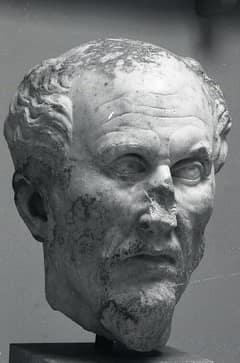
The shared characters of things are Forms that exist before and apart from sensibles, not as separate objects but as the thoughts that make up divine Intellect. They do not depend on any human mind.
Scholarly consensuseide, nous, ta noetaDraft — not yet reviewed
Plotinus also argues for Forms of individuals (V.7), which goes beyond realism about universals; how consistently he holds it is disputed: Rist (1963) takes it as his view, Blumenthal (1966) doubts it is settled doctrine.
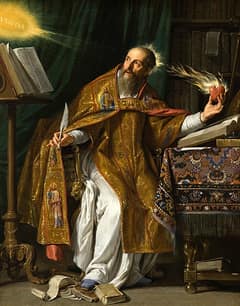
The forms by which things are what they are are eternal, unchanging reasons in the mind of God, after which everything that comes to be is made; this is how Augustine accepts Plato's Ideas.
Stated in the textideae, rationes, formaeDraft — not yet reviewed
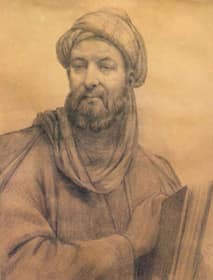
A nature such as horseness, taken in itself, is neither universal nor particular; it is particular in individual things and universal only as conceived by an intellect.
Scholarly consensusmāhiyya, kullī, al-iʿtibārāt al-thalāthaDraft — not yet reviewed
Natures also exist before the many, as known by the separate intellects and the First, which the later Latin scheme of before, in and after things takes from him.
Only the logic layer addresses the question, and it restates Ibn Sina's account; he presents logic as neutral, containing nothing religion must reject (Deliverance, on philosophy). His Ashʿarite ontology of created individuals and accidents would sit as easily with `conceptualism`; no metaphysical text of his settles it.
Each natural species has a separate light that governs it and holds its perfections, its "lord"; Suhrawardi identifies these lights with Plato's Forms and defends them against the Peripatetics. Universality as such, being said of many, is a consideration of the mind.
The lords of the species are individual lights, not universals predicated of their members, so `platonic-realism` fits their separate, mind-independent existence but not the universal as such, which is mental. Walbridge (The Leaven of the Ancients, 2000) treats his Platonism at length.
A nature taken in itself is neither universal nor particular. As a universal it exists only in the mind; the nature exists outside only in its individuals. Tusi restates Ibn Sina's three ways of considering a quiddity.
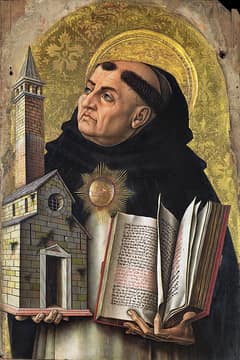
A nature such as humanity exists in individuals as particular and is universal only as the intellect abstracts it; it does not exist apart from them, except as an exemplar idea in God's mind.
Stated in the textnatura absolute considerata, universale, ideae divinaeDraft — not yet reviewed
In the Treatise on Motion he argues as a Peripatetic and rejects the Platonic Forms, and in the Treatise on Gradation he denies that an essence can be more or less itself. Universal natures are then real only in their individuals and as the mind conceives them.
Another reading. The ode says that every form in the world below has its original in the world above, which the ode's commentators and many readers take as the Platonic Forms affirmed in verse.
Contested readingal-muthul al-aflāṭūniyya, māhiyya, tashkīkDraft — not yet reviewed
The positive stance is inferred from his rejection of the Forms; neither treatise is known to give an account of universals of its own. Some read the ode itself as stating the Platonic view in order to refute it in the Peripatetic manner.
Each species has an intellectual archetype, a separate light or intellect that governs it, and Sadra defends these Platonic Forms against Ibn Sina. A quiddity as a universal concept exists only in the mind, and as a nature it is real only through the existence of its individuals.
With quiddity derivative, universals are at bottom mental; the archetypes are real as existents, not as universals. He takes the defence of the Forms from Suhrawardi and recasts them as degrees of existence.
Universals are only modes of thinking: they arise when we use one idea to think of all the individuals that resemble one another, and exist nowhere but in the mind.
Stated in the textuniversalia, modi cogitandiDraft — not yet reviewed
There are no abstract general ideas: every idea is particular, and becomes general in use when it is attached to a word that calls up, by custom, any of the resembling individuals.
Stated in the textabstract ideas, general terms, resemblance, customDraft — not yet reviewed
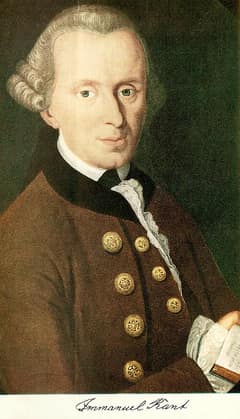
A concept is a general representation that refers to objects through marks that many things can share, and it exists only in thought. Kant does not pose the realism question directly; the pure concepts are rules of synthesis whose claim to objects is settled by the deduction, not by a theory of universals.
Another reading. Kant replaces the old question of where universals exist with the question how a priori concepts can apply to objects at all (A84–92/B116–124); on this reading none of the traditional stances applies.
Contested readingCritical periodBegriff, conceptus, Merkmal, KategorieDraft — not yet reviewed
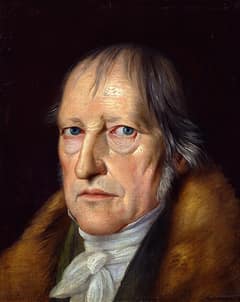
›G. W. F. Hegel1770–1831Moderate realism* (contested reading)
The universal is not a common mark abstracted by the mind but the concept that particularises itself and is the essence of the individual thing: the genus is in the individual, not beside it. This "concrete universal" is objective, not merely conceived.
Another reading. The concrete universal fits none of the stances: unlike moderate realism it is not universal only as conceived, and unlike Platonic realism it is not apart from its instances.
Contested readingEncyclopaedia (1830)konkretes Allgemeines, Begriff, GattungDraft — not yet reviewed
The option's clause "universal only as conceived by the mind" does not fit; the shared ground is that universals are real and do not exist apart from particulars. The realist reading is Stern's (Hegelian Metaphysics, 2009), who takes the concrete universal as a substance-universal.
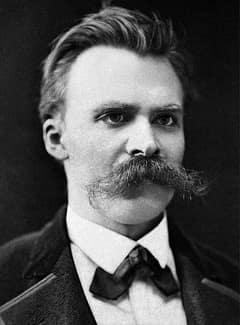
Every concept arises by equating unequal things and overlooking differences; logic itself grew from the useful habit of treating the similar as the same. There are no forms or natures corresponding to general words.
Scholarly consensusOn Truth and Lies (1873); Gay Science (1882)Gleichsetzen des Nicht-Gleichen, BegriffDraft — not yet reviewed
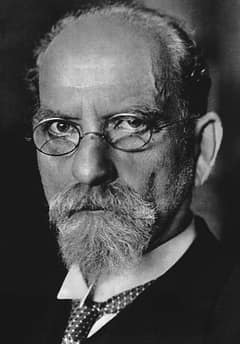
Species and essences are ideal objects, genuinely given and genuinely meant, and not reducible to general words, mental images or resemblances among particulars. Husserl insists this is not a metaphysical hypostasis of universals into a separate realm.
Scholarly consensusLogical Investigations II (1901); Ideas I (1913)ideale Spezies, Wesen, EidosDraft — not yet reviewed
Husserl accepts the realism of the option (independent of particulars and of minds) but rejects the label "Platonic realism" (Ideas I §22) where it implies real existence apart from the world.
Not addressed. Heidegger takes no side on whether universals exist; the related thesis that Being is not a genus answers a different question.
The universality of Being exceeds every generic universality, and the doctrine of the idea as the "look" of things is, for Heidegger, where truth turned into correctness. He treats the realism dispute as internal to that metaphysics without taking a side.
Scholarly consensusBeing and Time (1927); "Plato's Doctrine of Truth" (1940/1942)Draft — not yet reviewed
The 1915 habilitation thesis on the theory of categories and meaning then ascribed to Duns Scotus may be an earlier layer with a view on universals; not checked in this pass.
Hekmat. "What is the nature and ontological standing of universals?." Draft, awaiting review; last updated 20 October 2026. https://hekmat.local/questions/ont-universals/