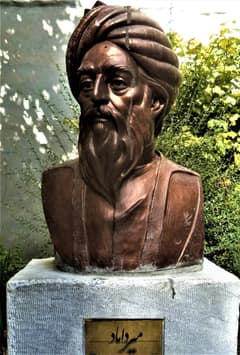
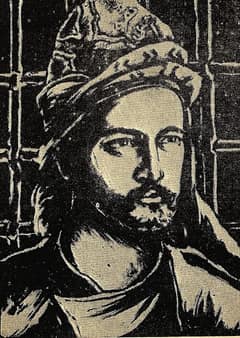
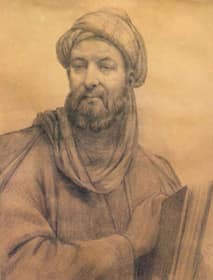
Sadr al-Din Shirazi, known as Mulla Sadra, held that existence, not quiddity, is what is real; that existence is one reality graded in intensity from God down to matter; and that material things change in their very substance. On these principles he argued that the soul begins as a bodily form and becomes immaterial, that knowing is the knower's union with what it knows, and that the body is resurrected.
Central question
If existence, not quiddity, is what is real, how do one graded existence, a world in constant change and the soul's ascent to God fit together?
Method
Mulla Sadra joins demonstration (burhān), the unveiling (kashf) of the mystics and the Quran and hadith, holding that each confirms the others when rightly understood. How Mulla Sadra works ↓
Wrote mainly in Arabic. The Four Journeys (al-Asfar), his summa, is cited by journey and volume of the standard nine-volume edition; shorter works by part or section. He also glossed Ibn Sina and Suhrawardi and commented on Shi'i hadith. No text or translation is held in Hekmat.
Stated in the text 1
Scholarly consensus 18
Contested reading 1
4 arguments9 works0 quotations checked word for word0 of 24 positions and arguments reviewed by an expert
Only existence is real; quiddities are the mind's outlines of its limits. Existence is one reality graded from God, pure existence without limit or quiddity, down to prime matter, and every other existent is a dependent degree of it, a relation to its cause rather than a thing that has a relation.
Stated in the textaṣālat al-wujūd, tashkīk al-wujūd, ṣirf al-wujūd, al-wujūd al-rābiṭDraft — not yet reviewed
Sadra says he first defended the primacy of quiddity and was then led to the primacy of existence. In his discussion of causality he goes further, saying that effects are only modes of the one existence; how this personal unity of existence relates to gradation is discussed by Rizvi (Mulla Sadra and Metaphysics: Modulation of Being, 2009).
›UniversalsRealism before things
Each species has an intellectual archetype, a separate light or intellect that governs it, and Sadra defends these Platonic Forms against Ibn Sina. A quiddity as a universal concept exists only in the mind, and as a nature it is real only through the existence of its individuals.
With quiddity derivative, universals are at bottom mental; the archetypes are real as existents, not as universals. He takes the defence of the Forms from Suhrawardi and recasts them as degrees of existence.
›God and the fundamentalDemonstrable by reason
God's existence is proved from existence itself, without reasoning from motion or contingency: existence is one graded reality, and a graded reality whose lower degrees are deficient and dependent requires a highest degree without limit or need, which is God. Sadra calls this the proof of the sincere.
Scholarly consensusburhān al-ṣiddīqīn, ṣirf al-wujūd, al-wājibDraft — not yet reviewed
He presents this as the strongest form of Ibn Sina's proof of the same name, which starts from the concept of existence rather than its reality.
›Soul and bodyHylomorphism
The soul begins as the form of a body, and being the soul of a body is its very mode of existence, not a relation added to it. Through substantial motion it grows more intense in being until it becomes an immaterial substance that survives the body: bodily in its origin, spiritual in its survival.
Neither option holds the process: `hylomorphism` fits the soul's origin and its unity with the body, `substance-dualism` its end. Against Ibn Sina, the soul is not immaterial from the moment it comes to be.
›Death and immortalityThe soul is immortal
The individual soul survives death, and the person is raised soul and body: the soul gives itself a body formed by its imaginative power and shaped by the traits it acquired, and this body is the same person's body, since a body's identity lies in its soul.
Scholarly consensusal-maʿād al-jismānī, badan mithālī, khayālDraft — not yet reviewed
Against Ibn Sina, who accepted bodily resurrection on the authority of revelation (Metaphysics IX.7), Sadra claims to demonstrate it.
›The cosmosEternal but produced
Divine giving of existence has no beginning, but the natural world, being in constant substantial motion, is renewed at every instant: each of its parts, and so the whole, is preceded in time by its own non-existence. Sadra presents this as proving that the world is originated, as revelation teaches, without positing a first moment of time.
Scholarly consensusḥudūth zamānī, al-ḥaraka al-jawhariyya, tajaddudDraft — not yet reviewed
Neither option holds the view: the world as a whole has no first moment, yet nothing in it is eternal, and Sadra presents this as vindicating the theologians' origination of the world (so `created-in-time` is the nearest rival code). A candidate for the own-position option in codebook 1.2.0.
›Freedom and determinismFree and determined
Human acts are done by will and are truly the agent's own, yet the will and its act exist only as a degree of the existence that flows from God, so they are also God's. Sadra takes this as the meaning of the Imami formula "a matter between two matters", between compulsion and delegation.
The formula answers how one act can belong to both God and the agent, given the gradation of existence; it does not pose responsibility under determinism, so `compatibilist` fits only loosely. A candidate for the own-position option in codebook 1.2.0.
›CausationCauses necessitate
A thing does not exist until it is necessitated, and the complete cause necessitates its effect. But the effect's possibility is not that of an essence indifferent to being; it is need itself: its existence is nothing but a relation to its cause. Pressed to the end, causation becomes manifestation, and effects are modes of the one existence rather than things that receive it.
Scholarly consensusFour Journeys, Journey I (the stage on cause and effect)al-ʿilla al-tāmma, al-wujūd al-rābiṭ, imkān faqrī, imkān māhawī, tashaʾʾun, tajallī, shaʾnDraft — not yet reviewed
He keeps the Avicennian rule that what is not necessitated does not exist, but replaces quidditative possibility with the poverty of what is only a relation, and ends by reducing causation to the cause's self-manifestation (Rizvi, Mulla Sadra and Metaphysics, 2009). The second step has no option of its own.
Epistemology
›Sources of knowledgeIllumination from a higher intellect
Knowing is a mode of existence. Sense and imagination are the soul's own productions, not imprints, and the soul rises through them by substantial motion until it can unite with the active intellect and witness the intelligible forms. Intellectual knowledge comes from that union with a higher intellect, which experience only prepares.
Sadra keeps the language of abstraction (tajrīd) but takes it to be the soul's own ascent, not the stripping of forms from matter, so `experience-then-intellect` fits less well. Kalin (Knowledge in Later Islamic Philosophy: Mulla Sadra on Existence, Intellect, and Intuition, 2010) presents his theory of knowledge as a theory of existence.
›Certainty, doubt and the limits of knowledgeYes
Certain knowledge is attainable, by demonstration and, more fully, by unveiling, in which the knower is present to what is known; Sadra holds that demonstration, unveiling and the Quran cannot disagree.
Scholarly consensusyaqīn, burhān, kashf, ʿilm ḥuḍūrīDraft — not yet reviewed
The soul comes to be as a bodily form with no knowledge, a material intellect in potency to every intelligible, and becomes an intellect in act only through its substantial motion and its union with what it comes to know.
As in Suhrawardi, the soul's awareness of itself is by presence and is not acquired; it is the soul's existence, not a stored content.
›TruthCorrespondence · Truth as a feature of being
A statement is true when it matches how things are in themselves (nafs al-amr), but "the true" is said first of existence, and most of all of God, the Real, whose existence is pure and unmixed.
Scholarly consensusḥaqq, ṣidq, nafs al-amr, wujūdDraft — not yet reviewed
›Epistemic justificationKnowledge by presence or identity · Demonstration from first principles
Knowing is a mode of existence: the soul knows by becoming one with the intelligible form, and its knowledge of itself and of what it produces is by presence, not by representation. Demonstration still has full authority in its domain, and Sadra holds that demonstration, unveiling (kashf) and the Quran cannot disagree, so a claim is secure when demonstrated and most secure when also witnessed.
Scholarly consensusThe Four Journeys (Asfar)wujūd, ʿilm ḥuḍūrī, ittiḥād al-ʿāqil wa-l-maʿqūl, burhān, kashfDraft — not yet reviewed
Kalin (Knowledge in Later Islamic Philosophy: Mulla Sadra on Existence, Intellect, and Intuition, 2010) presents his theory of knowledge as part of his ontology. The two codes are one view: presence grounds, demonstration articulates and checks.
The soul's perfection is to become an intellectual world matching the order of existence, united with the intelligibles. The philosopher's four journeys run from creation to God, in God, from God back to creation, and in creation with God. The ascent begins in this life and is completed after death.
Another reading. Read from the eschatology of Journey IV and the Wisdom of the Throne, the highest happiness is meeting God after death, which this life only prepares.
Not addressed. Sadra gives no account of what makes an action right. Ethics appears as purification of the soul and obedience to revealed law, serving the soul's perfection in knowledge and existence.
Not coded; for Sadra practice serves the soul's ascent, and he does not ask what makes an act right.
Scholarly consensusDraft — not yet reviewed
›Virtue and knowledgeKnowledge plus habituation
Knowledge is the soul's perfection, but acts repeated become settled traits that enter the soul's very substance; without purification knowledge does not take hold, and the soul's traits shape the body it is given after death.
Scholarly consensusmalaka, ʿilm, ʿamal, tazkiyaDraft — not yet reviewed
Human beings need a law and a lawgiver; the prophet gives the law, and the head of the virtuous city must unite knowledge, intellect and the qualities al-Farabi lists for the first ruler.
Scholarly consensusnabī, sharīʿa, al-madīna al-fāḍila, imāmDraft — not yet reviewed
The ruler is a prophet-lawgiver and, after him, the imam, following al-Farabi and Ibn Sina; politics is a small part of his work.
›Beauty and artBeauty as ascent
Every existent is beautiful and loved to the degree of its existence. Love of beautiful human forms, when chaste and found in refined souls, refines the soul and prepares it for intellectual love, and ultimately for the love of God.
Scholarly consensusʿishq, jamāl, ʿishq al-ẓurafāʾDraft — not yet reviewed
Art and poetry are not discussed; the coding rests on his account of beauty and love.
›JusticeJustice laid down by a prophet-lawgiver
Repeating Ibn Sina's argument, Sadra holds that people need one another and so need dealings ruled by justice, which they cannot settle among themselves; a prophet-lawgiver must give the law. Justice matters to him chiefly as part of the account of prophecy and of the soul's discipline on its way to perfection.
Scholarly consensusʿadl, sharīʿa, nabī, madanī bi-l-ṭabʿDraft — not yet reviewed
The coding rests on his reworking of Ibn Sina's argument for prophecy; Sadra adds no theory of justice of his own, and the coding should be checked against the texts before review.
›The nature of valueGood convertible with being
Existence is pure good, and every good comes back to existence; evil is a lack of existence or of some perfection. Because existence comes in degrees of intensity, goodness, beauty and lovability rise with it, up to the Necessary Existent, which is pure existence and pure good.
Coded on good (khayr), not "value". # check: exact chapters in Asfar vol. 1 and vol. 7 for existence as pure good and evil as privation.
* contested reading · open a row for the explanation and its sources
Method روش و شیوه اندیشهورزی فلسفی
Mulla Sadra joins demonstration (burhān), the unveiling (kashf) of the mystics and the Quran and hadith, holding that each confirms the others when rightly understood. He works through the Peripatetic, Illuminationist, Sufi and theological traditions and recasts them on his own principles, above all the primacy and gradation of existence, in a summa organised as four journeys of the intellect.
Posing questions
Sadra poses philosophical questions as stages of a journey of the soul toward God and back, so that the order of topics (general metaphysics, natural philosophy, theology, the soul and its return) is also an order of spiritual ascent. He first asks how existence stands to quiddity, since on his view the answer decides most other questions. A problem is usually introduced through the views of earlier schools, which he sets side by side before stating his own.
He requires that every claim be supported by demonstration, but holds that some truths were first reached by unveiling and only then proved, and that a proof which conflicts with sound unveiling or with revelation is defective. His key arguments rest on the reality and gradation of existence: from them he derives the unity of the knower with the known, substantial motion and the bodily resurrection. He also reads Quranic verses and Shiʿi hadith as stating the same truths in another register and interprets them at length.
Sadra glosses Ibn Sina's Healing and Suhrawardi's Philosophy of Illumination, accepting much and correcting them where they rest on the primacy of quiddity or deny substantial motion. He treats his own earlier view as one of the positions refuted, saying he once defended the primacy of quiddity before he was guided to the primacy of existence. He also criticises literalist jurists and self-styled Sufis who reject reasoned inquiry, and theologians who rely on dialectic alone.
Reason, unveiling and revelation are three ways to one truth, and Sadra's method is their agreement: reason without unveiling stays external, unveiling without proof cannot be taught or checked. In his own account the decisive insights came after a period of withdrawal and ascetic practice, when what he had known by proof was disclosed to him directly. Intellect at its height is united with what it knows, which for him is a matter of being, not only of representation.
The Asfar is a vast synthesis that quotes earlier philosophers, theologians and mystics at length before commenting and judging, so that it reads in part as an anthology with arguments. Its four journeys (from creation to God, in God with God, from God to creation with God, and in creation with God) give the work a mystical frame. His shorter works restate the system more compactly, sometimes in a style of witnesses (shawāhid) and illuminations rather than full proofs.
›The primacy of existence over quiddityExistence is what is fundamentally real (aṣīl); quiddities are derivative constructs of the mind (iʿtibārī), real only through the existence they bound.
1A quiddity taken in itself is neither existent nor non-existent; both lie outside what it is.
2What is real, and has effects outside the mind, cannot be something that in itself is indifferent to existing and not existing.
3The same quiddity exists in the mind without its effects and outside the mind with them (fire in thought does not burn); what differs is not the quiddity but its existence.
4So what makes things real and active is existence; a quiddity is what the mind draws from the limits of a given existence.
5Existence does not exist through a further existence but by itself, so the regress urged against its reality does not arise.
∴Existence is what is fundamentally real (aṣīl); quiddities are derivative constructs of the mind (iʿtibārī), real only through the existence they bound.
Suhrawardi objects. (Earlier; Sadra answers it.) If existence were real it would itself exist and so need an existence, without end; existence is a consideration of the mind.
›The gradation of existenceExistence is a single reality graded in intensity, priority and perfection, from pure existence without limit, God, down to prime matter.
1Existence is one concept, said in the same sense of everything that exists.
2One concept drawn from many things requires a real unity among them.
3Yet existents differ, as cause from effect, the necessary from the possible, the stronger from the weaker.
4Quiddity is not what is real, and outside existence there is only nothing, so the difference must lie in existence itself.
5So existence is one reality in which that by which existents differ is that by which they agree, as lights differ only in intensity.
∴Existence is a single reality graded in intensity, priority and perfection, from pure existence without limit, God, down to prime matter.
›Substantial motionMaterial substances are in constant motion in their very being (al-ḥaraka al-jawhariyya); the natural world is renewed at every instant, and the soul rises by this motion from a bodily form to an immaterial intellect.
1Bodies change in quantity, quality, place and position.
2The proximate cause of a changing thing must itself be changing; from a fixed cause only a fixed effect follows.
3The proximate cause of a body's accidental changes is its nature, its substantial form.
4Accidents have no existence apart from their substance, so their renewal is a renewal of the substance's own existence.
5So the nature itself is in continuous renewal, and time measures that renewal.
∴Material substances are in constant motion in their very being (al-ḥaraka al-jawhariyya); the natural world is renewed at every instant, and the soul rises by this motion from a bodily form to an immaterial intellect.
Ibn Sina objects. (Earlier; Sadra answers it.) There is no motion in the category of substance. A substantial form comes to be and passes away at once; if a substance moved in its substance, nothing of the same species would persist as the subject of the motion.
Aristotle objects. (Earlier; the thesis Sadra's argument denies.) Change in substance is coming to be and passing away, not motion, since substance has no contrary.
›The demonstration of bodily resurrectionAfter death the soul gives itself a body suited to the traits it has acquired, and this body is the same person's body; so the same individual returns, soul and body, and bodily resurrection can be demonstrated, not only believed.
1A thing is what it is by its form, not its matter; a person is who they are by their soul.
2A body remains the same body as long as its soul is the same, whatever its matter, as one man is the same at twenty and at seventy.
3Imagination is not a bodily power; it belongs to the soul and survives with it.
4The soul can bring into being images that subsist through it, not in matter, as in dreams.
5Such images have shape, size and sensible qualities; they are bodies, not concepts.
∴After death the soul gives itself a body suited to the traits it has acquired, and this body is the same person's body; so the same individual returns, soul and body, and bodily resurrection can be demonstrated, not only believed.
Ibn Sina objects. (Earlier; Sadra answers it.) Reason can demonstrate the soul's survival and its happiness or misery, but not a bodily return; that is accepted on the authority of the prophet's law.
the primacy of existence · existence as fundamentally realExistence, not quiddity, is what is real in things and has effects; a quiddity is the outline the mind draws from the limits of a given existence. Sadra says he first held the opposite.2 links to other thinkers →
the gradation of existence · modulation of existenceExistence is one reality that comes in degrees of intensity, priority and perfection, so that what distinguishes existents is what they share. The highest degree is God; the lowest is prime matter.1 link to other thinkers →
substantial motionMaterial things change continuously in their very substance, not only in their accidents, and time is the measure of this renewal. By it the natural world is new at every instant, and the soul rises from a bodily form to an immaterial intellect.1 link to other thinkers →
the union of the intellect and the intelligibleIn knowing, the knower does not receive a form as a container receives a thing but becomes, in its existence, what it knows; the soul grows in being as it comes to know.2 links to other thinkers →
bodily in origination · spiritual in survivalThe soul begins as the form of a body and, through substantial motion, becomes an immaterial substance that survives the body.1 link to other thinkers →
the simple reality is all thingsWhat is wholly simple lacks no perfection of existence, so it holds every existent in a higher way, without their limits: God is all things and none of them.1 link to other thinkers →
bodily resurrectionThe same person returns after death, soul and body. The body is made by the soul's own imaginative power, and it is the same body because a body's identity lies in its soul.
the transcendent philosophy · transcendent wisdomSadra's name for a philosophy in which demonstration, the unveiling of the mystics and revelation agree, set out as the soul's four journeys from creation to God and back.1 link to other thinkers →