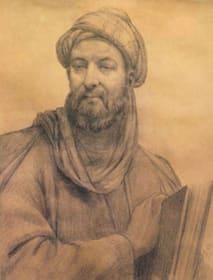
Medieval Islamic · 11th c.
Ibn Sina (Avicenna)
ابنسینا980–1037Islamic Peripatetics (Mashshāʾī)
Ibn Sina distinguished what a thing is (essence) from that it is (existence). Every contingent being needs a cause, and the chain ends in a being necessary in itself. His "flying man" argues that the soul knows itself without the body.
- Central question
- How are essence and existence related, and what is the necessary being?
- Method
- Ibn Sina builds philosophy as a demonstrative system: each science has its own subject and principles, and its conclusions follow by syllogism from what is self-evident or already proven. How Ibn Sina works
wujūd / māhiyya existencewājib al-wujūd the necessary existental-ʿaql al-faʿʿāl the active intellectal-nafs al-nāṭiqa the rational soulal-kullī the universal
- Stated in the text 6
- Scholarly consensus 11
- Contested reading 3
Answers 20 of 20 questions
Epistemology
Sources of knowledgeIllumination from a higher intellect (contested reading)
Perception, imagination and reflection prepare the soul, but the universal form is received from the Active Intellect, which emanates intelligibles onto a soul made ready for them, as the sun's light lets the eye see.
Another reading. Gutas ("The Empiricism of Avicenna", 2012): emanation is Ibn Sina's metaphysical description of what is, in cognitive terms, abstraction from sensory images by the human intellect, so the source is experience completed by intellect.
Another reading. Hasse ("Avicenna on Abstraction", 2001) and McGinnis (2007) reject the either/or: abstraction prepares the soul and emanation completes it, so both codes apply.
The Book of Healing Psychology V.5 · The Book of Healing Psychology II.2
The coding follows the emanation reading, on which the Active Intellect does the work (Davidson, 1992). The `illumination` option already allows that the senses prepare the mind first.
Certainty, doubt and the limits of knowledgeYes
Certain knowledge is attainable: the first notions (existent, thing, necessary) and the first principles are known in themselves, and demonstrations from them yield certainty; whoever denies the principle of contradiction has to be made to feel its force.
The Book of Healing Metaphysics I.5 · The Book of Healing Metaphysics I.8
Innate knowledgeNo innate contents
The human intellect begins as pure potentiality, a material intellect with no forms of its own, and acquires intelligibles step by step; even the first principles come to it without learning but are not stored in it from birth.
The Book of Healing Psychology I.5 · The Book of Healing Metaphysics I.5
The primary notions (existent, thing, necessary) are said to be in the soul from the first and cannot be acquired from anything better known (Metaphysics I.5), which borders on innateness; but the intellect has them only once it is actualised, not from birth.
TruthCorrespondence · Truth as a feature of being
A statement is true when it corresponds to how the thing is, but "true" is said first of existence itself, and most of all of the Necessary Existent, whose existence is permanent.
The Book of Healing Metaphysics I.8 · The Book of Healing Metaphysics VIII.6
Epistemic justificationDemonstration from first principles
Certain knowledge comes by demonstration, and demonstration rests on premises of determinate kinds: primary propositions the intellect affirms by itself, observations, experiential propositions, and some others, each with its own warrant. Experience (tajriba) yields universal premises only when it is joined with a hidden syllogism showing that the regularity is not by chance. The middle terms of demonstration can be found by intuition (ḥads), a contact with the Active Intellect.
The Book of Healing Demonstration I.9 · The Salvation Logic · The Book of Healing Psychology V.6
Intuition (ḥads) is a source of middle terms (Gutas, "Intuition and Thinking: The Evolving Structure of Avicenna's Epistemology", 2001), but what is grasped is still certified by its place in a demonstration, so `illumination` (coded for him under epi.source) is not added here. On experience in the Burhān, McGinnis ("Scientific Methodologies in Medieval Islam", 2003).
Axiology
The highest goodContemplation (contested reading)
The soul's perfection is to become an intellectual world mirroring the whole order of existence, joined to the Active Intellect; its pleasure, begun in this life, is complete after death.
Another reading. Pointers and Reminders describes happiness as love and joy in the First, reached through the stations of the knowers and perfect only after death, nearer to union with God.
The Book of Healing Metaphysics IX.7 · Pointers and Reminders VIII–IX
The basis of moralityVirtue
Right action keeps to the mean set by practical wisdom, through temperance, courage and wisdom whose sum is justice; the prophet's law gives that mean to people who cannot reach it by reason.
The Book of Healing Metaphysics X.5 · The Book of Healing Metaphysics IX.7
Ethics is thin in his works; the role of revealed law has no option of its own.
Virtue and knowledgeKnowledge plus habituation
Theoretical knowledge alone does not perfect the soul: it must also acquire, by habit, a disposition of the mean that keeps it from being ruled by bodily inclinations.
The state and legitimacyRule by the wise
The best city is founded by a prophet who gives it law, and ruled after him by a successor distinguished by practical wisdom and knowledge of the law; justice is each class doing its work.
The Book of Healing Metaphysics X.2–5
The ruler is a prophet-lawgiver, as in al-Farabi, not a philosopher-king.
Beauty and artValuable imitation · Beauty as ascent
Poetry is imitative speech that moves the soul by imaginative assent rather than by demonstration, and is useful for that; beauty in its highest sense is the First's own perfection, which souls love and are drawn toward.
The Book of Healing Poetics (Fann al-shiʿr) · The Book of Healing Metaphysics VIII.7 · Pointers and Reminders VIII · Treatise on Love whole work
Poetics belongs to logic for Ibn Sina, as the art of imaginative assent; no option names that.
JusticeJustice laid down by a prophet-lawgiver · Order of the soul
Human beings cannot live alone; their partnership needs exchange, and exchange needs a law (sunna) and justice. These cannot be left to people, each of whom judges just what is to his own advantage, so they must be laid down by a human lawgiver whom God distinguishes, the prophet. In the soul, temperance, courage and practical wisdom are the chief virtues, and their sum is justice.
The Book of Healing Metaphysics X.2 · The Book of Healing Metaphysics X.5 · Pointers and Reminders Logic, Sixth Method
In logic Ibn Sina counts "justice is good" among widely accepted premises, not first truths of reason, which fits his grounding of justice in law rather than in a justice reason knows by nature.
The nature of valueGood convertible with being
Good is what each thing desires, which is existence and the perfection of existence; evil has no essence and is a lack of existence or of a perfection. The Necessary Existent, whose existence lacks nothing, is pure good. Moral judgments such as "justice is fine" are not first principles of reason but widely accepted, praised opinions held from upbringing and common life; someone raised alone would not find them evident.
The Book of Healing Metaphysics VIII.6 · The Book of Healing Metaphysics IX.6 · Pointers and Reminders Logic, Sixth Method
Two levels: goodness as existence and perfection holds whatever anyone judges, while the common moral appraisals of praise and blame rest on general acceptance, not demonstration. The stance codes the first; the second is the main reason this coding should be reviewed.
contested reading · open a row for the explanation and its sources
Method روش و شیوه اندیشهورزی فلسفی
Ibn Sina builds philosophy as a demonstrative system: each science has its own subject and principles, and its conclusions follow by syllogism from what is self-evident or already proven. He restates the Aristotelian sciences in his own order, uses thought experiments as "pointers" for an attentive mind, and in the late Pointers and Reminders compresses the whole system into terse hints.
- Posing questions
Ibn Sina places each question in the science it belongs to and first fixes that science's subject: metaphysics studies the existent as existent, and God is something it seeks to prove, not its subject. He starts from the first notions, existent, thing and necessary, which cannot be defined without circularity and can only be called to mind. A question is then settled by finding the middle term that joins its subject and predicate.
The Book of Healing Metaphysics I.1–2 · The Book of Healing Metaphysics I.5 · The Book of Healing Demonstration (al-Burhān)
- Arguing and justifying
His standard of proof is demonstration (burhān): a syllogism from true, primary and necessary premises that gives the cause of its conclusion, as set out in the logic of the Shifāʾ. In metaphysics he prefers proofs that rest on the analysis of existence itself, necessary or possible in itself, rather than on motion or the created world, and he says so of his proof of the Necessary Existent in the Ishārāt. The flying man is a different tool: a thought experiment that asks the reader to imagine a person created in mid-air, cut off from all sensation, and to notice that he would still affirm his own existence.
The Book of Healing Demonstration (al-Burhān) · Pointers and Reminders IV · The Book of Healing Metaphysics I.6–7 · The Book of Healing Psychology I.1 · Pointers and Reminders III.1
- Criticising rival views
Rival views are restated and then tested by the same logic. The Shifāʾ refutes the Platonists' separate Forms and mathematical objects, and rejects the view he ascribes to Porphyry that the intellect becomes one with what it knows. Against the theologians who say that a thing, once made, no longer needs its maker, he argues that an effect depends on its cause for as long as it exists. He judges the Peripatetics too, claiming to keep what is sound in them and to add what his own reflection found.
The Book of Healing Metaphysics VII.2–3 · The Book of Healing Psychology V.6 · Pointers and Reminders VII · The Book of Healing Metaphysics VI.1–2 · The Book of Healing Prologue
- Reason, experience and other ways of knowing
The intellect ranks highest, and logic is its instrument against error. The senses give particulars from which the intellect abstracts universals, but knowledge itself comes when the soul is joined to the Active Intellect. He also credits intuition (ḥads), the power to hit on a middle term without being taught, which at its height is the holy intellect of a prophet. The last chapters of the Ishārāt describe the states and stations of the knowers (ʿārifūn) in their own terms, as a summit of the same path rather than a rival to it.
Pointers and Reminders Logic · The Book of Healing Psychology V.5 · The Book of Healing Psychology V.6 · Pointers and Reminders VIII–IX
- Language and style
The Shifāʾ is an encyclopedia that restates the sciences in its own order (logic, natural philosophy, mathematics, metaphysics) in expository Arabic prose, not as line-by-line commentary; the Najāt abridges it. The Ishārāt is deliberately compressed: short chapters headed "pointer", "reminder" or "delusion and alert" leave the reader to complete the argument, and the book closes by asking that it be kept from those unready for it. He also wrote a philosophical compendium in Persian, the Dānishnāma-yi ʿAlāʾī, and symbolic treatises such as the Treatise on Love.
The Book of Healing Prologue · The Salvation whole work · Pointers and Reminders X · Treatise on Love whole work
- Across the works
- The Book of Healing, The SalvationThe Shifāʾ (c. 1020–1027) follows the order and demonstrative ideal of the Peripatetics; its prologue says so and refers readers who want his views without concession to the school to another book, the Eastern Philosophy. The Najāt is a shorter compendium drawn largely from it.The Book of Healing Prologue
- Pointers and RemindersThe Ishārāt, a late work, recasts the system as compressed hints, puts the argument from existence at the head of its metaphysics, and ends with chapters on happiness and the stations of the knowers, read philosophically.Pointers and Reminders IV · Pointers and Reminders VIII–IX
- Treatise on Love, AutobiographyShorter works use other forms. The Treatise on Love treats love as a force running through all beings in a Neoplatonic idiom; the Autobiography tells how he learned logic and metaphysics largely on his own, praying when he could not find a middle term.Treatise on Love whole work · Autobiography whole work
burhān, qiyās, al-ḥadd al-awsaṭ, mawḍūʿ, ḥads, ishāra, tanbīh
Arguments
Key terms
All key terms →- وجود / ماهيةwujūd / māhiyya
- existence · essence · quiddityWhat a thing is differs from that it is: one can grasp what a triangle is without knowing whether any exists. In everything but the necessary existent, existence comes to the essence from a cause.3 links to other thinkers →
- واجب الوجودwājib al-wujūd
- the necessary existentA being that exists of itself, as against possible beings (mumkin al-wujūd), which need a cause to exist. Even taken as a whole, a chain of possible beings needs a cause outside it: one necessary existent, wholly simple.3 links to other thinkers →
- العقل الفعّالal-ʿaql al-faʿʿāl
- the active intellect · agent intellectA separate intellect, the last of the celestial intelligences, which gives forms to matter and intelligibles to minds prepared to receive them. Human understanding is the soul's contact with it.3 links to other thinkers →
- النفس الناطقةal-nafs al-nāṭiqa
- the rational soulThe human soul is an immaterial substance that uses the body but does not depend on it. A person created in mid-air, with no sensation of his body, would still affirm that he exists.7 links to other thinkers →
- الكلّيal-kullī
- the universalA nature such as horseness is in itself neither universal nor particular. It is particular as it exists in things, and universal only as the mind takes it as said of many.
- السعادةal-saʿāda
- happiness · felicityThe soul's true perfection: to become an intellectual world that mirrors the order of all things, and after death the pleasure of that perfection, beside which bodily pleasure is faint.1 link to other thinkers →
Entries
Relations
Open in the network →
Works
- The Book of HealingOnline · 3Kitab al-Shifa · c. 1020–1027
- AutobiographyOnline · 3
- The SalvationOnline · 2Kitab al-Najat
- Pointers and RemindersOnline · 1al-Isharat wa-l-tanbihat
- Treatise on LoveOnline · 2Risala fi l-ishq
How to cite
Hekmat. "Ibn Sina (Avicenna)." Draft, awaiting review; last updated 20 October 2026. https://hekmat.local/thinkers/avicenna/