Entries · Lineage
Aristotle through the Islamic world
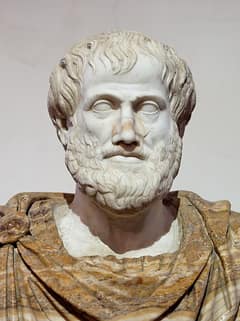
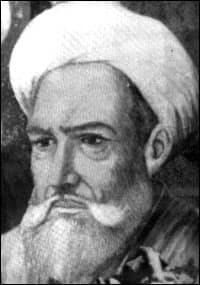
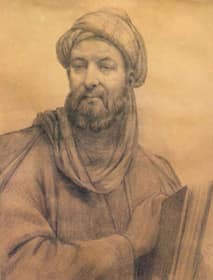
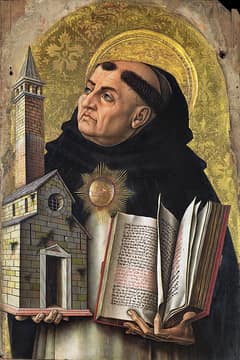
Arabic translators and philosophers rebuilt Aristotle into a system of being and necessity, and Aquinas took much of his metaphysics from that rebuilt Aristotle while rejecting key parts of it.
Scope. This entry traces how Aristotle's works passed through Syriac and Arabic into Latin, what al-Farabi and Ibn Sina made of them, and how Aquinas received and corrected Ibn Sina and the Latin followers of Ibn Rushd. It leaves aside Jewish philosophy, Ibn Rushd's own system, and the Greek-to-Latin transmission except where it bears on the Arabic route.
Transmission
Aristotle’s logic had been studied in Syriac by Christian scholars since late antiquity. Under the Abbasid caliphs, from the late eighth to the tenth century, translators in Baghdad rendered almost the whole surviving corpus into Arabic, often by way of Syriac. Hunayn ibn Ishaq and his son Ishaq produced many standard versions; Abu Bishr Matta translated the Posterior Analytics and Poetics; al-Kindi’s circle produced an early Arabic Metaphysics. Two Neoplatonic works travelled with this corpus under misleading names: the so-called Theology of Aristotle, a paraphrase of parts of Plotinus’ Enneads IV–VI, and a treatise drawn from Proclus that the Latins later knew as the Liber de causis. Arabic readers thus met Aristotle with a Neoplatonic theology attached.
Until the twelfth century Latin readers had only Boethius’ versions of the elementary logic. Then two routes opened. From Greek, James of Venice translated the Posterior Analytics, Physics, De Anima and part of the Metaphysics around the middle of the century. From Arabic, translators in Toledo, among them Gerard of Cremona and Dominicus Gundissalinus, rendered Aristotle together with al-Farabi and the psychology and metaphysics of Ibn Sina’s Healing. In the 1220s and 1230s Michael Scot translated Ibn Rushd’s commentaries, which made him “the Commentator” of the Latin schools. Paris banned lectures on Aristotle’s natural philosophy in 1210 and 1215; by 1255 its arts faculty required them.
Al-Farabi, the Second Teacher
Al-Farabi (c. 870–950) studied logic in Baghdad with Christian Aristotelians, and later tradition called him “the Second Teacher”, after Aristotle. His Enumeration of the Sciences mapped the Aristotelian curriculum, and a Latin version reached Toledo. His short treatise on the aims of the Metaphysics argued that its subject is being as such, of which theology is only a part. Ibn Sina said that this treatise unlocked a book he had read forty times without understanding it (Autobiography, on reading the Metaphysics).
In The Virtuous City al-Farabi set Aristotle’s psychology inside an emanation scheme. A series of intellects proceeds from the First, and the last of them, the Active Intellect, actualises human thought. A ruler whose intellect is joined to the Active Intellect is both philosopher and prophet, which reworks Plato’s philosopher-king.
Ibn Sina: essence, existence and the necessary existent
Ibn Sina (980–1037) wrote the most comprehensive Arabic restatement of Aristotle, the Healing (al-Shifa’). He follows al-Farabi in making the existent as such the subject of metaphysics, with God’s existence something to be proved within it (Book of Healing, Metaphysics I.1–2). The ideas of “existent”, “thing” and “necessary” are the first impressed on the soul (Book of Healing, Metaphysics I.5).
Two distinctions carry his system. The first is between what a thing is and that it is. A nature considered in itself is just that nature: horseness is only horseness, neither one nor many, neither universal nor particular, and existence comes to it from outside (Book of Healing, Metaphysics V.1). The second sorts existents into those possible in themselves, which need a cause to exist, and one necessary in itself. In the Healing such causes cannot form an infinite series, so the series ends in a Necessary Existent, whose essence is nothing other than its existence (Book of Healing, Metaphysics I.6–7, VIII.1–4). The Salvation and the Pointers add a proof that need not deny an infinite regress: the whole collection of possible existents, finite or not, is itself possible, so its cause lies outside it and is necessary (The Salvation, Metaphysics; Pointers and Reminders IV). He calls it the proof of the truthful: it attends to existence itself, not its effects (Mayer 2001).
This departs from Aristotle, who reached his first mover from eternal motion, as a final cause (Metaphysics Λ.6–7, 1071b3–1073a13), and denied that being is the essence of anything (Posterior Analytics II.7, 92b4–25) without making that a distinction within each creature. Ibn Sina’s God gives existence to everything else and is reached by metaphysics rather than physics (ont.god). His “flying man”, created at once and suspended in air with no sensation of his body, would still affirm his own existence; Ibn Sina offers this as an alerting (tanbīh) to the soul’s distinctness from the body, not a demonstration (Book of Healing, Psychology I.1; ont.soul-body), and how much it shows is debated (Marmura 1986).
Aquinas’ reception
Aquinas opens On Being and Essence by citing Ibn Sina, at the beginning of his Metaphysics, for the claim that being and essence are what the intellect first conceives (De ente et essentia, prologue). He adopts Ibn Sina’s threefold consideration of a nature (in itself, in individuals, in the intellect) as his answer on universals (De ente et essentia, ch. 3; ont.universals). He then argues that we can understand what a man or a phoenix is without knowing whether it exists, so existence differs from essence in everything except one being whose essence is its existence, and there can be only one such being (De ente et essentia, ch. 4). The third of his five ways, from possibility and necessity, echoes Ibn Sina in allowing beings that are necessary through another (Summa Theologiae I q.2 a.3).
Against Ibn Rushd’s Latin followers, Siger of Brabant chief among them, Aquinas argued in 1270 that the possible intellect is not one separate substance for all humans but a power of each soul, which is the form of its body. He argued from Aristotle’s text, the Greek commentators and the fact that this individual human understands (On the Unity of the Intellect against the Averroists, chs. 1–5; Summa Theologiae I q.76 a.1–2). Earlier Latin readers, in what Étienne Gilson (1929) called “Avicennizing Augustinianism”, had identified Ibn Sina’s Active Intellect with God illuminating the mind, a reading Aquinas resists.
Where Aquinas departs from Ibn Sina
Al-Ghazali’s Incoherence (1095) had already branded three of the philosophers’ doctrines unbelief: the world’s eternity, God’s knowing particulars only in a universal way, and the denial of bodily resurrection (Incoherence of the Philosophers, conclusion). Aquinas rejects the first two on other grounds, holding that God knows singulars (Summa Theologiae I q.14 a.11).
He departs from Ibn Sina at four points. He treats existence (esse) not as something that comes to an essence like an accident, but as the act through which any form or nature is actual (Summa Theologiae I q.3 a.4). He rejects the emanation of the world through intermediary intellects, a view he attributes to Avicenna, and holds that God creates all things directly and freely (Summa Theologiae I q.47 a.1). He denies that a separate agent intellect supplies forms to our minds, making it a power of each soul (Summa Theologiae I q.79 a.4; Summa Theologiae I q.84 a.4). And against Ibn Sina’s eternally caused world he holds that neither the world’s eternity nor its beginning can be demonstrated, its beginning being known by faith (Summa Theologiae I q.46 a.1–2; ont.cosmos). Both hold that each human soul survives death, on different grounds: for Aquinas the soul is at once the form of the body and subsistent through its intellectual activity (Summa Theologiae I q.75 a.2), whereas Ibn Sina treats it as a substance that uses the body (ont.immortality).
Contested readings
Is existence an accident for Ibn Sina? Ibn Rushd, and Latin readers after him, took Ibn Sina to make existence an accident added to essence, and objected that an accident would itself need to exist. Defenders reply that he meant only that existence is no part of an essence and comes to it from a cause. Most current scholarship reads him in the weaker sense and traces the stronger reading largely to Ibn Rushd’s polemic.
Real or conceptual distinction in Aquinas? Some Thomists find the real distinction of essence and existence in creatures established in De ente ch. 4. Others hold that the phoenix argument shows only a conceptual distinction, with the real distinction following only once God is proved to be the unique being whose essence is existence. The chapter argues in stages; readers differ over which step yields the real distinction.
How Aristotelian were the falasifa? One camp reads al-Farabi and Ibn Sina as Neoplatonists misled by pseudepigrapha such as the Theology of Aristotle. Another treats them as systematic Aristotelians who reshaped the corpus deliberately, borrowing from Neoplatonism where Aristotle was silent. Ibn Sina argues for his departures, such as proving God in metaphysics, which many take to favour the second reading; the Theology still shaped how both read Aristotle on God.
Latin Averroism. “Averroist” was largely an opponents’ label. Some historians see a coherent radical Aristotelianism in the Paris arts faculty; others see philosophers reporting what Aristotle concludes without asserting it against faith. The condemnations of 1270 and 1277 at least show that the authorities saw a movement.
Primary passages
- Enneads PlotinusEnneads IV–VI
- Enumeration of the Sciences al-FarabiEnumeration of the Sciences
- Autobiography Ibn Sina (Avicenna)Autobiography, on reading the Metaphysics
- The Virtuous City al-FarabiThe Virtuous City
- The Book of Healing Ibn Sina (Avicenna)Book of Healing, Metaphysics I.1–2Book of Healing, Metaphysics I.5Book of Healing, Metaphysics V.1Book of Healing, Metaphysics I.6–7, VIII.1–4Book of Healing, Psychology I.1
- The Salvation Ibn Sina (Avicenna)The Salvation, Metaphysics
- Pointers and Reminders Ibn Sina (Avicenna)Pointers and Reminders IV
- Metaphysics AristotleMetaphysics Λ.6–7, 1071b3–1073a13
- Posterior Analytics AristotlePosterior Analytics II.7, 92b4–25
- On Being and Essence Thomas AquinasDe ente et essentia, prologueDe ente et essentia, ch. 3De ente et essentia, ch. 4
- Summa Theologiae Thomas AquinasSumma Theologiae I q.2 a.3Summa Theologiae I q.76 a.1–2Summa Theologiae I q.14 a.11Summa Theologiae I q.3 a.4Summa Theologiae I q.47 a.1Summa Theologiae I q.79 a.4Summa Theologiae I q.84 a.4Summa Theologiae I q.46 a.1–2Summa Theologiae I q.75 a.2
- On the Unity of the Intellect against the Averroists Thomas AquinasOn the Unity of the Intellect against the Averroists, chs. 1–5
- The Incoherence of the Philosophers al-GhazaliIncoherence of the Philosophers, conclusion
Further reading
- Greek Sources in Arabic and Islamic Philosophy Stanford Encyclopedia of Philosophy
- al-Farabi Stanford Encyclopedia of Philosophy
- Ibn Sina's Metaphysics Stanford Encyclopedia of Philosophy
- Influence of Arabic and Islamic Philosophy on the Latin West Stanford Encyclopedia of Philosophy
- Thomas Aquinas Stanford Encyclopedia of Philosophy
- Avicenna (Ibn Sina) Internet Encyclopedia of Philosophy
Related
How to cite
Hekmat. "Aristotle through the Islamic world." First drafted 19 October 2026; revised 20 October 2026. https://hekmat.local/entries/aristotle-through-islam/
BibTeX
@incollection{hekmat-aristotle-through-islam,
  title = {Aristotle through the Islamic world},
  booktitle = {Hekmat},
  year = {2026},
  note = {First drafted 2026-10-19, revised 2026-10-20},
  url = {https://hekmat.local/entries/aristotle-through-islam/}
}History: first drafted 2026-10-19; revised 2026-10-20. Drafted with AI assistance from the primary texts; status draft.