David Hume — The question of the soul's substance is unintelligible, since we have no impression of a substance in which perceptions inhere; the self is a bundle of perceptions. This rejects only part of the question as posed: on how thought and body are related he does answer, from experience.
Suspends judgment
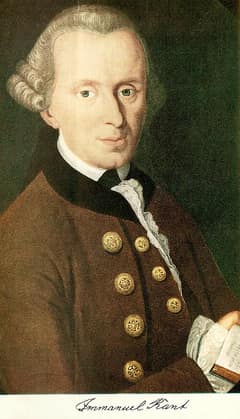
Immanuel Kant — Kant suspends judgment on the soul's nature: the Paralogisms show that rational psychology cannot know whether the thinking subject is a simple, immaterial substance, so neither spiritualism nor materialism can be established. On the interaction problem he goes further and denies its presupposition, since it arises only from an illusion (A384–393); the mode records the first half.
In order of birth. Open a row for the reading, its confidence and the passages. * contested reading.
›Socratesc. 470–399 BCENot addressed
Not addressed. He urges care of the soul as an ethical task but gives no account of what the soul is or how it relates to the body.
Socrates tells the Athenians to care for their souls more than their bodies or wealth, and in the Crito speaks of the part of us that justice benefits and injustice ruins, "whatever it is". That phrase leaves the soul's nature open. The arguments that the soul is separate from and akin to the Forms come from the Phaedo, usually counted as Plato's.
Another reading. If the Socrates of the Phaedo is counted, the soul is a separate thing that the philosopher tries to free from the body (Phaedo 64c–67d, 78b–80b).
Scholarly consensusPlato, early dialogues (Apology, Crito)psyche, epimeleia tes psychesDraft — not yet reviewed
The soul is distinct from the body, rules it, and can exist apart from it; death is the separation of the two. The body troubles thought with its desires and confused perceptions, so the philosopher tries to free the soul from it. The soul is akin to the invisible, unchanging Forms, the body to the visible and perishable.
Scholarly consensusmiddle dialogues (Phaedo, Republic IV, Phaedrus); speaker Socratespsyche, soma, logistikon, thumoeides, epithumetikonDraft — not yet reviewed
Plato's psyche is a life principle and self-mover with three parts (reason, spirit, appetite), not a Cartesian thinking thing; "separable soul" captures separability but not this structure. The Timaeus (69c–d) calls the lower parts a mortal kind of soul.
The soul is the form, or first actuality, of a natural body that has life potentially. It is no more sensible to ask whether soul and body are one than to ask this of the wax and its shape. So the soul is not separable from the body, except perhaps for some part that is not the actuality of any bodily organ.
Stated in the textDe Anima II.1–2, III.4psyche, entelecheia, eidos, hyle, soma organikonDraft — not yet reviewed
On the standard reading Aristotle is not a materialist: the soul is form, not fine matter, and intellect is said to be unmixed with the body. Functionalist and materialist readings of De Anima are defended in the literature, and the exception for intellect is where the hylomorphic picture strains.
The soul is a body of very fine particles spread through the whole frame, like breath mixed with heat, with a still finer part that accounts for thought and feeling. It perceives only while housed in the body, and when the body is broken up it is scattered. Only void is incorporeal, and void can neither act nor be acted upon, so calling the soul incorporeal is foolish.
Stated in the textLetter to Herodotus 63–67psyche, soma, leptomeres, pneuma, thermonDraft — not yet reviewed
The soul is an incorporeal substance that cannot be a body or the form of a body; the body is rather in the soul than the soul in the body, and the true self stays above the living compound that soul's image forms with the body.
Scholarly consensuspsyche, soma, to koinon, ousia asomatosDraft — not yet reviewed
"Separable soul" fits, but Plotinus' soul is not a Cartesian mind: it pervades and animates the body as a whole, and he rejects the Aristotelian entelechy view explicitly.
The soul is an incorporeal substance endowed with reason and fitted to rule the body; the mind knows itself with certainty and does not know itself as air or fire, so it is none of these.
Scholarly consensusanima, mens, substantia rationis particepsDraft — not yet reviewed
The soul's faculties are ordered as form and matter, each the matter of the one above, and the material intellect is a disposition in a bodily being. Only an intellect actualised by knowledge can come to subsist without matter.
Another reading. For the perfected soul the result is a separate substance: once the acquired intellect is reached, the soul no longer needs the body and survives as an immaterial substance, so for those souls `substance-dualism` fits (Davidson, Alfarabi, Avicenna, and Averroes, on Intellect, 1992).
Contested readingnafs, al-ʿaql al-hayūlānī, al-ʿaql al-mustafādDraft — not yet reviewed
The rational soul is an incorporeal substance, since intellectual thought cannot reside in any bodily organ. A man created in the void, aware of no body, would still affirm his own self; Ibn Sina offers this as a pointer to the soul's otherness from the body, not as the proof.
Stated in the textnafs nāṭiqa, jawhar, al-insān al-ṭāʾir, tanbīhDraft — not yet reviewed
The soul comes into being with its body and is individuated by it (Psychology V.3), so it is not pre-existent as in Plato. The force of the flying man is disputed (Marmura, 1986; Kaukua, 2015), and it meets the objection Arnauld pressed against Descartes: affirming one thing without affirming another does not show they are distinct (Fourth Objections, AT VII 201–203).
The true human is the heart in its inner sense: a subtle, spiritual reality that knows and perceives, related to the bodily heart as a ruler to his kingdom and distinct from the body it uses.
Scholarly consensusRevival, Book 21; Incoherence, Discussion 18 (polemic)qalb, rūḥ, laṭīfa rabbāniyya, nafsDraft — not yet reviewed
In the Incoherence (Discussion 18) he does not deny that the soul is a self-subsisting immaterial substance; he denies only that the philosophers have demonstrated it. The Revival affirms what the Incoherence leaves undemonstrated.
The soul is the form of the living body. The material intellect and the agent intellect are not powers of the individual soul but separate and one for all humans; each person is joined to them through his own imaginative forms.
Scholarly consensusLong Commentary on De Animanafs, ṣūra, al-ʿaql al-hayūlānī, al-quwwa al-mufakkiraDraft — not yet reviewed
The codebook's hylomorphism allows a separable intellectual part; for Ibn Rushd the separable intellect is not a part of any individual soul. His view developed: in the Epitome of De Anima the material intellect is a disposition in the individual's imaginative faculty, after Ibn Bajja, and only the Long Commentary makes it one separate substance (Davidson, 1992; Taylor's translation, 2009).
The human soul is an immaterial light, the commanding or managing light, which governs a body it is not. A body is a dark barrier, mere magnitude, with no awareness of itself; the soul is aware of itself even when it attends to nothing of its body.
The rational soul is an immaterial substance, not a body or a power in a body, since it knows universals and itself, which no bodily organ can do. It comes to be with its body and governs it.
Scholarly consensusnafs nāṭiqa, jawhar mujarrad, tadbīrDraft — not yet reviewed
The intellectual soul is the one substantial form of the human body, so a human is one substance, not a soul using a body; yet because understanding uses no bodily organ, the soul subsists on its own.
Stated in the textforma corporis, anima intellectiva, subsistensDraft — not yet reviewed
Not addressed. No surviving work discusses the soul's nature or its relation to the body. The Treatise on the Crafts compares bodily organs and faculties with social classes, which assumes the soul governs the body but does not say what the soul is.
Not coded; nothing in the surviving works on the nature of the soul.
The soul begins as the form of a body, and being the soul of a body is its very mode of existence, not a relation added to it. Through substantial motion it grows more intense in being until it becomes an immaterial substance that survives the body: bodily in its origin, spiritual in its survival.
Neither option holds the process: `hylomorphism` fits the soul's origin and its unity with the body, `substance-dualism` its end. Against Ibn Sina, the soul is not immaterial from the moment it comes to be.
Because I clearly understand myself as a thinking, unextended thing and body as an extended, unthinking thing, God can make each exist without the other, so the mind is really distinct from the body; yet it is joined to it closely enough to make one whole, not lodged in it like a sailor in a ship.
Stated in the textdistinctio realis, res cogitans, unioDraft — not yet reviewed
›David Hume1711–1776Rejects the question* (contested reading)
Rejects the question. The question of the soul's substance is unintelligible, since we have no impression of a substance in which perceptions inhere; the self is a bundle of perceptions. This rejects only part of the question as posed: on how thought and body are related he does answer, from experience.
Hume rejects the question as posed: there is no idea of a soul-substance to relate to the body, only a bundle or succession of perceptions, and experience alone tells us that thought depends on bodily states.
Another reading. A naturalist answer: matter and motion may be, and in fact are, causes of thought (Treatise 1.4.5), and "Of the Immortality of the Soul" argues from the mind's dependence on the body, so Hume answers the question in the direction of materialism.
Contested readingbundle of perceptions, personal identity, substance of the soulDraft — not yet reviewed
Against a straightforward materialism, Treatise 1.4.5 holds that most perceptions exist nowhere and cannot be located in body. He later admits his account of personal identity leaves him in a labyrinth (Appendix).
Suspends judgment. Kant suspends judgment on the soul's nature: the Paralogisms show that rational psychology cannot know whether the thinking subject is a simple, immaterial substance, so neither spiritualism nor materialism can be established. On the interaction problem he goes further and denies its presupposition, since it arises only from an illusion (A384–393); the mode records the first half.
The "I think" accompanies all representations but is not an intuition of a substance, so arguments from it to a simple, immaterial and persisting soul are fallacies. The question of how soul and body interact arises only when appearances of inner and outer sense are taken for things in themselves.
Stated in the textCritical periodParalogismus, Ich denke, Gemeinschaft der Seele mit dem KörperDraft — not yet reviewed
In the first-edition Fourth Paralogism Kant calls the transcendental idealist an empirical realist and, in that sense, a dualist (A370): matter and thinking are two kinds of appearance, not two substances.
›G. W. F. Hegel1770–1831Hylomorphism* (contested reading)
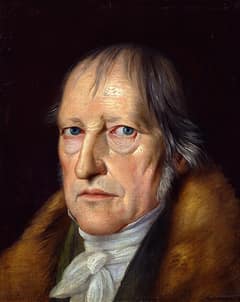
The soul is not a thing beside the body but the body's ideality, nature's immateriality in general. Hegel praises Aristotle's De Anima as still the best work on the subject (Enc. §378). The old question of how two independent things, soul and matter, communicate arises only when both are taken as fixed.
Another reading. Hegel rejects the question's framing: soul and body are moments of spirit's self-development, and the communion problem is an artefact of the understanding.
Contested readingEncyclopaedia, Philosophy of Spirit (1830)Seele, Idealität, LeiblichkeitDraft — not yet reviewed
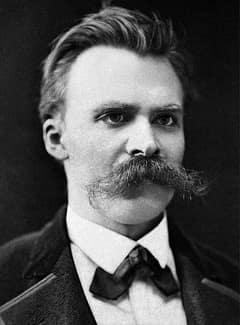
Zarathustra says that he is body through and through, and that soul is only a word for something about the body. In his own voice Nietzsche treats the soul as a society of drives and affects rather than a simple, immortal atom.
Another reading. Nietzsche also rejects materialistic atomism (BGE 12), and many read the "great reason" of the body as dissolving the soul–body dichotomy rather than reducing one side to the other.
Contested readingZarathustra I (1883); Beyond Good and Evil (1886)Leib, große Vernunft, Seelen-Atomistik, Gesellschaftsbau der TriebeDraft — not yet reviewed
The lived body (Leib) is not one physical thing among others but the bearer of sensation, the organ of the will and the zero-point of orientation; through it the soul is part of nature as a psychophysical unity. The person is first met in the personalistic attitude, as an embodied subject in a surrounding world.
Another reading. The thought experiment of the annihilation of the world (Ideas I §49) leaves pure consciousness intact, which critics such as Heidegger read as a residual Cartesian separation of consciousness from body and world.
Contested readingIdeas II (manuscripts 1912–1928)Leib, Körper, Nullpunkt der Orientierung, personalistische EinstellungDraft — not yet reviewed
Transcendental consciousness is not the soul, which belongs to the world (Ideas I §53); the coding concerns the human being as constituted, not the transcendental ego.
›Martin Heidegger1889–1976Embodied, world-involved existence
The human being is Dasein, being-in-the-world, and cannot be built up from a soul, a body and a spirit put together. Being-in is not a spatial containment of one thing in another but familiar dwelling in a world.
Scholarly consensusBeing and Time (1927)Dasein, In-der-Welt-sein, Sein-bei, LeiblichkeitDraft — not yet reviewed
Being and Time sets bodiliness aside as a problem of its own (SZ 108); it is taken up chiefly in the Zollikon Seminars (1959–1969), and earlier in the 1936–37 Nietzsche course (GA 43), which holds that we do not have a body but are bodily. So the "embodied" half of the option fits less well than the rejection of the soul–body dichotomy.
Hekmat. "How is the relation of soul or mind to body explained?." Draft, awaiting review; last updated 20 October 2026. https://hekmat.local/questions/ont-soul-body/