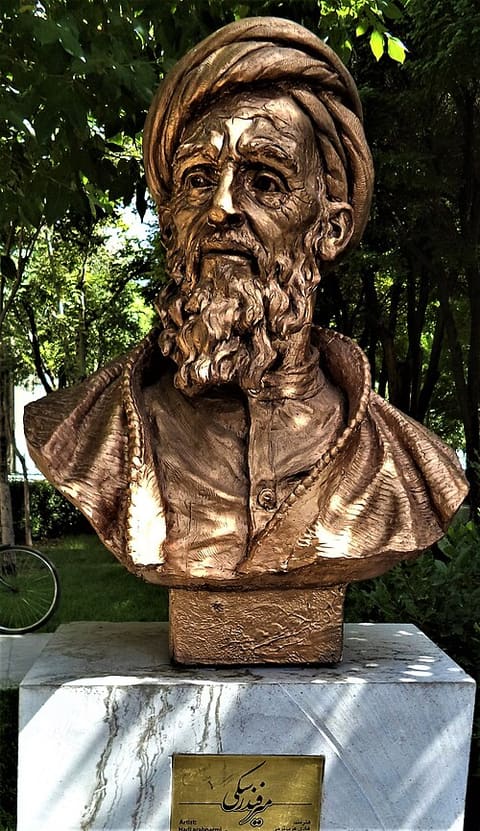
Early Modern · 17th c.
Mir Findiriski
میرفندرسکیc. 1562–1640Islamic Peripatetics (Mashshāʾī)
Abu al-Qasim Mir Findiriski taught Ibn Sina's philosophy in Safavid Isfahan in the generation of Mir Damad, and travelled repeatedly to India. His surviving philosophical writing is slight. Short Arabic treatises argue in Peripatetic fashion that all motion goes back to a first mover and, against the Illuminationists, that essences do not come in degrees; a Persian treatise classifies and ranks the crafts by their ends; his ode says that every form above has its likeness below and that knowledge can climb from the one to the other; and he annotated and excerpted the Persian Yoga Vasistha.
- Central question
- How does the visible order of the heavens and of human making answer to a higher order, and can Peripatetic philosophy reach it?
- Method
- Findiriski wrote little philosophy, and in different registers: short Arabic treatises in the Peripatetic manner, a Persian treatise that classifies the crafts, a philosophical ode, and notes comparing an Indian text with Greek and Islamic thought. How Mir Findiriski works
ṣināʿa craftal-muḥarrik al-awwal the first movertashkīk gradational-muthul al-aflāṭūniyya the Platonic Forms
Wrote in Persian and Arabic. Little survives and less is edited; the treatises on motion and on gradation are known chiefly from Ashtiyani's selections. All works are cited whole. Later biographers name Mulla Sadra among his students, but Sadra does not mention him. No text or translation is held in Hekmat.
- Scholarly consensus 19
- Contested reading 1
Answers 4 of 20 questions · does not address 16Why some questions don’t apply
Epistemology
Sources of knowledgeNot addressed
Not addressed. No surviving work gives an account of how knowledge is gained. The ode speaks of a ladder of knowledge by which the soul climbs to the origin of forms and says outward understanding cannot reach it, which bears on the question but does not say what the sources of knowledge are.
Not coded; the ode's ladder of knowledge is an image, not an account of knowing.
Read as an epistemology, the ode would sit near `illumination`; that would be Hekmat's construction.
Epistemic justificationNot addressed
Not addressed. No surviving work discusses what justifies a belief.
Not coded; the surviving works do not take up justification.
Innate knowledgeNot addressed
Not addressed. No surviving work discusses innate knowledge or principles.
Not coded; the surviving works do not take up innate knowledge.
TruthNot addressed
Not addressed. No surviving work discusses what truth is.
Not coded; the surviving works do not take up truth.
Certainty, doubt and the limits of knowledgeNot addressed
Not addressed. No surviving work discusses the reach or limits of certain knowledge. The ode's line that al-Farabi and Ibn Sina could not grasp its teaching sets a limit to outward understanding, not to knowledge as such.
Not coded; the ode limits outward understanding but gives no account of certainty.
Axiology
The highest goodNot addressed
Not addressed. The Treatise on the Crafts ranks crafts by their ends and puts highest the one whose end is in itself, but the summaries available do not say which craft or life that is, and no other work states the highest good.
Not coded; the ranking of crafts implies a highest end that the available summaries do not name.
The basis of moralityNot addressed
Not addressed. No surviving work discusses what makes an action right.
Not coded; the surviving works do not take up the basis of morality.
Virtue and knowledgeNot addressed
Not addressed. No surviving work discusses virtue and its relation to knowledge.
Not coded; the surviving works do not take up virtue.
JusticeNot addressed
Not addressed. The Treatise on the Crafts discusses the place of craftsmen in society and compares social classes with the organs of the body, which suggests that each part should do its own work, but the summaries available do not show it giving an account of justice.
Not coded; the body–society comparison in the Treatise on the Crafts is not an account of justice.
If the treatise does call that order justice, `order-of-soul` would be the nearest stance.
The state and legitimacyNot addressed
Not addressed. No surviving work discusses who should rule or why rule is legitimate.
Not coded; the surviving works do not take up political authority.
Beauty and artOwn position
Own position. Art in the broad sense (ṣināʿa) is any making by the rational and practical powers, and the arts are valued and ranked by their ends and their use to human life, the noblest being the one whose end is in itself.
The Treatise on the Crafts takes ṣināʿa to cover everything human reason and skill make, defines and divides it, and ranks the crafts by their aims, benefits and uses, and by how far each serves another or is an end in itself. It discusses the standing of craftsmen in society. Beauty is not its subject.
Treatise on the Crafts whole work
The question's options concern fine art and beauty; Findiriski's subject is making in general and its value for society, which the question's scope includes. Whether the treatise belongs here at all is a judgment for review.
The nature of valueNot addressed
Not addressed. No surviving work discusses whether values are found or made. Ranking the crafts by their ends assumes an order of ends without saying what grounds it.
Not coded; the surviving works do not take up the nature of value.
contested reading · open a row for the explanation and its sources
Method روش و شیوه اندیشهورزی فلسفی
Findiriski wrote little philosophy, and in different registers: short Arabic treatises in the Peripatetic manner, a Persian treatise that classifies the crafts, a philosophical ode, and notes comparing an Indian text with Greek and Islamic thought. What links them is a taste for classification and a view of the world as ordered levels that answer to one another.
- Posing questions
His treatises answer set questions, sometimes put to him by others: the Treatise on Gradation replies to a question from Aqa Muzaffar Kashani. The Treatise on the Crafts starts from a definition of making and asks how its kinds are divided, how they relate and what each is for.
Treatise on Gradation whole work · Treatise on the Crafts whole work
- Arguing and justifying
In the Arabic treatises he argues as a Peripatetic: every motion needs a mover and the series ends in a first mover. The Treatise on the Crafts argues by definition, division and ranking by ends, and draws an analogy between the body's organs and faculties, the classes of society and the order of the cosmos.
Treatise on Motion whole work · Treatise on the Crafts whole work
- Criticising rival views
He rejects the Platonic Forms in the Peripatetic way and, against the Illuminationists, denies that an essence comes in degrees. The ode turns on Peripatetic learning itself, saying that outward understanding, even al-Farabi's and Ibn Sina's, cannot reach its teaching.
Treatise on Motion whole work · Treatise on Gradation whole work · The Philosophical Ode whole work
- Reason, experience and other ways of knowing
Demonstrative reason in the treatises; in the ode, a knowledge that climbs from the lower forms to their originals, set against outward understanding. His notes on the Yoga Vasistha compare its teaching with Greek philosophy and Islamic belief, but how far he made its views his own is disputed.
Treatise on Motion whole work · The Philosophical Ode whole work · Selections from the Yoga Vasistha whole work
- Language and style
Plain, orderly Persian prose with Quranic verses, traditions and sayings of the learned in the Treatise on the Crafts; terse Arabic in the treatises; a short ode in the high style; and marginal notes and excerpts, with a glossary of the Indian terms, for the Yoga Vasistha.
Treatise on the Crafts whole work · The Philosophical Ode whole work · Selections from the Yoga Vasistha whole work
- Across the works
- Treatise on Motion, Treatise on GradationPeripatetic school treatises in Arabic, on motion and on gradation.Treatise on Motion whole work · Treatise on Gradation whole work
- Treatise on the CraftsA Persian classification of the crafts and their place in society.Treatise on the Crafts whole work
- The Philosophical Ode, Selections from the Yoga VasisthaThe ode and the Yoga Vasistha notes speak of an ascent beyond outward learning; whether they show a change of view or a different register from the treatises cannot be settled from what survives.The Philosophical Ode whole work · Selections from the Yoga Vasistha whole work
ṣināʿa, ḥaraka, tashkīk, nardibān-i maʿrifat
Arguments
Key terms
All key terms →- صناعةṣināʿa
- craft · art · makingAnything human reason and practical skill make. The Treatise on the Crafts defines and divides the crafts and ranks them by their ends and uses, the noblest being the one whose end is in itself.
- المحرّك الأوّلal-muḥarrik al-awwal
- the first moverThe mover to which every motion goes back, itself unmoved; the Treatise on Motion argues for it in the Peripatetic way.1 link to other thinkers →
- تشكيكtashkīk
- gradation · being more and lessWhether one essence can be found in things more and less, as more and less intense. Findiriski denies it of essences, against the Illuminationists.1 link to other thinkers →
- المثل الأفلاطونيةal-muthul al-aflāṭūniyya
- the Platonic FormsSeparate archetypes of the species. The Treatise on Motion rejects them; the ode's forms above, of which things below are likenesses, have been read as a return to them.2 links to other thinkers →
Relations
Open in the network →Shaped by
None recorded yet.
Shaped
None recorded yet.
Works
- Treatise on the CraftsRisala-yi sinaiyya (Haqaiq al-sanai)
- Treatise on MotionRisala fi l-haraka
- Treatise on GradationRisala fi l-tashkik
- The Philosophical OdeQasida-yi hikmiyya (Charkh ba in akhtaran)
- Selections from the Yoga VasisthaMuntakhab-i Jug (Jug-basasht)
How to cite
Hekmat. "Mir Findiriski." Draft, awaiting review; last updated 20 October 2026. https://hekmat.local/thinkers/mir-findiriski/