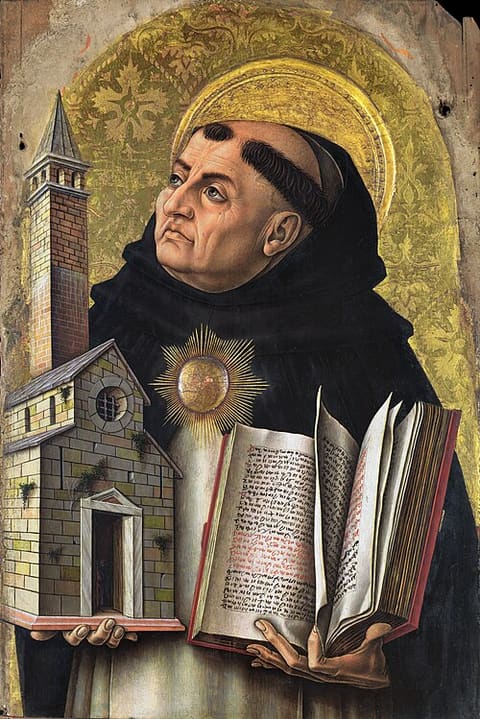
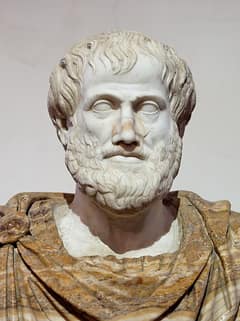
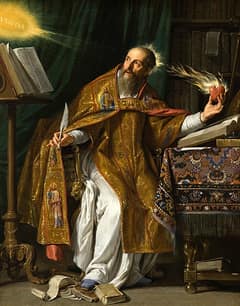
Aquinas synthesised Aristotle with Augustine and Christian doctrine. God is being itself, the soul is the form of the body, and morality follows a natural law that reason can know.
Central question
How do faith and reason fit together in one account of God, the world and the human good?
Method
Aquinas thinks in the scholastic quaestio: each article states a question, lists objections, cites an authority on the other side, gives his answer and replies to each objection. How Thomas Aquinas works ↓
2 arguments9 works0 quotations checked word for word0 of 22 positions and arguments reviewed by an expert
Answers 20 of 20 questions
Metaphysics
›Being and realityGod as being itself · Substances
God is subsistent being itself, whose essence is his act of existing; every other thing is a substance whose essence receives existence from God, so created substances are real but not self-existent.
Stated in the textipsum esse subsistens, esse, essentia, actus essendiDraft — not yet reviewed
Angels are created forms without matter, so Aquinas' substances include separate forms besides God, which the option's wording does not foresee.
›UniversalsModerate realism
A nature such as humanity exists in individuals as particular and is universal only as the intellect abstracts it; it does not exist apart from them, except as an exemplar idea in God's mind.
Stated in the textnatura absolute considerata, universale, ideae divinaeDraft — not yet reviewed
›God and the fundamentalDemonstrable; revelation adds more
God's existence is not self-evident to us but can be demonstrated from his effects, as the five ways do; truths such as the Trinity exceed reason and are known only by revelation.
Stated in the textquinque viae, praeambula fidei, demonstratio quiaDraft — not yet reviewed
The intellectual soul is the one substantial form of the human body, so a human is one substance, not a soul using a body; yet because understanding uses no bodily organ, the soul subsists on its own.
Stated in the textforma corporis, anima intellectiva, subsistensDraft — not yet reviewed
The human soul is incorruptible because it has an operation of its own and is a subsistent form; separated, it is not a complete person, and the resurrection of the body completes it.
Stated in the textanima separata, incorruptibilis, resurrectioDraft — not yet reviewed
The world was created from nothing and began, with time; this is held by faith alone, since its beginning depends on God's free will and cannot be demonstrated, any more than its eternity can.
Stated in the textaeternitas mundi, creatio, sola fide teneturDraft — not yet reviewed
His distinctive thesis answers a different question, what reason can show: reason cannot settle whether the world began (`undecidable` for reason alone). He holds this against the Latin Averroists, who took eternity as demonstrated, and against Bonaventure (In II Sent. d.1), who took the beginning as demonstrable.
›Freedom and determinismFree, not determined* (contested reading)
Humans have free choice because reason can weigh particular goods either way, and no finite good necessitates the will; without it counsels, commands and punishments would be pointless.
Another reading. Intellectualist readings: choice follows the intellect's last practical judgment, and God moves the will as first cause, so his account is a form of compatibilism with rational self-determination at its centre.
Contested readingliberum arbitrium, electio, voluntas ut naturaDraft — not yet reviewed
The libertarian reading is defended by MacDonald ("Aquinas's Libertarian Account of Free Choice", 1998) and Stump (Aquinas, 2003). `rational-self-determination` also has a claim, since freedom is rooted in reason's judgment.
›CausationReal causes under a free first cause · Ends govern explanation · Real contingency
God works in every created agent as first cause, yet created things have their own actions, and the same effect is wholly from God and wholly from the natural agent at different levels. Every agent acts for an end, and God is the end of all. God's will imposes necessity on some effects and contingency on others, giving them necessary or contingent proximate causes, so that providence does not make everything necessary.
Stated in the textSumma Theologiae I; Summa contra Gentiles IIIcausa prima, causa secunda, instrumentum, finis, providentia, necessarium, contingensDraft — not yet reviewed
Summa contra Gentiles III.69 argues against those who deny natural agents their own actions, naming the theologians of Islam, so his view is written against `occasionalism`. The third way (I q.2 a.3) uses the possible and the necessary, with necessary beings caused by another, a scheme that comes from Ibn Sina.
Epistemology
›Sources of knowledgeExperience, completed by intellect
All our knowledge begins in the senses, and the agent intellect abstracts universal natures from the images that perception and imagination supply; in this life we understand only by turning to those images.
Stated in the textintellectus agens, phantasmata, abstractio, species intelligibilisDraft — not yet reviewed
He keeps Augustine's language of illumination by making the agent intellect a light participated from God (ST I q.84 a.5).
›Certainty, doubt and the limits of knowledgeYes
Questioning stops at first principles known in themselves, such as that the same thing cannot be affirmed and denied together; the intellect is not deceived about these, and demonstration from them yields science.
Stated in the textprincipia per se nota, scientia, demonstratioDraft — not yet reviewed
The human intellect is at first like a blank tablet, with no innate ideas; but it has a natural light and a natural disposition by which first principles are known at once when their terms are grasped.
Stated in the texttabula rasa, synderesis, semina scientiarum, lumen naturaleDraft — not yet reviewed
The "seeds of knowledge" (De veritate q.11 a.1) are pre-existing principles, but they are known through species drawn from the senses, not stored as ideas.
›TruthCorrespondence · Truth as a feature of being
Truth is the adequation of intellect and thing, found properly in the judging intellect; things too are called true by their conformity to the divine intellect that conceived them.
Stated in the textadaequatio rei et intellectus, verum, transcendentaliaDraft — not yet reviewed
›Epistemic justificationDemonstration from first principles · Trustworthy testimony or revelation
The intellect assents in different ways. It is moved by the object itself either at once, in understanding first principles, or through them, in science, which is demonstrated knowledge of conclusions; when the object does not move it enough, it gives opinion, or, moved by the will, the firm assent of faith. Faith is certain because it rests on God's authority, not on seeing, and sacred doctrine is a science whose principles are known by a higher science, God's own. Argument from human authority is the weakest, from revealed authority the strongest.
Stated in the textDisputed Questions on Truth (1256–1259); Summa Theologiae (1265–1273)assensus, scientia, intellectus principiorum, opinio, fides, auctoritasDraft — not yet reviewed
Faith and science are not two routes to the same assent: no one can have science and faith about the same thing in the same respect (ST II-II q.1 a.5). The demonstrative standard follows his commentary on the Posterior Analytics, which is not in the works list and is not cited.
Axiology
›The highest goodUnion with God
No created good satisfies the will; perfect happiness is the vision of God's essence, possible only after this life, while the contemplative life gives an imperfect happiness here.
Stated in the textbeatitudo, visio Dei, felicitas imperfectaDraft — not yet reviewed
Actions are right when they accord with reason: the first precept, to do good and avoid evil, unfolds into precepts following our natural inclinations, a share in God's eternal law, and the virtues, guided by prudence, make us act on them.
Stated in the textlex naturalis, lex aeterna, prudentia, inclinatio naturalisDraft — not yet reviewed
Charity is the form of all the virtues (II-II q.23 a.8), so `love-of-god` also has a place at the level of infused virtue.
›Virtue and knowledgeKnowledge plus habituation* (contested reading)
Virtue needs prudence and also moral virtues formed by habit in the appetite; one can know what is good and fail through passion, as the incontinent person does.
Another reading. Only infused virtues, given by grace, are virtues simply and perfectly, so his considered answer is that knowledge and habit are not enough without grace.
Contested readinghabitus, prudentia, incontinentia, virtutes acquisitaeDraft — not yet reviewed
›The state and legitimacyMixed constitution* (contested reading)
The best ordering of a city joins kingship, aristocracy and democracy: one rules by virtue, a few govern under him, and all can choose and be chosen, as in the law Moses gave.
Another reading. On Kingship I argues that rule by one is best simply, with tyranny guarded against; taken as his considered view, the mixed regime of the Summa is a safeguard on kingship, not the ideal.
Contested readingregimen mixtum, bonum commune, lexDraft — not yet reviewed
The codebook has no monarchy option. The mixed-constitution reading is Blythe's (Ideal Government and the Mixed Constitution in the Middle Ages, 1992). On Kingship was completed by Ptolemy of Lucca; Aquinas' part ends early in Book II (numbering varies), so Book I, cited here, is his.
›Beauty and artBeauty as ascent* (contested reading)
Beauty is what pleases when seen, through wholeness, proportion and clarity, and all created beauty shares in the divine beauty from which it comes; art is right reason in making things.
Another reading. Aquinas has no theory of art and beauty as such: his remarks on beauty are scattered, "art" means any craft, and beauty is not a distinct transcendental for him (Aertsen, 1991), so no codebook option applies.
Contested readingpulchrum, integritas, proportio, claritas, arsDraft — not yet reviewed
"Art" in the sense of the fine arts is anachronistic for him. The coding follows those who build a Thomist aesthetics: Maritain (Art and Scholasticism) and Eco (The Aesthetics of Thomas Aquinas).
›JusticeRendering each their due · Proportional and corrective equality · Justice by nature
Justice is the habit by which one gives each their right (ius) with a constant and perpetual will. What is right is so either by nature or by human enactment, and positive law is just only as far as it derives from the natural law, the rational creature's share in the eternal law. Legal justice orders all virtues to the common good; particular justice is distributive, by proportion to standing, or commutative, by arithmetic equality in exchange.
Stated in the textSumma theologiae I-II (1271) and II-II (1271–1272)iustitia, ius, ius naturale, ius positivum, lex naturalis, iustitia legalis, iustitia distributiva, iustitia commutativaDraft — not yet reviewed
›The nature of valueGood convertible with being · Natural ends
Good and being are the same in reality and differ only in concept: "good" adds desirability, and a thing is desirable as it is perfect, which it is as it actually exists. Everything is good by its own form and by likeness to God's goodness, its exemplar and end. What is good for each thing follows its nature, and the first precepts of natural law follow natural inclinations. To say that justice depends simply on God's will would be to say that God does not act by wisdom.
Stated in the textbonum, ens, appetibile, perfectio, convertuntur, inclinatio naturalisDraft — not yet reviewed
* contested reading · open a row for the explanation and its sources
Method روش و شیوه اندیشهورزی فلسفی
Aquinas thinks in the scholastic quaestio: each article states a question, lists objections, cites an authority on the other side, gives his answer and replies to each objection. He holds that reason and revelation cannot truly conflict, so he argues from natural reason where the opponent shares no scripture and from revealed principles in theology, and he comments on Aristotle and scripture line by line.
Posing questions
Every topic is broken into questions and every question into articles, each posed as a yes-or-no question ("whether God exists", "whether the soul is the form of the body"). The order of questions follows the order of the subject, which the prologue of the Summa Theologiae says beginners need, rather than the order of commenting on books or the chance of disputations. A question is opened by the best arguments against the answer he will give.
The answer (respondeo) usually turns on a distinction or a principle that shows why each side saw part of the truth. Theology is a science in Aristotle's sense, but its principles are revealed and received on faith, as music takes its principles from arithmetic. It argues from authority, since its principles come from revelation, but also uses reason to make clear what is revealed and to answer objections, because grace does not destroy nature but perfects it. With an opponent who accepts no scripture, as in the Summa contra Gentiles, he must argue from natural reason alone.
Rival views are stated as objections in their strongest form and answered one by one, so that the article itself records the debate. He reads Aristotle, Augustine, Pseudo-Dionysius, Ibn Sina and Ibn Rushd as authorities to be interpreted in their best sense, and against the Latin Averroists he argues from Aristotle's own words and those of his Greek and Arabic commentators rather than from faith, ending with a challenge to answer him openly in writing. He was also a careful critic of sources: he recognised that the Book of Causes was drawn from Proclus, not from Aristotle.
Natural reason can prove some truths about God, such as his existence and unity, while others, such as the Trinity, exceed it and are known only by revelation; both are given so that all may know what salvation needs. Human understanding starts from the senses and abstracts the intelligible from images, so even knowledge of God proceeds from his effects. Reason works discursively, step by step, and is perfected in understanding, the simple grasp of principles.
The disputed questions record a university exercise in which a master settled a question after objections and answers had been argued. The Summa Theologiae compresses that form into short articles for students, while the Summa contra Gentiles is written in continuous chapters that argue a thesis and then answer objections. His commentaries on Aristotle divide the text into its parts and expound it phrase by phrase, and his opuscula are short treatises on a single question.
On Being and EssenceAn early short treatise (c. 1252–56) that proceeds from the meanings of "being" and "essence" by distinctions and argument, with authorities but without the article form.On Being and Essence prologue
quaestio, articulus, videtur quod, sed contra, respondeo, ad primum, sacra doctrina, praeambula fidei, expositio
Arguments
›The first way, from motionThere must be a first mover that is moved by nothing, and this everyone understands to be God.
1It is evident to the senses that some things in the world are moved.
2Whatever is moved is moved by another, since to move is to bring something from potency to act, and nothing can be in potency and in act in the same respect at once.
3If the mover is itself moved, it too is moved by another, and so on.
4This series is essentially ordered (per se), each mover acting here and now only because it is moved by the one before it; such a series cannot go on to infinity, for then there would be no first mover and so no other mover either. A series ordered only accidentally in time, as of fathers begetting sons, is not ruled out.
∴There must be a first mover that is moved by nothing, and this everyone understands to be God.
Immanuel Kant objects. (Applied; Kant does not discuss the first way.) The principle of causality holds only within possible experience; using it to infer a first cause beyond the sensible world is an illegitimate extension.
David Hume objects. (Applied; Hume does not discuss Aquinas.) A priori anything may be the cause of anything, and only experience teaches causes; we have no experience of the origin of worlds, so no inference from the world's motions to a single first mover can be justified.
›The world's beginning cannot be demonstratedThat the world began is held by faith alone and cannot be demonstrated; nor can its eternity be demonstrated.
1A demonstration proceeds from the essence of a thing, and essences abstract from here and now, so no demonstration from the world's nature can show that it has not always existed.
2Nor can it be shown from the efficient cause, since God acts by will, and what God wills freely, beyond what he wills necessarily, cannot be investigated by reason.
3The arguments that the world is eternal are not demonstrative either, since they answer only those who think the world began by natural change.
4It is not contradictory that something be made by God and yet always have existed, since an efficient cause acting at once need not precede its effect in time.
∴That the world began is held by faith alone and cannot be demonstrated; nor can its eternity be demonstrated.
al-Ghazali objects. (Earlier; an argument of the kind Aquinas answers in ST I q.46 a.2.) The philosophers fail to demonstrate that the world is eternal. An eternal world would imply an infinite number of past heavenly revolutions, and infinities of different sizes, odd and even at once; these are pressed as difficulties for the philosophers rather than as a proof that the world began.
Ibn Sina objects. A cause that is eternal and always fully in act, with no new state of will, has its effect always; so the world, produced by the First, has no first moment. Aquinas replies that God acts by will, not by necessity of nature (ST I q.19 a.4), so an eternal cause can will an effect that begins.
act of being · essenceIn every creature what it is (essence) differs from its act of being (esse), which it receives from another. Only in God are the two the same: God is subsistent being itself (ipsum esse subsistens).2 links to other thinkers →
act · potencyWhatever can change is partly in potency and partly in act, and potency is actualised only by something already in act. God is pure act, with no potency at all.1 link to other thinkers →
agent intellectA power of each human soul that abstracts intelligible forms from sense images (phantasmata). Without it nothing material could be understood, since nothing in matter is actually intelligible.2 links to other thinkers →
the soul · form of the bodyThe intellectual soul is the one substantial form of a human being, not a separate thing steering a body. Because it has an activity, understanding, in which the body has no part, it subsists and survives death.1 link to other thinkers →
the five waysFive arguments from features of the world (motion, efficient causes, contingency, degrees of perfection, order) to a first cause "that all call God". They show that God is, not what God is.1 link to other thinkers →
natural lawThe rational creature's share in God's eternal law. Its first precept, that good is to be done and evil avoided, is self-evident, and the rest follow the natural inclinations of human beings.
truth as the agreement of thing and intellectTruth lies first in the intellect, when it conforms to what is; things are called true by their conformity to the divine intellect that made them.1 link to other thinkers →
beatitude · perfect happinessThe last end of human life is the vision of God's essence, which no created good can supply. The happiness possible in this life is real but imperfect.1 link to other thinkers →
Thinkers named, not addressed, in the texts Hekmat holds. Naming someone is not evidence of influence.
Names in their works
None in the texts held here.
Named by
›Friedrich Nietzsche1 passage
On the Genealogy of Morals I.15… by an authority who in such matters is not to be disparaged, Thomas of Aquinas, the great teacher and saint. “Beati in regno celesti” says he, as gently as …