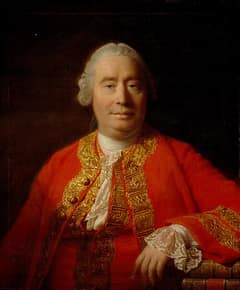
Hume argued that all ideas come from impressions and that our belief in causation rests on habit, not reason. Morality rests on sentiment, not reason, and reason is "the slave of the passions".
Central question
What can experience justify, and what do we believe only by custom?
Method
Hume brings the "experimental method of reasoning" into moral subjects: he observes the mind as natural philosophers observe bodies, tests every idea by tracing it to an impression, and admits no principle that experience does not support. How David Hume works ↓
›Being and realitySuspends judgment* (contested reading)
Suspends judgment. We have no idea of substance beyond a collection of qualities, and no reasoning can show that our perceptions are caused by external objects, so what ultimately exists cannot be known.
Hume suspends judgment on what is ultimately real: all we are acquainted with are perceptions, and both substance and the continued, independent existence of bodies outrun experience.
Another reading. The "New Hume": Hume is a sceptical realist who takes bodies and causal powers to exist while denying we can know their nature (Wright, The Sceptical Realism of David Hume, 1983; Strawson, The Secret Connexion, 1989; Read and Richman, eds, The New Hume Debate, 2000). Winkler ("The New Hume", 1991) defends the traditional reading coded here.
Contested readingperceptions, substance, double existenceDraft — not yet reviewed
There are no abstract general ideas: every idea is particular, and becomes general in use when it is attached to a word that calls up, by custom, any of the resembling individuals.
Stated in the textabstract ideas, general terms, resemblance, customDraft — not yet reviewed
›God and the fundamentalUndecidable* (contested reading)
Experience cannot carry us from the world's order to an author with any definite attributes, and a priori proofs of a necessary being fail; at most the cause of order may bear some remote analogy to human intelligence.
Another reading. Philo's final concession is sincere: Hume accepts an "attenuated deism" (Gaskin, Hume's Philosophy of Religion), a probable but empty belief in an intelligent cause with no practical consequences.
Another reading. Hume's caution is prudential and his arguments leave belief in God without warrant, so his considered view is irreligious (Russell, The Riddle of Hume's Treatise, 2008).
The Dialogues speak through characters, and which of them, if any, voices Hume is itself disputed. The case against a priori proofs is put by Cleanthes (Dialogues IX); Hume's own voice says that the non-existence of any being is as clear an idea as its existence (EHU XII, Part 3).
›Soul and bodyRejects the question* (contested reading)
Rejects the question. The question of the soul's substance is unintelligible, since we have no impression of a substance in which perceptions inhere; the self is a bundle of perceptions. This rejects only part of the question as posed: on how thought and body are related he does answer, from experience.
Hume rejects the question as posed: there is no idea of a soul-substance to relate to the body, only a bundle or succession of perceptions, and experience alone tells us that thought depends on bodily states.
Another reading. A naturalist answer: matter and motion may be, and in fact are, causes of thought (Treatise 1.4.5), and "Of the Immortality of the Soul" argues from the mind's dependence on the body, so Hume answers the question in the direction of materialism.
Contested readingbundle of perceptions, personal identity, substance of the soulDraft — not yet reviewed
Against a straightforward materialism, Treatise 1.4.5 holds that most perceptions exist nowhere and cannot be located in body. He later admits his account of personal identity leaves him in a labyrinth (Appendix).
›Death and immortalityMortal
Metaphysical and moral arguments for immortality fail, and the analogy of nature, the only sound guide here, strongly suggests that the soul ends with the body; only revelation could teach otherwise.
Scholarly consensusanalogy of nature, revelationDraft — not yet reviewed
The essay was withdrawn before publication and appeared posthumously; its closing deference to revelation is generally read as ironic.
›The cosmosNot decidable by reason
Whether the world began cannot be settled, because it is a unique effect and we have experience of no other worlds; rival cosmogonies are equally unsupported, and a priori anything may produce anything.
Scholarly consensussingular effect, experience, cosmogonyDraft — not yet reviewed
For Hume it is undecidable by experience, the only judge of matters of fact, rather than by reason in the sense of the codebook's other examples. The Dialogues VI–VIII citations are Philo's speeches.
›Freedom and determinismFree and determined
Human actions are caused as regularly as natural events, and liberty means only the power of acting according to the determinations of the will; this liberty is consistent with necessity and is what responsibility requires.
Stated in the textliberty of spontaneity, necessity, constant conjunctionDraft — not yet reviewed
Treatise 2.3.1–2 is harder-line than the Enquiry: liberty of indifference amounts to chance. Russell (Freedom and Moral Sentiment, 1995) argues that responsibility rests on moral sentiment rather than on a reconciliation of liberty and necessity.
›CausationNecessity from the mind
No reasoning a priori finds an effect in its cause, and in experience we see only one event following another, never a tie between them. The idea of necessary connection comes from the mind's customary move, after repeated conjunction, from one object to the idea of its usual attendant. Whatever is conceivable is possible, and the contrary of every matter of fact is possible, so no causal law is necessary in itself.
Another reading. The "New Hume": he denies that we know or have an idea of necessary connection in things, not that real powers exist (Wright, The Sceptical Realism of David Hume, 1983; Strawson, The Secret Connexion, 1989); Winkler ("The New Hume", 1991) defends the traditional reading. Both fit the option, which is about where our idea of necessity comes from.
Stated in the textTreatise 1.3 (1739); Enquiry IV–VII (1748)necessary connexion, constant conjunction, custom, power, two definitions of causeDraft — not yet reviewed
Necessity in this sense holds of human actions as of bodies (Enquiry VIII), and chance is only our ignorance of causes. Unlike Kant, the necessity has no a priori ground.
Epistemology
›Sources of knowledgeExperience
Every idea is copied from an earlier impression of sense or reflection, so the mind's materials all come from experience; reason only compares ideas or infers from what experience has shown.
Stated in the textimpressions, ideas, copy principle, relations of ideas, matters of factDraft — not yet reviewed
›Certainty, doubt and the limits of knowledgeSceptical
Reason cannot justify our belief in causes, in the external world or in a lasting self; we hold these beliefs from custom and nature, which are too strong for scepticism to dislodge, and a mitigated scepticism keeps inquiry within common life.
Scholarly consensusmitigated scepticism, custom, belief, PyrrhonismDraft — not yet reviewed
Relations of ideas, as in mathematics, are known with certainty by intuition and demonstration (EHU IV, Part 1), though Treatise 1.4.1 argues that even demonstration decays into probability in practice. Naturalist readings (Kemp Smith) still fit the option, which allows belief from nature. What "reason" fails to justify is disputed: Stove (1973) reads it as deductive reason, Garrett (1997) and Owen (1999) as the faculty of reasoning.
›Innate knowledgeNo innate contents
No idea is innate if that means present before experience; if "innate" only means original and not copied, then impressions are innate and ideas are not, so the dispute dissolves into a question of words.
Stated in the textinnate ideas, impressions, originalDraft — not yet reviewed
Truth is agreement either with the real relations of ideas or with real existence and matter of fact; what cannot so agree, such as passions and actions, cannot be true or false.
Stated in the texttruth, relations of ideas, real existenceDraft — not yet reviewed
His scepticism about objects beyond perceptions makes agreement with "real existence" hard to check, a tension he does not resolve.
›Epistemic justificationNature, custom or life, not reasons · Borne out by experience
Relations of ideas are known by intuition or demonstration. All reasoning about matters of fact beyond memory and the senses rests on cause and effect, and that inference is not founded on any argument but on custom, the great guide of life; nature has determined us to judge as it has to breathe, and no system can defend the understanding or the senses. Within that given practice there is still a standard: the wise man proportions his belief to the evidence, from proof down to probability, weighing opposite experiments.
Another reading. Kemp Smith (The Philosophy of David Hume, 1941) reads Hume as a naturalist for whom nature, not reason, settles our basic beliefs; the sceptical arguments only clear the ground for that.
Another reading. Stove (Probability and Hume's Inductive Scepticism, 1973) reads Hume as an inductive sceptic who denies that any experience makes an unobserved matter of fact even probable, which leaves the rule of proportioning belief without a rational basis.
Stated in the textTreatise of Human Nature Book 1 (1739); Enquiry concerning Human Understanding (1748)custom, belief, proof, probability, relations of ideas, matters of fact, mitigated scepticismDraft — not yet reviewed
Two codes because Hume says two things: what produces belief (custom, nature) and how a reflective person should regulate it (proportion to experience). How these fit together is the classic problem of Humean "normativity". Demonstrative knowledge of relations of ideas (EHU 4.1) is real but narrow, and the Treatise argues that even it decays into probability (1.4.1).
Axiology
›The highest goodRejects the question* (contested reading)
Rejects the question. There is no single highest good for all people; happiness depends on how a person's passions and temper suit their pursuits, and no philosophy can prescribe one object for everyone.
Hume denies that philosophy can name one highest good: what makes a life happy varies with temper and taste, though virtue, peace of mind and good company commonly serve best.
Another reading. "The Sceptic" is one of four personae, and the Enquiry concerning the Principles of Morals presents virtue as the surest route to happiness (IX, Part 2), so Hume holds a form of flourishing through virtue.
Contested readinghappiness, temper, peace of mindDraft — not yet reviewed
`rejects` denies a presupposition: that there is a single highest good for every human being. It rests on a persona essay; EPM IX, Part 2 supports the alternative, not the main code.
›The basis of moralityMoral sentiment
Reason cannot tell virtue from vice; we call a character virtuous because contemplating it gives a peculiar feeling of approval, and the virtues are the traits useful or agreeable to their possessor or to others.
Stated in the textmoral sentiment, sympathy, utility, artificial virtuesDraft — not yet reviewed
What the is–ought paragraph (Treatise 3.1.1.27) forbids is disputed: the standard reading takes it to deny any derivation of "ought" from "is"; MacIntyre ("Hume on 'Is' and 'Ought'", 1959) reads it as allowing a bridge through wants and needs.
›Virtue and knowledgeNot knowledge
Knowledge can never move us to act on its own, because reason is the slave of the passions; virtue lies in passions and character that win approval, not in knowing.
Stated in the textreason is the slave of the passions, calm passionsDraft — not yet reviewed
›The state and legitimacyMixed constitution* (contested reading)
Asked to design the best commonwealth, Hume proposes a large republic of county representatives, senators and magistrates balancing one another under law; but all government rests on opinion, and established forms should not be overturned for an ideal.
Another reading. The essay itself warns against trying experiments on established governments and offers its plan for speculation; read with "Of the First Principles of Government" (all government rests on opinion), Hume names no best order simply.
Contested readingopinion, convention, perfect commonwealth, balanceDraft — not yet reviewed
`mixed-constitution` fits only loosely: the perfect commonwealth is a republic with no hereditary single ruler, balancing representatives, senate and magistrates.
›Beauty and artJudgment of taste
Beauty is not a quality in things but a feeling in the mind; still there is a standard of taste, found in the joint verdict of critics with delicacy, practice, comparison and freedom from prejudice.
Stated in the textstandard of taste, delicacy, true judgesDraft — not yet reviewed
That beauty is no quality in things is first presented as the view of a sceptical philosophy and then qualified by the standard of taste; Treatise 2.1.8 gives his own account of beauty as an order of parts fitted to please.
›JusticeConvention for mutual advantage
Justice is an artificial virtue. Limited generosity and the scarcity and easy transfer of external goods make society unstable until people come, without any promise, to a convention to respect stable possession, from a shared sense of common interest. Self-interest is the original motive for establishing justice, and sympathy with the public interest is the source of the moral approval of it; public utility is the sole origin of justice. The rules are artificial but not arbitrary, and the common definition of justice as giving each their due wrongly assumes rights and property prior to it.
Stated in the textTreatise of Human Nature 3.2 (1740); Enquiry concerning the Principles of Morals III (1751)artificial virtue, convention, stability of possession, public utility, sympathyDraft — not yet reviewed
The convention is a shared sense of interest, explicitly not a promise (3.2.2.10). Hume calls the rules of justice laws of nature in the sense that they are inseparable from the species (3.2.1.19), which is not `natural-law`.
›The nature of valueGrounded in feeling
Examine a vicious act as you will and you find only passions, motives and thoughts; the vice appears only when you turn to the feeling of disapproval it raises in you, so it lies in yourself, not in the object. Reason finds things as they are; taste gilds or stains them with colours borrowed from sentiment. These sentiments are not private whims: we correct them from steady and general points of view, and they rest on the common constitution of human nature.
Another reading. Moral qualities are projections of sentiment onto the world, and ordinary moral talk treats them as more objective than they are (Mackie, Hume's Moral Theory, 1980).
Another reading. Hume is a quasi-realist: projected sentiments earn moral talk of truth and objectivity without error (Blackburn, Ruling Passions, 1998).
Stated in the textsentiment, approbation, taste, general point of view, moral senseDraft — not yet reviewed
Hume compares virtue and vice to colours and sounds as understood by modern philosophy, not to fictions: the stance fits, but whether value is then independent of judgment is exactly what the readings dispute.
* contested reading · open a row for the explanation and its sources
Method روش و شیوه اندیشهورزی فلسفی
Hume brings the "experimental method of reasoning" into moral subjects: he observes the mind as natural philosophers observe bodies, tests every idea by tracing it to an impression, and admits no principle that experience does not support. The result is a mitigated scepticism, set out first as a systematic treatise and later in essays, enquiries and a dialogue.
Posing questions
Hume turns philosophical questions into questions about human nature. Instead of asking what causation or virtue is in itself, he asks from what impression the idea is derived and what in the mind produces the belief or the sentiment. Since all the sciences depend on the science of man, the study of the understanding, the passions and morals comes first. Questions that cannot be put this way, such as the nature of a substance beyond its qualities, he treats as having no clear idea behind them.
He distinguishes demonstrative reasoning about relations of ideas from probable reasoning about matters of fact, which rests on experience and custom. The principle that every simple idea is copied from an impression works as a test: a term with no impression behind it has no meaning. About matters of fact he reasons by analogy and by weighing evidence, so that a wise person proportions belief to the evidence, as in his treatment of miracles. His "experiments" are observed cases: he confirms a principle by several instances and by what happens when a condition is removed, and he states rules for judging causes.
Hume answers rival views by asking for the impression behind their key terms and by showing that the reasoning they claim cannot be drawn from experience: necessary connexion, the substance of the soul and the design argument all fail this test. He turns ancient sceptical arguments against dogmatic reason, but also rejects excessive (Pyrrhonian) scepticism, which no one can live by. His closing rule for libraries states the criterion at its sharpest: a book with neither abstract reasoning about quantity nor experimental reasoning about matters of fact should be committed to the flames.
Experience and observation are the only ground for knowledge of matters of fact. Reason in the narrow sense compares ideas; it cannot by itself ground causal inference or move us to act. Belief is a lively idea produced by custom, a natural instinct surer than reasoning, and moral distinctions come from sentiment rather than reason. Imagination does much of the work other philosophers give to reason, filling gaps between perceptions and producing our belief in bodies and in a continuing self.
Hume wrote the Treatise as an anatomy of the mind and later judged that it failed through its manner, recasting it in the shorter and more elegant Enquiries and asking that they alone be taken as his philosophy. He wanted to join the "easy" philosophy that pleases and moves with the "accurate" one that reasons closely. His essays address a polite reading public, and in some, such as The Sceptic, he speaks through a character. The Dialogues concerning Natural Religion give the argument to Cleanthes, Philo and Demea, framed by a narrator, so that Hume's own view is never stated outright.
science of man, experimental method of reasoning, relations of ideas, matters of fact, custom, mitigated scepticism
Arguments
›Inference from experience is not founded on reasonOur inferences from experience are not determined by reason but by custom or habit.
1All reasoning about matters of fact beyond present sense and memory rests on the relation of cause and effect.
2Knowledge of causes is never reached a priori but only from experience of constant conjunction, since any effect is distinct from its cause and its contrary is conceivable.
3Inferring from observed to unobserved cases presupposes that the future will resemble the past.
4That principle cannot be demonstrated, since its denial implies no contradiction.
5Nor can it be established by reasoning from experience, since all such reasoning presupposes it, which would be circular.
∴Our inferences from experience are not determined by reason but by custom or habit.
›The idea of necessary connexion comes from customThe idea of necessary connexion is copied from the mind's customary transition, felt internally and spread onto objects; belief in causal connection is a natural feeling, not a product of argument.
1Every simple idea is copied from a preceding impression.
2In a single instance of cause and effect we observe only succession and contiguity, never a power or necessary connexion in the objects.
3Nor do we find such a power in the mind's command over the body or over its own ideas; we learn their effects only from experience.
4After many like instances, the mind on the appearance of one object is carried by custom to expect the other, and this felt determination is the only new thing in the repeated case.
∴The idea of necessary connexion is copied from the mind's customary transition, felt internally and spread onto objects; belief in causal connection is a natural feeling, not a product of argument.
Immanuel Kant objects. Hume rightly saw that the concept of cause cannot come from experience, but wrongly concluded it is a product of habit; it is a pure concept of the understanding that makes experience of objective succession possible in the first place.
›No "ought" from an "is"The distinction between virtue and vice is not founded merely on relations of objects, nor perceived by reason; morality is a matter of feeling rather than of judgment.
1Reason discovers only relations of ideas or matters of fact.
2In every system of morality the author reasons for a while in the ordinary way about God or human affairs, and then passes, without notice, from propositions joined by "is" to propositions joined by "ought".
3An "ought" expresses a new relation, which needs to be explained, and it is inconceivable how it could be deduced from relations of a different kind.
4Vice is not found in any matter of fact in the object but only when we turn to our own breast and find a sentiment of disapproval.
∴The distinction between virtue and vice is not founded merely on relations of objects, nor perceived by reason; morality is a matter of feeling rather than of judgment.
Immanuel Kant objects. (Applied; Kant targets moral-sense theory, not this paragraph.) Moral feeling cannot ground morality either, since feelings differ in degree and give no uniform standard; the "ought" comes from pure practical reason giving itself a law a priori.
Perceptions are either impressions, the lively ones of sensation and feeling, or ideas, their fainter copies in thought. Every simple idea is copied from an impression, so a word with no impression behind it has no meaning.
Objects of reasoning are either relations of ideas, known by thought alone and certain, as in mathematics, or matters of fact, whose contrary is always conceivable and which only experience can settle.1 link to other thinkers →
habitAfter seeing one kind of event constantly followed by another, the mind is carried by habit to expect the second. Custom, not reason, underlies every inference from experience.
We never perceive a power binding cause to effect, only constant conjunction. The idea of necessity is copied from an inner impression: the felt push of the mind from one to the other.1 link to other thinkers →
Looking inward, I never catch a self without some perception. The mind is a bundle of perceptions in constant flux, and the identity we give it is a work of the imagination.
Virtue and vice are not found by reason but felt: approval or blame arises in a spectator who views a character from a general point of view. Reason informs about facts; sentiment decides.
The way another's feelings become ours: the idea of their passion grows lively until it becomes the passion itself. It explains why we approve of what is useful or agreeable to others, not only to us.
Thinkers named, not addressed, in the texts Hekmat holds. Naming someone is not evidence of influence.
Names in their works
›Cicero12 passages · 3 works
An Enquiry concerning Human Understanding 1.4… right path, and secures himself from any dangerous illusions. The fame of Cicero flourishes at present; but that of Aristotle is utterly decayed. La Bruyere …
An Enquiry concerning the Principles of Morals 2.1.3… as well as contempt. A high ambition, an elevated courage, is apt, says Cicero, in less perfect characters, to degenerate into a turbulent ferocity. The …
A Treatise of Human Nature 1.3.8.5n21… INEST IN LOCIS; UT NON SINE CAUSA EX HIS MEMORIAE DUCTA SIT DISCIPLINA. Cicero de Finibus, lib. 5. {"Should I, he said, "attribute to instinct or to some …
An Enquiry concerning Human Understanding 11.2… of this bigotted jealousy, with which the present age is so much infested. Epicurus lived at Athens to an advanced age, in peace and tranquillity: Epicureans …
An Enquiry concerning Human Understanding 11.4… can justly be jealous of certain tenets of philosophy, such as those of Epicurus, which, denying a divine existence, and consequently a providence and a …
An Enquiry concerning Human Understanding 5.2.17n9… aut scriptum aliquod legamus? Velut ego nunc moveor. Venit enim mihi Plato in mentem, quera accepimus primum hic disputare solitum: cuius etiam illi …
A Treatise of Human Nature 1.3.8.5n21… written? This is just what is happening to me now; for I am reminded of Plato who, we are told, was the first to make a practice of holding discussions …
A Treatise of Human Nature 1.4.5.17… a true atheism, and will serve to justify all those sentiments, for which Spinoza is so universally infamous. From this topic, I hope at least to reap one …
A Treatise of Human Nature 1.4.5.18… The fundamental principle of the atheism of Spinoza is the doctrine of the simplicity of the universe, and the unity of that substance, in which he supposes …
A Treatise of Human Nature 1.4.5.21… men, ships, houses, and other productions either of art or nature. Here Spinoza appears, and tells me, that these are only modifications; and that the …
An Enquiry concerning Human Understanding 1.4… illusions. The fame of Cicero flourishes at present; but that of Aristotle is utterly decayed. La Bruyere passes the seas, and still maintains his …
An Enquiry concerning the Principles of Morals 8.9… to overvalue than undervalue themselves; notwithstanding the opinion of Aristotle. This makes us more jealous of the excess on the former side, and causes us …
An Enquiry concerning Human Understanding 8.1.7… them. Nor are the earth, water, and other elements, examined by Aristotle, and Hippocrates, more like to those which at present lie under our …
An Enquiry concerning Human Understanding 1.4… of Malebranche is confined to his own nation, and to his own age. And Addison, perhaps, will be read with pleasure, when Locke shall be entirely forgotten. …
A Treatise of Human Nature 1.1.1.1n2… I rather restore the word, idea, to its original sense, from which Mr Locke had perverted it, in making it stand for all our perceptions. By the terms of …
An Enquiry concerning Human Understanding 2.9n1… Again, the word idea, seems to be commonly taken in a very loose sense, by LOCKE and others; as standing for any of our perceptions, our sensations and …
An Enquiry concerning Human Understanding 11.2… penal statutes. For, except the banishment of Protagoras, and the death of Socrates, which last event proceeded partly from other motives, there are scarcely …
An Enquiry concerning the Principles of Morals 7.17… Who admires not Socrates; his perpetual serenity and contentment, amidst the greatest poverty and domestic vexations; his resolute contempt of riches, and his …
A Treatise of Human Nature Intro.7… betwixt the origins of these sciences; and that reckoning from THALES to SOCRATES, the space of time is nearly equal to that betwixt, my Lord Bacon and some …
An Enquiry concerning Human Understanding 5.1.1… within our own minds, we may, at last, render our philosophy like that of Epictetus, and other Stoics, only a more refined system of selfishness, and reason …
An Enquiry concerning the Principles of Morals 7.17… friends and disciples, and avoided even the dependence of an obligation? Epictetus had not so much as a door to his little house or hovel; and therefore, soon …
An Enquiry concerning the Principles of Morals App4.14… Epictetus has scarcely ever mentioned the sentiment of humanity and compassion, but in order to put his disciples on their guard against it. The virtue of the …
›Protagoras1 passage
An Enquiry concerning Human Understanding 11.2… any creeds, concessions, or penal statutes. For, except the banishment of Protagoras, and the death of Socrates, which last event proceeded partly from other …
A Treatise of Human Nature Intro.7… interval betwixt the origins of these sciences; and that reckoning from THALES to SOCRATES, the space of time is nearly equal to that betwixt, my Lord …
Named by
›Friedrich Nietzsche3 passages · 2 works
Beyond Good and Evil 252… Bacon represents an attack on the philosophical spirit generally, Hobbes, Hume, and Locke, an abasement, and a depreciation of the idea of a “philosopher” …
The Gay Science 357… the notion of causality. Not that he at all doubted its legitimacy, like Hume: on the contrary, he began cautiously to define the domain within which this …
The Gay Science 370… of life than had been characteristic of the eighteenth century, the age of Hume, Kant, Condillac, and the sensualists: so that the tragic view of things …