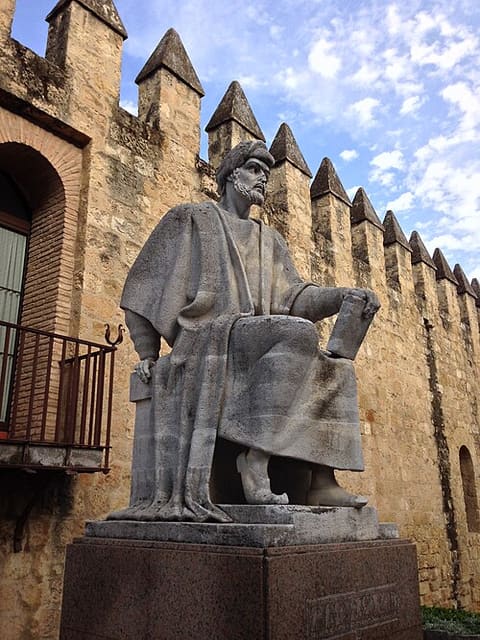
Medieval Islamic · 12th c.
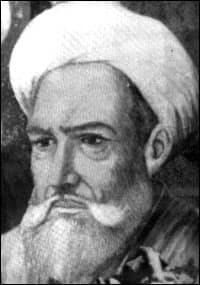
Ibn Rushd (Averroes)
ابن رشد1126–1198Islamic Peripatetics (Mashshāʾī)
Ibn Rushd, a judge in Seville and Córdoba, commented on nearly all of Aristotle and became "the Commentator" of the Latin schools. He argued that the Law commands philosophical study and that demonstrated truth cannot contradict revealed truth, answered al-Ghazali point by point, and read Aristotle as teaching one material intellect for all humans, a thesis condemned in Paris in 1270.
- Central question
- What does Aristotle actually teach, and how does demonstrative philosophy stand to the revealed Law?
- Method
- Ibn Rushd's method is commentary in the service of demonstration: he expounds Aristotle at three lengths to recover what Aristotle proved, and judges every other way of arguing by how far it falls short of proof. How Ibn Rushd works
al-burhān demonstrational-taʾwīl interpretational-ʿaql al-hayūlānī the material intellectal-ittiṣāl conjunctional-ḥudūth al-dāʾim perpetual origination
Many works survive complete only in Hebrew or Latin; the Long Commentary on De Anima chiefly in Michael Scot's Latin, the Commentary on Plato's Republic only in Hebrew. His views developed across epitome, middle and long commentaries, notably on the material intellect.
- Scholarly consensus 19
- Contested reading 1
Answers 20 of 20 questions
Epistemology
Sources of knowledgeExperience, completed by intellect
Knowledge begins with sensation and imagination. The agent intellect, a separate substance, acts on the forms held in imagination as light acts on colours, making them actually intelligible, and the material intellect receives them.
Long Commentary on Aristotle's De Anima III, comm. 5 · Long Commentary on Aristotle's De Anima III, comm. 18–20
`illumination` would fit only in Aristotle's own sense of the agent intellect as light; he rejects Ibn Sina's giver of forms, and the intelligibles are drawn from the senses.
Certainty, doubt and the limits of knowledgeYes
Demonstration, the most perfect kind of syllogism, yields certain knowledge from true and necessary premises; those capable of it reach certainty, while others assent through dialectic or rhetoric.
Innate knowledgeNo innate contents
The material intellect has no form of its own; it is pure capacity to receive the forms of material things, which it receives only through imagination and sense.
TruthCorrespondence
A judgment is true when it agrees with what is outside the soul. Truth is one: what is demonstrated cannot conflict with what the Law teaches, since one truth cannot contradict another; each confirms the other.
The Decisive Treatise Ch. 2 · Long Commentary on Aristotle's Metaphysics Book Θ
The Decisive Treatise's principle is about the consistency of truths, not their nature; the definition is Aristotle's, which he comments on.
Epistemic justificationDemonstration from first principles
The Law commands reflection on beings, and the most perfect reflection is by demonstration, which gives certain knowledge from true premises; demonstrative truth cannot contradict scripture rightly read. People differ by nature in how they come to assent: some by demonstration, some by dialectical and some by rhetorical arguments, and scripture speaks to all three. Only demonstrative assent is knowledge in the strict sense, and only the demonstrative class may interpret.
The Decisive Treatise Ch. 1 · The Decisive Treatise Ch. 2 · The Decisive Treatise Ch. 3 · The Incoherence of the Incoherence First Discussion
The three ways to assent are not three kinds of justification of equal rank but grades suited to capacities; rhetorical assent to scripture is legitimate for the many without being knowledge, which is why `authority` is not coded.
Axiology
The highest goodContemplation
The ultimate human end is theoretical perfection, completed by conjunction (ittiṣāl) with the agent intellect, in which the human knows the separate intellect; it is reached, if at all, in this life.
Long Commentary on Aristotle's De Anima III, comm. 36
He weighs Ibn Bajja's and al-Farabi's views on whether conjunction is possible before affirming it. The Commentary on the Republic adds that this perfection is reached only in a city ordered by the practical virtues.
The basis of moralityVirtue
Right action is that of the virtues of character, settled by habituation under law and governed by practical wisdom; the Law gives everyone the practical virtues and right beliefs suited to them.
Commentary on Plato's Republic Treatise I · Exposition of the Methods of Proof Ch. 5
Against the Ashʿarites he holds that justice and injustice are such in themselves, not only because God commands or forbids (Exposition, on justice). The Law's role has no option of its own.
Virtue and knowledgeKnowledge plus habituation
Theoretical virtue comes by instruction, and the virtues of character by habituation from youth; the many are brought to virtue by persuasion and those who resist by compulsion.
The state and legitimacyRule by the wise
Following Plato, the best city is ruled by the philosopher, who is also king, lawgiver and imam; each class does its own work, and women can share the guardians' tasks, ruling included. The cities of his own time are degenerate regimes.
Commentary on Plato's Republic Treatises I–II · Commentary on Plato's Republic Treatise III
The commentary paraphrases Plato's Republic, so how far it states his own view is a question of register; he applies it to Andalusian regimes in his own voice.
Beauty and artValuable imitation
Poetry belongs to logic: it imitates and represents things to the imagination, and its proper aim is to move people toward virtue by praising the good and blaming the bad. Poems that imitate vice are to be excluded from the virtuous city.
Middle Commentary on Aristotle's Poetics whole commentary · Commentary on Plato's Republic Treatise I
Reading the Poetics through Arabic poetry, he makes tragedy the art of praise and comedy the art of blame. The Republic commentary keeps Plato's censorship, which touches `suspect-imitation`.
JusticeOrder of the soul · Justice by nature
Following Plato, justice in the city is each class doing its own work and in the soul each part doing what it should, under wisdom. Against the Ashʿarites, who hold that acts are just or unjust only because God commands or forbids them, he argues that justice and injustice are such in themselves, so that God's justice is intelligible to us.
Commentary on Plato's Republic Treatise I · Exposition of the Methods of Proof Ch. 5
The commentary paraphrases Plato, so how far it states his own view is a question of register; the Exposition argues in his own voice. Hourani ("Averroes on Good and Evil", Studia Islamica 16, 1962) reads the Exposition as holding an objective, rational ethics against Ashʿarite voluntarism.
The nature of valueNatural ends
Against the Ashʿarites, Averroes holds that just and unjust are not made so by the revealed command alone: some things are just or unjust in themselves, and reason can know it, as the Law presupposes when it calls God just. Things have natures and ends, and God acts with wisdom, so the good of each thing follows its nature, not an unconstrained will.
Exposition of the Methods of Proof Ch. 5
Coded on just and unjust, good and bad; the anti-voluntarist point is explicit, the positive account less so. Convertible-with-being may also fit his commentaries on the Metaphysics.
contested reading · open a row for the explanation and its sources
Method روش و شیوه اندیشهورزی فلسفی
Ibn Rushd's method is commentary in the service of demonstration: he expounds Aristotle at three lengths to recover what Aristotle proved, and judges every other way of arguing by how far it falls short of proof. In his legal-theological writings he holds that the Law calls people to the truth by demonstration, dialectic or rhetoric according to their capacity, and that only those capable of demonstration may interpret its outward sense.
- Posing questions
He poses the question of philosophy itself as a legal question: is the study of philosophy and logic permitted, forbidden, recommended or obligatory under the Law? He answers that the Law commands reflection on beings by the best kind of reasoning, which is demonstration. In the commentaries the questions are Aristotle's own, taken up passage by passage, and the task is to find what the text demonstrates and where later commentators went wrong.
The Decisive Treatise Ch. 1 · Long Commentary on Aristotle's Metaphysics Book Λ · Long Commentary on Aristotle's De Anima III, comm. 5
- Arguing and justifying
Demonstration from necessary premises is the standard, and he distinguishes it carefully from dialectic, which argues from accepted opinions, and rhetoric, which persuades. Since truth does not contradict truth, a demonstrated conclusion that conflicts with the apparent sense of scripture shows that the passage must be interpreted (taʾwīl), following the conventions of Arabic figurative speech. On questions where demonstration is lacking he says so, and marks his own replies as dialectical where that is all the subject allows.
The Decisive Treatise Ch. 2 · The Incoherence of the Incoherence First Discussion · Long Commentary on Aristotle's De Anima III, comm. 5
- Criticising rival views
The Incoherence of the Incoherence quotes al-Ghazali's text section by section and answers each, often by showing that his arguments are dialectical or sophistical rather than demonstrative, and sometimes conceding that Ibn Sina gave al-Ghazali an easy target by departing from Aristotle. The Exposition of the Methods of Proof judges the proofs of the theologians, especially the Ashʿarites, as fit neither for the learned nor for the public, and offers proofs from providence and invention drawn from the Quran instead. Theologians err by publishing interpretations to people unable to follow them.
The Incoherence of the Incoherence whole work · The Incoherence of the Incoherence Third Discussion · Exposition of the Methods of Proof Ch. 1 · The Decisive Treatise Ch. 3
- Reason, experience and other ways of knowing
People differ by nature in how they come to assent: some by demonstration, some by dialectical arguments, most by rhetorical ones, and the Law addresses all three. Reason at its height, the intellect that understands demonstrations, is for Ibn Rushd the means of human perfection, and the De Anima commentaries return several times to how it is related to the material and Active Intellect. Imagination serves the public through the images of the Law and of poetry, which he treats as an art of representation in his commentary on the Poetics.
The Decisive Treatise Ch. 3 · Long Commentary on Aristotle's De Anima III, comm. 18–20 · Middle Commentary on Aristotle's Poetics whole commentary
- Language and style
His commentaries come in three forms: the epitome, which restates a subject in his own order; the middle commentary, which paraphrases Aristotle closely; and the long commentary, which quotes each passage and comments on it phrase by phrase, weighing Alexander, Themistius, al-Farabi and Ibn Sina. Where a text was missing he made do, commenting on Plato's Republic because Aristotle's Politics was not available to him. The Decisive Treatise is written as a legal opinion (fatwā), in the terms of jurisprudence.
Long Commentary on Aristotle's Metaphysics Book Ζ · Commentary on Plato's Republic Treatise I · The Decisive Treatise Ch. 1
- Across the works
- Long Commentary on Aristotle's De Anima, Long Commentary on Aristotle's Metaphysics, Middle Commentary on Aristotle's Poetics, Commentary on Plato's RepublicThe commentaries. His views developed across epitome, middle and long commentaries, most clearly on the material intellect, where the Long Commentary on De Anima reaches the view that it is one for all humans.Long Commentary on Aristotle's De Anima III, comm. 5
- The Decisive Treatise, Exposition of the Methods of ProofThe legal-theological works of about 1179–80 address the Law's audiences: the Decisive Treatise argues for philosophy's legal standing and limits interpretation, the Exposition sets out what the public should believe and by what proofs.The Decisive Treatise Chs. 2–3 · Exposition of the Methods of Proof Ch. 1
- The Incoherence of the IncoherenceA point-by-point reply to al-Ghazali that often argues dialectically, since it answers a dialectical work, and says so.The Incoherence of the Incoherence First Discussion
burhān, jadal, khiṭāba, taʾwīl, ẓāhir, bāṭin, sharḥ, talkhīṣ, jawāmiʿ, al-ḥaqq lā yuḍādd al-ḥaqq
Arguments
The Law commands the study of philosophyStudy of the books of the ancients is obligatory by the Law for those who have both natural ability and religious probity, and forbidding it to them turns people away from the door to knowing God.
- 1Philosophy is nothing other than reflection on beings insofar as they point to their Maker, and the more complete the knowledge of the beings, the more complete the knowledge of the Maker.
- 2The Law urges reflection on beings by the intellect, in verses such as Qur'an 59:2, which bids those who have insight to reflect, so such reflection is obligatory or at least recommended.
- 3Reflection of this kind is drawing the unknown from the known, which is syllogism, and its most perfect form is demonstration; so the Law commands demonstrative study for those able to undertake it.
- 4Demonstration needs the study of logic and of what earlier thinkers achieved, whatever their religion, as a tool is used whoever made it.
- 5Demonstration does not lead to anything that conflicts with the Law, since one truth cannot contradict another; where it seems to, the outward sense of the text is to be interpreted, and the Law itself contains passages that call for interpretation.
- ∴Study of the books of the ancients is obligatory by the Law for those who have both natural ability and religious probity, and forbidding it to them turns people away from the door to knowing God.
al-Ghazali objects. (Earlier; the charge Ibn Rushd answers.) The philosophers' metaphysics does not meet their own standard of demonstration, and on three doctrines, the world's eternity, God's knowing particulars only universally and the denial of bodily resurrection, it contradicts the Law and is unbelief. Ibn Rushd replies that there is no settled consensus on such theoretical matters and that interpretation by the learned is not unbelief.
deductive · The Decisive Treatise Ch. 1 · The Decisive Treatise Ch. 2
Draft — not yet reviewed
To deny causes is to deny knowledgeDenying efficient causes is sophistry that destroys knowledge itself; things act by their natures, which God gave them, and the regularity of the world is their necessity, not a custom.
- 1Suppose, with al-Ghazali, that no thing has a power or nature from which its act necessarily proceeds.
- 2Then a thing would have no proper act, and so no nature distinguishing it from other things; fire would no more be fire than water.
- 3A thing's definition states its nature and causes, and knowledge of a thing is knowledge through its causes.
- 4So without causes there would be no definitions and no knowledge at all, not even of God as the maker of a world whose order shows him.
- ∴Denying efficient causes is sophistry that destroys knowledge itself; things act by their natures, which God gave them, and the regularity of the world is their necessity, not a custom.
al-Ghazali objects. (Earlier; the argument Ibn Rushd answers.) What we observe is concurrence, not necessitation; God can create knowledge in us that he will keep the usual order, so denying necessary connection does not destroy knowledge, and miracles stay possible.
reductio · The Incoherence of the Incoherence Seventeenth Discussion
Draft — not yet reviewed
Key terms
All key terms →- البرهانal-burhān
- demonstrationThe most perfect kind of syllogism, from true and necessary premises, which yields certainty. The Law addresses it to those able to follow it, as it addresses dialectic and rhetoric to others.
- التأويلal-taʾwīl
- interpretation · figurative interpretationTaking a word of the Law from its literal to its figurative sense, by the usage of the Arabic language. Where demonstration conflicts with the outward sense, those able to demonstrate must interpret it; they should not publish their interpretations to the many.
- العقل الهيولانيal-ʿaql al-hayūlānī
- the material intellect · intellectus materialis · possible intellectThe capacity that receives the intelligibles. Having no form of its own, it is neither a body nor a power in one, and so is one separate substance for all humans, joined to each through his imaginative forms.
- الاتصالal-ittiṣāl
- conjunction · continuationThe joining of the human intellect with the agent intellect, when the intelligibles are fully actualised and the agent intellect becomes form for us; it is the ultimate human happiness.1 link to other thinkers →
- الحدوث الدائمal-ḥudūth al-dāʾim
- perpetual origination · perpetual creationThe world is eternal yet made: it is always being brought about by the First, so it is originated without a first moment. Calling it eternal or originated is close to a dispute over names.1 link to other thinkers →
- السببal-sabab
- causeThings act through natures God gave them, and their definitions state those natures; to know a thing is to know it through its causes, so whoever denies causes denies knowledge.1 link to other thinkers →
Relations
Open in the network →

Works
- Long Commentary on Aristotle's De AnimaCommentarium magnum in Aristotelis De anima libros
- The Decisive TreatiseFasl al-maqal · c. 1179
- Exposition of the Methods of Proofal-Kashf an manahij al-adilla · c. 1179
- The Incoherence of the IncoherenceTahafut al-tahafut · c. 1180
- Long Commentary on Aristotle's MetaphysicsTafsir ma bad al-tabia
- Middle Commentary on Aristotle's PoeticsTalkhis kitab al-shir
- Commentary on Plato's RepublicArabic lost; extant in Hebrew
How to cite
Hekmat. "Ibn Rushd (Averroes)." Draft, awaiting review; last updated 20 October 2026. https://hekmat.local/thinkers/averroes/