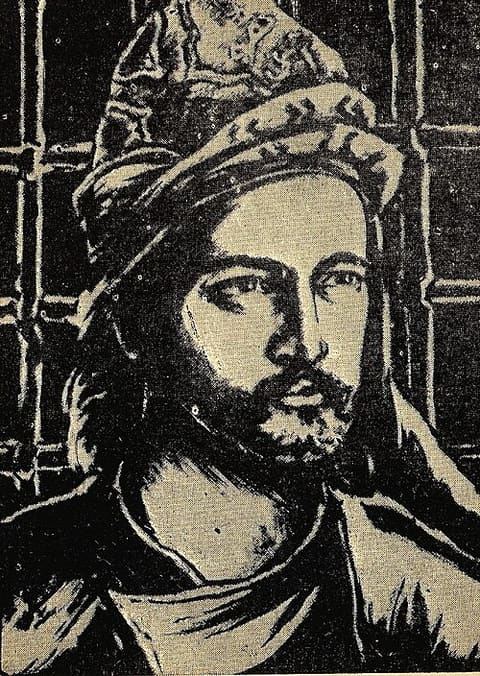
Medieval Islamic · 12th c.
Suhrawardi
سهروردی1154–1191Illuminationism (Ishrāqī)
Shihab al-Din Yahya al-Suhrawardi, executed at Aleppo in 1191, founded the philosophy of illumination. He argued that Peripatetic definitions cannot make essences known, that the self knows itself by its own presence rather than through a representation, and that reality is a hierarchy of lights, differing only in intensity, which flows from the Light of Lights. Existence, by contrast, is a concept the mind adds.
- Central question
- Can knowledge rest on definitions and abstracted forms, or must it rest on what is directly present, and what is reality if it is light?
- Method
- Suhrawardi joins discursive proof to "tasting" (dhawq): what the sage first sees by ascetic practice and vision he then seeks to prove, and proof without vision is incomplete. How Suhrawardi works
nūr / ẓulma lightnūr al-anwār the Light of Lightsishrāq illuminational-ʿilm al-ḥuḍūrī knowledge by presenceal-nūr al-isfahbad the commanding light
Wrote in Arabic and Persian. Peripatetic-style treatises (the Intimations), the Philosophy of Illumination (1186), shorter Persian and Arabic treatises and symbolic tales. The Philosophy of Illumination is cited by part and discourse; its standard paragraph numbers are those of the Walbridge–Ziai edition (1999). No text or translation is held in Hekmat.
- Stated in the text 1
- Scholarly consensus 18
- Contested reading 1
Answers 15 of 20 questions · does not address 5Why some questions don’t apply
Epistemology
Sources of knowledgeIllumination from a higher intellect
The soul knows by presence. It knows itself because it is a light manifest to itself, and it knows other things when they are present to it with nothing veiling them, or when the higher lights shine on it and it witnesses them. The highest knowledge comes from this illumination and witnessing, prepared by ascetic practice, not from definitions or abstracted forms.
The Philosophy of Illumination Introduction · The Philosophy of Illumination Part II, Discourse 1 · The Intimations dream-vision of Aristotle
`illumination` catches the shining of higher lights on a prepared soul, but the core of the view, knowledge by presence with no representing form, has no option; `intuition` is close in structure but is defined in phenomenological terms. Sense perception is itself a case of presence: sight occurs when a lit object faces a sound eye with no veil between them.
Certainty, doubt and the limits of knowledgeYes
Certainty is attainable. Suhrawardi says he first reached his doctrine by tasting and only then sought proofs for it, so that if the proofs were set aside no doubter could make him doubt it. What is known by presence leaves no gap between knower and known in which error could arise.
The Philosophy of Illumination Introduction
The immunity of knowledge by presence to error is the standard reading (Ha'iri Yazdi, The Principles of Epistemology in Islamic Philosophy, 1992), not a sentence of Suhrawardi's.
Innate knowledgeNo innate contents
The soul has no stock of ideas. It is a light aware of itself as soon as it exists, and that self-awareness is its very being, not something learned; everything else it comes to know by the presence of things to it or by illumination from the lights above it.
The Philosophy of Illumination Part II, Discourse 1 · The Intimations dream-vision of Aristotle
Self-awareness is unacquired and prior to every experience, which borders on `innate-knowledge`; but it is the self's being, not a content stored in it, as with Ibn Sina's primary notions.
TruthNot addressed
Not addressed. No account of what truth is, of statements or of things, is found in the works cited. The nearest thesis, that light is what is manifest in itself and makes other things manifest, answers what is real, not what truth is.
Not coded. Suhrawardi's theory of light as self-manifestation bears on truth only indirectly.
Read as a theory of truth, light as manifestation would sit near `being-itself`; that would be Hekmat's construction, not his.
Epistemic justificationKnowledge by presence or identity
Definitions cannot give the essence of a thing, since they define by what is no better known, so knowledge cannot rest on definitions as the Peripatetics hold. The self knows itself by being a light manifest to itself, without any representing form, and things are known when they are present to it with no veil, or when the higher lights are witnessed. Suhrawardi says he first had his doctrine by tasting and only afterwards sought proofs for it, so that proofs, though required, are secondary to witnessing.
The Philosophy of Illumination Introduction · The Philosophy of Illumination Part I, Discourse 1 · The Philosophy of Illumination Part II, Discourse 1 · The Intimations dream-vision of Aristotle
The shining of the higher lights on a prepared soul is also `illumination`; it is not coded because what warrants knowledge for Suhrawardi is the presence of the object, of which illumination is one case. The phrase "knowledge by presence" (ʿilm ḥuḍūrī) is the standard later name for his view (Ha'iri Yazdi, The Principles of Epistemology in Islamic Philosophy, 1992).
Axiology
The highest goodContemplation
The soul's good is to free itself from the darkness of the body and return to the world of lights, witnessing them and taking joy in their illumination. Sages who have stripped themselves of the body reach this in part in this life, in experiences of light, and fully after death.
The Philosophy of Illumination Part II, Discourse 5 · The Tale of the Western Exile whole work
The basis of moralityNot addressed
Not addressed. He gives no account of what makes an action right. Ethics appears as ascetic discipline and detachment that prepare the soul for illumination, which answers how one comes to know, not what rightness is.
Not coded; ascetic practice in Suhrawardi serves knowledge and the soul's return, not a theory of right action.
Virtue and knowledgeNot addressed
Not addressed. He does not ask whether knowing the good is enough to do it. The nearby thesis runs the other way: discursive knowledge without ascetic practice cannot reach the highest knowledge.
Not coded; for Suhrawardi practice is a condition of knowledge, not knowledge a condition of virtue.
He asks readers of the Philosophy of Illumination to prepare by a period of ascetic retreat before studying it.
The state and legitimacyRule by the wise (contested reading)
The world is never without a sage versed in both experience and discursive philosophy, and such a sage is God's true vicegerent. When he holds power the age is full of light; when he is hidden, darkness prevails.
Another reading. Corbin (En Islam iranien II, 1971) reads the sage as the hidden spiritual pole of the world, whose rule need not be visible or political; on that reading the passage names no political order.
The Philosophy of Illumination Introduction
The coding follows Ziai ("The Source and Nature of Authority: A Study of al-Suhrawardi's Illuminationist Political Doctrine", in Butterworth, ed., The Political Aspects of Islamic Philosophy, 1992), who reads the passage as a political doctrine. The sage-ruler is defined by mystical experience joined to philosophy, not by philosophy alone.
Beauty and artBeauty as ascent
In his Persian treatise on love, Beauty, Love and Sorrow are born of the first intellect's knowledge; love is the longing for beauty and, joined with sorrow, the way the soul is drawn back toward its origin.
On the Reality of Love whole work
Art as such is not discussed. His own symbolic tales teach through images, and the world of suspended images makes visions and imaginal forms real (Philosophy of Illumination, Part II); no option names that.
JusticeNot addressed
Not addressed. No held work gives an account of what justice is or what grounds it. The Philosophy of Illumination speaks of the sage as God's vicegerent (a question for axi.legitimacy), and the ethical counsel of the Persian treatises concerns detachment and purification.
Suhrawardi writes nothing on justice as such; his practical teaching serves the soul's return to the light.
The nature of valueOwn position
Own position. Perfection and goodness follow light: a light is more perfect the more intense and unveiled it is, lower lights love and are mastered by higher ones, and darkness is only the absence of light.
Suhrawardi grades all reality as light, from the Light of Lights down to the dim lights of souls; what is more intense in light is more perfect, and the lower is drawn to the higher by love while the higher dominates it. Darkness is no positive principle but the lack of light. In his Persian treatise on love, beauty is the perfection that love longs for.
The Philosophy of Illumination Part II, Discourse 1 · The Philosophy of Illumination Part II, Discourse 2 · On the Reality of Love whole work
Convertible-with-being does not fit, because Suhrawardi takes existence to be a mental notion, not something real in things; light does the work being does for Avicenna and Aquinas.
contested reading · open a row for the explanation and its sources
Method روش و شیوه اندیشهورزی فلسفی
Suhrawardi joins discursive proof to "tasting" (dhawq): what the sage first sees by ascetic practice and vision he then seeks to prove, and proof without vision is incomplete. He criticises the Peripatetic theory of definition, rebuilds logic and metaphysics in a language of lights, and reads the ancient sages of Greece and Persia as speaking in symbols.
- Posing questions
The introduction to the Philosophy of Illumination says that its contents did not come to him first by thought but by another way, and that he then looked for proofs, so that even without the proofs no doubt would arise about them. Questions are posed for a reader who is both an investigator and a practitioner, and the work ranks sages by their share of each. The central question shifts from what a thing is by definition to how it is manifest, that is, from essence to light and appearing.
The Philosophy of Illumination Introduction · The Philosophy of Illumination Part II, Discourse 1
- Arguing and justifying
Suhrawardi uses syllogistic proof and keeps much of Peripatetic logic, which he restates in a shorter form in the first part of the Philosophy of Illumination. But he holds that the deepest knowledge is by presence, as the self knows itself without any representation, and he sets out this knowledge by presence through a dream-vision in which Aristotle teaches him to begin from self-knowledge. Many of his arguments turn on showing that a Peripatetic distinction (existence, unity, necessity) is only a mental consideration with no reality outside the mind.
The Philosophy of Illumination Part I, Discourse 1 · The Intimations dream-vision of Aristotle · The Philosophy of Illumination Part I, Discourse 3
- Criticising rival views
His sharpest criticism of the Peripatetics is that their definitions cannot do what they promise: an essential definition would need to list every essential attribute, which no one can know they have done, and what is defined is finally known only through what is seen or already evident. He criticises them for treating mental abstractions as real and for denying the Platonic Forms, which he restores as lords of the species. Ancient sages who seem to disagree are, on his reading, speaking in symbols that cannot be refuted on their surface.
The Philosophy of Illumination Part I, Discourse 1 · The Philosophy of Illumination Part I, Discourse 3 · The Philosophy of Illumination Introduction
- Reason, experience and other ways of knowing
Discursive reason (baḥth) and experiential tasting (dhawq) are both needed; the best sage has both, while one who has only argument is a lesser rank. Tasting is won by ascetic practice and the turning away of the soul from the body, and it gives vision of lights directly. Vision and illumination ground even ordinary seeing, which he explains as the soul's illuminative presence to a lit object rather than as the reception of a form.
The Philosophy of Illumination Introduction · The Philosophy of Illumination Part II, Discourse 5 · The Philosophy of Illumination Part I, Discourse 3
- Language and style
He writes in several forms: Peripatetic-style treatises in Arabic, the Philosophy of Illumination with its own vocabulary of lights and darknesses, and short Persian and Arabic tales of exile and return in which the soul's journey is told as a story. The tales are meant to be read symbolically, like the sayings of the ancients. He asks that the Philosophy of Illumination be given only to those who have mastered the Peripatetic method and practised asceticism.
The Intimations whole work · The Tale of the Western Exile whole work · On the Reality of Love whole work · The Philosophy of Illumination Part II, Discourse 5
- Across the works
- The IntimationsThe Intimations follow the Peripatetic order and language, while already turning on knowledge by presence in the dream-vision of Aristotle.The Intimations dream-vision of Aristotle
- The Philosophy of IlluminationThe Philosophy of Illumination (1186) states the method in full: a reformed logic in Part I and a metaphysics of lights in Part II, grounded in tasting and offered for practitioners.The Philosophy of Illumination Introduction
- The Tale of the Western Exile, On the Reality of LoveThe symbolic narratives tell the soul's exile and return, or the relations of beauty, love and grief, as stories that the reader must decode.The Tale of the Western Exile whole work
ishrāq, dhawq, baḥth, ʿilm ḥuḍūrī, nūr, ramz, iʿtibārāt ʿaqliyya, ḥikmat al-ishrāq, arbāb al-anwāʿ
Arguments
Self-awareness and knowledge by presenceThe self is an immaterial light whose being is its own manifestation, and the model of knowledge is presence, not representation. In the Intimations the argument is put in the mouth of Aristotle, who appears to Suhrawardi in a dream and tells him to begin with knowledge of himself.
- 1I am aware of myself, and never absent from myself, even when I attend to nothing of my body.
- 2If I knew myself through a form or image of myself, that form would be something in me other than me.
- 3To take that form as a form of me, I would already have to know myself; so self-knowledge through a form either runs in a circle or never reaches me.
- 4Any form in the mind is universal, however many universals are combined in it, while what I know when I know myself is this one self, which cannot be shared.
- 5So I know myself not through a form or an attribute but by my own presence to myself.
- 6What is manifest to itself in this way is a light in itself, an immaterial light; nothing bodily is manifest to itself.
- ∴The self is an immaterial light whose being is its own manifestation, and the model of knowledge is presence, not representation. In the Intimations the argument is put in the mouth of Aristotle, who appears to Suhrawardi in a dream and tells him to begin with knowledge of himself.
David Hume objects. (Applied; Hume does not discuss Suhrawardi.) When I look into myself I always meet some particular perception and never a self apart from perceptions; there is no impression from which the idea of such a self could come.
Immanuel Kant objects. (Applied; Kant does not discuss Suhrawardi.) The "I" of self-consciousness is a bare representation that accompanies all thought; it gives no intuition of the self, so nothing follows about a simple, immaterial substance.
reductio · The Intimations dream-vision of Aristotle · The Philosophy of Illumination Part II, Discourse 1
Draft — not yet reviewed
The critique of Peripatetic definitionEssential definition as the Peripatetics conceive it cannot be achieved; knowledge rests on what is directly present to the knower, and a definition can only point to things already known in this way.
- 1On the Peripatetic view, a definition by genus and differentia makes the essence of the thing defined known.
- 2The parts of a definition must be known before the thing defined; but a differentia peculiar to the thing is not known to anyone who does not already know the thing, and defining it in turn starts a regress.
- 3Even with every known essential listed, one cannot be sure that none has been left out, so one can never know that a definition is complete.
- 4So knowledge cannot begin from definitions; it must end in what is known without them, things perceived or witnessed as they are, such as colours and the self.
- ∴Essential definition as the Peripatetics conceive it cannot be achieved; knowledge rests on what is directly present to the knower, and a definition can only point to things already known in this way.
dialectical · The Philosophy of Illumination Part I, Discourse 1
Draft — not yet reviewed
Key terms
All key terms →- نور / ظلمةnūr / ẓulma
- light · darknessLight is what is manifest in itself and makes other things manifest; darkness is whatever is not. Every reality is a light or a darkness, either self-subsistent or a state of something else, and lights differ from one another only as more or less intense.3 links to other thinkers →
- نور الأنوارnūr al-anwār
- the Light of LightsThe light that depends on nothing: one, simple, aware of itself and the source of every other light. A series of dependent lights cannot go on without end, so it ends in this light.2 links to other thinkers →
- إشراقishrāq
- illumination · the rising of lightThe shining of a higher light on a lower one, and the knowledge it gives the receiver, which in turn witnesses (mushāhada) the light above it. Suhrawardi names his philosophy after it and ties it to the wisdom of the ancient Persian and Greek sages.2 links to other thinkers →
- العلم الحضوريal-ʿilm al-ḥuḍūrī
- knowledge by presenceKnowing a thing by its own presence to the knower, with no form or concept between them. The self's awareness of itself is the model; sight and the soul's knowledge of the higher lights follow it.2 links to other thinkers →
- النور الإسفهبدal-nūr al-isfahbad
- the commanding light · the human soulThe immaterial light that governs a human body, as a commander governs his troops (isfahbad is a Persian title). It is aware of itself, is tied to its body by love and governance, and longs for the lights above it.1 link to other thinkers →
- أرباب الأنواعarbāb al-anwāʿ
- lords of the species · the Platonic FormsImmaterial lights, each of which governs one natural species and holds its perfections. Suhrawardi identifies them with Plato's Forms; they are individual lights, not universals said of many.2 links to other thinkers →
- اعتبار عقليiʿtibār ʿaqlī
- mental consideration · intellectual constructA concept the mind forms about things that has no counterpart of its own in them, such as existence, unity, possibility and necessity. If existence were something in things it would need an existence of its own, without end.2 links to other thinkers →
- المثل المعلّقةal-muthul al-muʿallaqa
- suspended images · the world of imagesImages that subsist on their own, neither in matter nor in a mind, in a world between bodies and pure lights. Visions, dreams, images in mirrors and the afterlife of souls not yet pure take place there.
Relations
Open in the network →
Works
- The Philosophy of IlluminationHikmat al-ishraq · 1186
- The Intimationsal-Talwihat al-lawhiyya wa-l-arshiyya
- On the Reality of LoveFi haqiqat al-ishq (Munis al-ushshaq)
- The Tale of the Western ExileQissat al-ghurba al-gharbiyya
How to cite
Hekmat. "Suhrawardi." Draft, awaiting review; last updated 20 October 2026. https://hekmat.local/thinkers/suhrawardi/