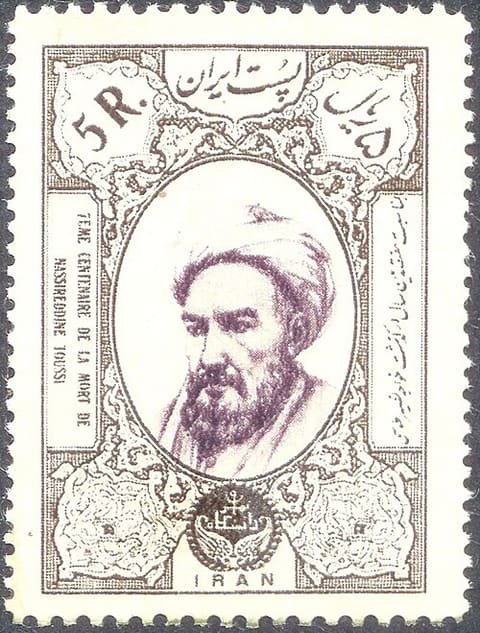
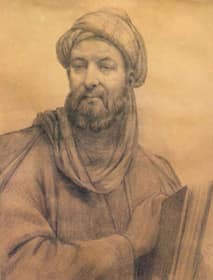
Khwaja Nasir al-Din Tusi worked for the Nizari Isma'ilis in Quhistan and Alamut, then for the Mongol Ilkhans, under whom he founded the observatory at Maragha. His commentary on Ibn Sina's Pointers and Reminders answered Fakhr al-Din al-Razi's objections and set the terms in which Ibn Sina was read thereafter; his Abstract of Belief built Twelver Shi'i theology on philosophical premises; his Nasirean Ethics joined Miskawayh's ethics, household management and al-Farabi's politics in Persian.
Central question
Can Ibn Sina's philosophy be defended against its theological critics, and how does it stand to a theology built by demonstration?
Wrote in Arabic and Persian. The Commentary on the Pointers is cited by namaṭ (chapter) of Ibn Sina's text; the Abstract of Belief by maqṣad (part); the Nasirean Ethics by discourse (maqāla); the Foundation of Inference by maqāla. The Commentary expounds Ibn Sina and the Abstract states Twelver theology, so positions name the work in `period` where the two differ. Works of his Isma'ili period are partly of disputed attribution. No text or translation is held in Hekmat.
Stated in the text 1
Scholarly consensus 13
Contested reading 6
3 arguments8 works0 quotations checked word for word0 of 23 positions and arguments reviewed by an expert
Answers 20 of 20 questions
Metaphysics
›Being and realityGod as being itself
Tusi keeps Ibn Sina's division of the existent into the necessary in itself and the possible in itself. Existence is one concept said of everything in the same sense, and in every possible being it is other than what the thing is; only in the Necessary Existent is there no quiddity besides existence.
Scholarly consensusThe Abstract of Belief; the Commentary on the Pointerswujūd, māhiyya, wājib al-wujūd, mumkin al-wujūd, ishtirāk maʿnawīDraft — not yet reviewed
The Abstract opens with existence: that it is self-evident, univocal and added to quiddity in the mind. Later Shi'i philosophy, Mulla Sadra included, read these theses through its commentaries.
›UniversalsModerate realism
A nature taken in itself is neither universal nor particular. As a universal it exists only in the mind; the nature exists outside only in its individuals. Tusi restates Ibn Sina's three ways of considering a quiddity.
The Abstract proves God in a single step: if what exists is necessary, that is what was sought; if it is possible, it needs a cause, and since circular and infinite chains of causes are impossible, the chain ends in a necessary existent. In the Commentary he defends Ibn Sina's proof from existence itself, which needs no premise about motion or the world.
Stated in the textThe Abstract of Belief; the Commentary on the Pointerswājib al-wujūd, mumkin, dawr, tasalsul, burhān al-ṣiddīqīnDraft — not yet reviewed
The rational soul is an immaterial substance, not a body or a power in a body, since it knows universals and itself, which no bodily organ can do. It comes to be with its body and governs it.
Scholarly consensusnafs nāṭiqa, jawhar mujarrad, tadbīrDraft — not yet reviewed
The rational soul survives the body. In the Abstract he also affirms the bodily resurrection taught by revelation, arguing that God can bring back what perished, and the Beginning and the End describes the soul's return and its reward or punishment as the soul's own states.
Scholarly consensusmaʿād, maʿād jismānī, iʿāda al-maʿdūmDraft — not yet reviewed
Where Ibn Sina accepts bodily resurrection on the authority of revelation, the Abstract argues for its possibility in the theologians' way.
›The cosmosCreated from nothing, with time* (contested reading)
In the Abstract, God is an agent who acts by choice, and the world, every body in it, is originated in time. As commentator on the Pointers he expounds and defends Ibn Sina's eternal production of the world, without saying it is his own view.
Another reading. Read from the Commentary and his philosophical correspondence, his considered view stays Ibn Sina's: the world proceeds eternally from the First, and the Abstract's origination is the theologians' register.
Contested readingThe Abstract of Belief (kalām); the Commentary on the Pointers (exposition of Ibn Sina)ḥudūth, qidam, mukhtār, mūjibDraft — not yet reviewed
›Freedom and determinismFree and determined* (contested reading)
Against the Ash'arites, our acts are ours: we know by necessity that they depend on our power and will, and God's justice in reward and punishment requires it. That an act follows necessarily once the motive is present does not take away the agent's power.
Another reading. In the Twelver tradition the Abstract is read as giving the agent power over both doing and not doing, which responsibility requires, so the view is libertarian.
Contested readingThe Abstract of Beliefikhtiyār, qudra, dāʿī, ʿadl, jabrDraft — not yet reviewed
What is possible in itself exists only when its cause makes it necessary, and a complete cause cannot fail to produce its effect. The effect needs its cause as long as it exists, because possibility, not origination, is what calls for a cause. Defending Ibn Sina against al-Razi, he holds that a single simple cause, as such, produces only one effect, so multiplicity enters the world through the aspects of the first effect.
Another reading. In the Abstract God is an agent who acts by choice and could have done otherwise, while created causes keep their efficacy, which is the theologians' version of the same causal rules.
Contested readingThe Commentary on the Pointers; the Abstract of Beliefal-ʿilla al-tāmma, wujūb bi-l-ghayr, imkān, al-wāḥid lā yaṣdur ʿanhu illā l-wāḥidDraft — not yet reviewed
The rule that a thing is not until it is necessitated holds in both works; they differ on whether the First necessitates the world or chooses it (see ont.cosmos).
Epistemology
›Sources of knowledgeIllumination from a higher intellect · Experience, completed by intellect* (contested reading)
Tusi follows Ibn Sina: the senses and imagination prepare the soul, the intellect abstracts and composes, and the intelligible forms come to a prepared soul from the Active Intellect. His Commentary keeps both halves of the account, the soul's work on what the senses give and the reception from above.
Another reading. As for Ibn Sina, emanation can be read as a metaphysical description of what, in cognitive terms, is abstraction by the human intellect, so only `experience-then-intellect` applies.
Contested readingal-ʿaql al-faʿʿāl, tajrīd, istiʿdād, ḥadsDraft — not yet reviewed
The dispute over Ibn Sina (Gutas, Hasse, McGinnis) carries over to the commentator; nothing found here sets Tusi apart from his master on this question.
›Epistemic justificationDemonstration from first principles
Knowledge in the full sense is certainty reached by demonstration from primary, necessary premises. The Foundation of Inference sorts premises by their warrant, primary, observed, experiential, widely accepted and the rest, and so by which art (demonstration, dialectic, rhetoric, poetics) can use them.
Scholarly consensusburhān, yaqīn, awwaliyyāt, mujarrabāt, mashhūrātDraft — not yet reviewed
Knowledge by presence, which Tusi applies to the self's knowledge of itself and to the First's knowledge of its effects, answers how one knows, not what justifies a claim, so `presence` is not added.
›Innate knowledgeNo innate contents
The human intellect starts as a material intellect, a bare potency for intelligibles, and passes through the intellect in habit and in act to the acquired intellect; the first principles come to it without learning but are not there from birth.
Later authors report that Tusi identified "how things are in themselves" with the separate intellect, which would add a `being-itself` element; that report is not checked here.
›Certainty, doubt and the limits of knowledgeYes
Certainty is attainable: demonstration from primary premises gives knowledge that cannot be otherwise, and his logic separates it from the lesser assent that dialectic, rhetoric and poetry produce.
Scholarly consensusyaqīn, burhān, taṣdīqDraft — not yet reviewed
Happiness is the perfection of the rational soul. Its higher power perfects itself in knowledge of the true order of existence and its practical power in ordering the soul and its acts, and the highest rank is reached by one whose knowledge and acts both become wholly turned toward God.
Another reading. The Nasirean Ethics makes happiness need both theoretical and practical perfection, with the virtues constituting the practical half, so the virtue-centred reading fits as well.
Discourse I follows Miskawayh's Refinement of Character closely; how far its ranking of happiness is Tusi's own is part of the reading.
›The basis of moralityVirtue
A good act comes from a settled good character, and a good character keeps the mean set by practical wisdom among the powers of the soul: wisdom, courage and temperance, with justice as their sum.
In the Abstract of Belief he also holds, with the Mu'tazila and against the Ash'arites, that some acts are good or evil in themselves and known to be so by reason, before any command. In the Commentary on the Pointers he expounds Ibn Sina, for whom "justice is good" is a widely accepted premise, not a truth of reason. The two registers are not reconciled in the works cited.
›Virtue and knowledgeKnowledge plus habituation
Character is a disposition of the soul from which acts come without deliberation. Some of it is natural, but all of it can be changed by habit and training, so knowing the good is not enough; ethics is the art of acquiring good dispositions and curing bad ones.
›JusticeOrder of the soul · Proportional and corrective equality · Justice laid down by a prophet-lawgiver
Justice is the most perfect virtue: in the soul it arises when wisdom, courage and temperance are in balance; between people it is equality and proportion in exchange and distribution. Equality is kept by three regulators, the divine law (the greatest nāmūs), the just ruler, and money, and the law that orders human association rests on a lawgiver who is divinely guided.
The account follows Miskawayh, who takes the three regulators and the equality of exchange from Aristotle's Nicomachean Ethics V, and al-Farabi for the city.
›The state and legitimacyRule by the wise* (contested reading)
People are political by nature and need a regulation of their association. The best regulation is by a law from a divinely guided lawgiver and by a ruler who is king in truth because of his wisdom; Discourse III describes the virtuous city and its ruler in al-Farabi's terms.
Another reading. In the Abstract of Belief the imam's authority rests on God's designation and on his infallibility, which divine grace requires, not on wisdom; no shared stance captures that ground.
Contested readingThe Nasirean Ethics; the Abstract of Beliefsiyāsat, malik ʿalā l-ḥaqīqa, ṣāḥib-i nāmūs, madīna-yi fāḍilaDraft — not yet reviewed
The Ethics was first written for the Isma'ili governor of Quhistan, and its preface was rewritten after the Mongol conquest; the ruler of Discourse III fits either patron.
›Beauty and artValuable imitation
Poetry is imaginative speech: it works by imitation and moves the soul to accept or reject by the images it raises, not by proof. The logician treats this imaginative power as what makes speech poetic; metre and rhyme are what the prosodist adds.
Scholarly consensusshiʿr, kalām mukhayyal, takhyīl, muḥākātDraft — not yet reviewed
As for Ibn Sina, poetics belongs to logic; Tusi does not treat beauty or the visual arts in the works cited.
›The nature of valueGood convertible with being
Existence is good and evil is a lack of existence or of a perfection; the Necessary Existent is pure good. In the Abstract he adds that good and evil in acts are known by reason and do not depend on God's command, so God does only what is good.
Scholarly consensusThe Commentary on the Pointers; the Abstract of Beliefkhayr, sharr, ʿadam, al-ḥusn wa-l-qubḥ al-ʿaqliyyānDraft — not yet reviewed
He rejects the Ash'arite view that acts are good only because God commands them (`divine-will`).
* contested reading · open a row for the explanation and its sources
Method روش و شیوه اندیشهورزی فلسفی
Tusi works mostly through other people's books. He comments on Ibn Sina line by line and answers his critics, digests and corrects the theologians' summae, and recasts Arabic models of logic and ethics as Persian handbooks. His own thought shows in how he restates, compresses and adjudicates, and in a few places where he sets his view beside the text he explains.
Posing questions
A question usually comes to him already posed by a text: a chapter of the Pointers, an objection of al-Razi, a thesis of al-Shahrastani or of al-Razi's Compendium. He states what the author meant, then what the objector said, and decides between them. In the Abstract of Belief he poses theology's questions himself but in the order of philosophy, starting from existence and its divisions before reaching God, prophecy, the imamate and the return.
His standard is demonstration as the Peripatetic logic defines it, and the Foundation of Inference sets out that logic in Persian, with each kind of premise matched to the art that may use it. In the Abstract the arguments are compressed to a few words each, often a single conditional with its grounds, which later commentators had to unfold.
Critique is his main genre. Against al-Razi's commentary on the Pointers he argues that al-Razi misread Ibn Sina or raised objections that do not touch the doctrine; against al-Shahrastani's attack on Ibn Sina he answers point by point; in the Digest he summarises al-Razi's theology and notes where it fails. He also corrects Ibn Sina, most clearly on how the First knows what it causes.
Reason, disciplined by logic, does the work, and revelation sets the questions theology must answer. In his Isma'ili works and the Beginning and the End he gives a place to the teaching of a guide and to the soul's own states, and in the Commentary he expounds Ibn Sina's chapters on the knowers without endorsing or dismissing them.
Exact and economical. The Arabic Abstract is famously terse; the Commentary is patient and close to the text; the Persian works, the Ethics and the Foundation of Inference among them, are clear handbooks that name their models and adapt them, Miskawayh for ethics and al-Farabi for politics. In the Commentary he undertakes to explain Ibn Sina rather than to give his own view.
›From the one only one proceedsThe multiplicity of the world does not come straight from the One; it enters through the aspects of the first effect, and Ibn Sina's principle stands.
1A cause produces a given effect through something in it by which it is the cause of that effect and not of another.
2If one cause produced two effects, that by which it produces the first would differ from that by which it produces the second.
3Then the cause would contain two different aspects, and so would not be simple.
4The First is simple in every respect.
5So the First, as such, produces one effect only, the first intellect.
6The first intellect has more than one aspect, being necessary through its cause, possible in itself and knowing its cause, and through these aspects a plurality of effects can proceed from it.
∴The multiplicity of the world does not come straight from the One; it enters through the aspects of the first effect, and Ibn Sina's principle stands.
fakhr-al-din-razi objects. "Producing" is a relation between cause and effect, and a simple thing can stand in many relations without becoming many in itself, as a point is the end of many lines. So nothing stops one simple cause from producing many effects. Tusi answers that the principle concerns not the relation but the state of the cause by which it gives this effect rather than that.
al-Ghazali objects. (Earlier and independent.) The philosophers' account of how multiplicity comes from the aspects of the first intellect is arbitrary, and the same reasoning would make every intellect produce the heavens it is said to produce or none.
›The proof of the Necessary Existent in one stepA necessary existent exists. The proof starts from existence as such, not from motion or from the world's having begun, which is the form Ibn Sina's Pointers had given it and Tusi defends.
1Something exists.
2Whatever exists is either necessary in itself or possible in itself.
3If it is necessary in itself, a necessary existent exists.
4If it is possible in itself, it exists only through a cause that makes it necessary.
5The chain of such causes can neither go round in a circle nor go on without end.
6So the chain ends in something that is necessary in itself.
∴A necessary existent exists. The proof starts from existence as such, not from motion or from the world's having begun, which is the form Ibn Sina's Pointers had given it and Tusi defends.
Immanuel Kant objects. (Applied; Kant does not discuss Tusi.) The argument from contingency passes from the existence of something to a necessary being and so rests on the ontological argument, since only the concept of a most real being could tell us which being is necessary.
›The First's knowledge of things by their presenceThe First knows its effect, and everything else through the forms in the intellects, by their presence to it, without forms inhering in its essence. Its knowledge does not make it many or receptive. In the Commentary Tusi gives this as his own view, setting it beside Ibn Sina's.
1Ibn Sina holds that the First knows things through their forms, which are in its essence; al-Razi objects that the First would then receive what it causes and contain a multiplicity.
2A knower need not have a further form of what it knows. The soul knows itself without a form of itself, and it knows the forms it produces in itself without further forms of those forms.
3What is made by a knowing cause, and is wholly from it, is present to that cause as the soul's own forms are present to the soul.
4The first intellect, the First's effect, is so present to the First; the forms of other things exist in the intellects, which are present to it.
∴The First knows its effect, and everything else through the forms in the intellects, by their presence to it, without forms inhering in its essence. Its knowledge does not make it many or receptive. In the Commentary Tusi gives this as his own view, setting it beside Ibn Sina's.
Mulla Sadra objects. On this view the First knows things only as they exist, and so after them in the order of being; its knowledge of things before their creation is not explained. Sadra holds instead that the First, as simple existence, contains all things in its essence and knows them there.
from the one only one proceedsA cause that is one and simple in every respect produces, as such, only one effect, since producing two would require two aspects in it. Tusi defends the rule against al-Razi and lets multiplicity enter through the aspects of the first effect.1 link to other thinkers →
knowledge by presenceKnowing a thing by its presence to the knower, without a form of it. Tusi uses the soul's knowledge of itself and of its own forms as the model for the First's knowledge of what it causes.2 links to other thinkers →
rational good and evilSome acts are good or evil in themselves, and reason knows them as such before any command: justice is good and wrongdoing evil whether or not God commands them, and God does no evil.
law · regulatorWhat keeps equality among people. The divine law is the greatest nāmūs, the just ruler the second, and money the third, which measures unequal goods against one another in exchange.
political by natureHuman beings cannot live or reach perfection alone; they need cooperation, and so a city with a law and a ruler to regulate it.1 link to other thinkers →
imaginative speechWhat makes speech poetic for the logician: it moves the soul by the images it raises, not by proof. Metre and rhyme are what the prosodist adds to it.1 link to other thinkers →