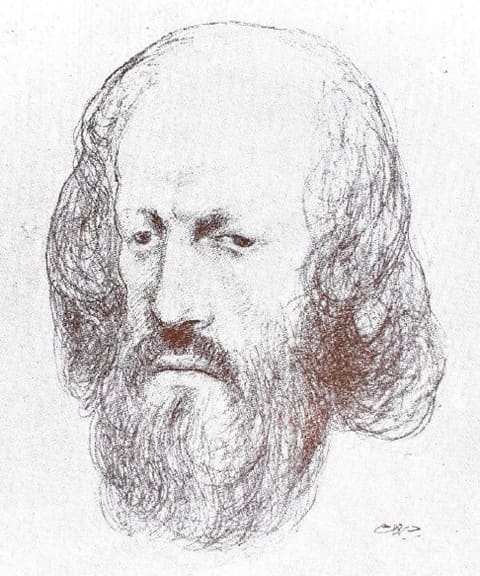
Medieval Islamic · 11th c.
al-Ghazali
غزالی1058–1111Ashʿarism (Ashʿarī kalām)Sufism
Al-Ghazali mastered the philosophers' sciences and argued in the Incoherence of the Philosophers that their metaphysics fails its own standard of demonstration, judging three of its doctrines unbelief. He kept their logic and much of their psychology, denied that causes necessitate their effects, and after a period of doubt and a later crisis turned to the Sufi way, which his Revival of the Religious Sciences sets out for the whole of religious life.
- Central question
- What can reason establish about God and the world, and where must it give way to revelation and to knowledge by experience of God?
- Method
- Al-Ghazali writes in several registers, and his method changes with them: in the Incoherence he refutes the philosophers on their own standard of demonstration without asserting a doctrine, in his kalām he argues for the creed, and in the Deliverance and the Revival he describes a knowledge reached by "tasting" in the Sufi path. How al-Ghazali works
al-iqtirān / al-ʿāda concomitanceal-irāda al-qadīma the eternal willal-yaqīn certaintyal-dhawq tastingal-qalb the heart
Writes in several registers. The Incoherence argues against the philosophers without asserting his own doctrine; Moderation in Belief gives his kalām; the Revival, Deliverance from Error and the Niche of Lights state his own views. Several works attributed to him are disputed. Positions name the layer in `period`.
- Stated in the text 3
- Scholarly consensus 15
- Contested reading 2
Answers 20 of 20 questions
Epistemology
Sources of knowledgeIllumination from a higher intellect
Sense and reason give knowledge in their domains, but the highest knowledge, of God and the soul's states, comes as light that God casts into the heart once it is cleansed. It reaches the Sufis by tasting (dhawq) and the prophets by revelation, beyond what the intellect reaches by learning.
Deliverance from Error on the ways of the Sufis · The Revival of the Religious Sciences Book 21
Learning and inspiration are two routes to the same knowledge: one by study, from the senses upward, the other from within, as a mirror takes images once polished. His account of inspired knowledge is built on Ibn Sina's psychology of the prophetic soul (Treiger, Inspired Knowledge in Islamic Thought, 2012).
Certainty, doubt and the limits of knowledgeYes
Certainty is knowledge in which no doubt remains and none is possible, so firm that a miracle against it would not shake it. After doubting the senses and the first principles of reason themselves, he regained trust in the principles not by argument but by a light from God.
Deliverance from Error introduction; on sophistry and scepticism
The doubt is told as a crisis of some two months, ended by God rather than by method; the parallel with Descartes' First Meditation is a modern comparison.
Innate knowledgeNo innate contents
The intellect is first a natural disposition (gharīza) by which humans can receive theoretical knowledge; necessary truths, such as that two exceed one, appear in the child at the age of discernment, and the rest is acquired by experience and learning.
The Revival of the Religious Sciences Book 1
He also speaks of the human disposition (fiṭra) to know God and, in Book 21, of the heart as holding the realities of things potentially, as a mirror holds images; both border on innate knowledge, held as capacity rather than content.
TruthTruth as a feature of being
God is the Real (al-Ḥaqq): he alone exists through himself, and everything else, taken in itself, is unreal and is real only through him. Truth belongs first to that being and to the light by which things are disclosed.
In his logic (Standard of Knowledge) he keeps the Aristotelian account of true and false judgment; that statement-level truth is not coded here.
Epistemic justificationDemonstration from first principles · A light from a higher source
Certain knowledge is that in which the known is disclosed so that no doubt remains with it, not even the possibility of error, and no miracle against it could shake it. Testing his beliefs by this standard he lost trust in the senses and then in the necessary truths of reason, and regained it not by an ordered proof but by a light God cast into his breast. He keeps the philosophers' logic and judges their metaphysics by its own standard of demonstration, which it fails; above reason, tasting (dhawq) gives the Sufis what learning cannot.
Deliverance from Error introduction; on sophistry and scepticism · The Standard of Knowledge whole work · The Incoherence of the Philosophers Preface and introductions · Deliverance from Error on the ways of the Sufis
The light restores trust in the first principles; it does not replace demonstration, which stays the test of every philosophical claim. Inherited belief (taqlīd) is what the Deliverance sets out to leave behind. Tasting is a higher, experiential knowing that `presence` would catch only in part.
Axiology
The highest goodUnion with God
The highest good is love of God and, in the hereafter, the vision of him, the greatest of all pleasures; in this life it is anticipated in the knowledge and intimacy of those who love him.
The basis of moralityVirtue · Ordered love
Good character is a settled state of the soul from which good acts flow easily, a balance of its powers under reason and the Law; an act's worth before God depends on the intention behind it, and its highest form is love of God.
The Revival of the Religious Sciences Book 22 · The Revival of the Religious Sciences Book 37
As an Ashʿarite jurist he holds that acts are obligatory or forbidden only by the revealed Law, not by reason; no option names divine command, so that thesis stays here.
Virtue and knowledgeKnowledge plus habituation
Character can be changed: good traits are acquired by practice and discipline of the soul until they become second nature. Knowledge produces a state of the heart, and the state produces action; knowledge alone is not enough.
The Revival of the Religious Sciences Book 22 · The Revival of the Religious Sciences Book 32 · Deliverance from Error on the ways of the Sufis
Deliverance recounts that he knew the Sufi way in theory but could not leave his post until God made it easy for him, which has the shape of `grace-needed`; the Revival's account of discipline is the general doctrine coded.
The state and legitimacyTwo cities (contested reading)
Worldly order matters as a means: religion needs security of life and livelihood, which needs an obeyed ruler. The legitimate order is the caliphate (imāma) under the revealed Law, backed by the sultan's power.
Another reading. He answers the question within the revealed Law: the best order is the caliphate sustained by the sultan, which no option names, and his accommodation of sultanic power is pragmatic rather than a view of politics as secondary (Lambton, State and Government in Medieval Islam, 1981; Hillenbrand, "Islamic Orthodoxy or Realpolitik?", 1988).
Moderation in Belief Treatise IV · The Revival of the Religious Sciences Book 1
`two-cities` captures the ordering of worldly rule to the hereafter, not a doctrine of two cities.
Beauty and artBeauty as ascent
Beauty is loved for its own sake, and inner beauty, perceived by the heart, is greater than outward beauty; since all beauty is God's, love of the beautiful leads to love of him. Listening to music and poetry is lawful and stirs whatever is in the heart, the love of God included.
The Revival of the Religious Sciences Book 36 · The Revival of the Religious Sciences Book 18
JusticeOrder of the soul · Justice laid down by a prophet-lawgiver
In the soul, justice is the virtue by which anger and appetite are kept under the direction of wisdom and the Law, the balance from which good character flows. What is just or unjust in acts, however, is not known by reason apart from revelation: obligation and prohibition come from the Law. Injustice is disposing of what belongs to another, so nothing God does can be unjust, since everything is His.
The Revival of the Religious Sciences Book 22 · Moderation in Belief Treatise III
`revealed-law` fits the Ashʿarite thesis that the Law, not reason, makes acts just or obligatory; the Revival's psychology is close to Ibn Sina's and Miskawayh's.
The nature of valueDivine will
"Good" and "bad" said of acts mean only that they agree or disagree with an agent's purposes, so they vary between people; what is obligatory or forbidden is known only from the revealed Law, not from reason. Since nothing is bad relative to God, he does no wrong whatever he does, and he is under no obligation to do what is best for his creatures.
Moderation in Belief Treatise III
The Revival describes good character as the soul's health in largely Aristotelian terms (Book 22), which concerns virtue, not what grounds value. His fullest treatment of good and bad is in al-Mustaṣfā, not yet in works.yaml.
contested reading · open a row for the explanation and its sources
Method روش و شیوه اندیشهورزی فلسفی
Al-Ghazali writes in several registers, and his method changes with them: in the Incoherence he refutes the philosophers on their own standard of demonstration without asserting a doctrine, in his kalām he argues for the creed, and in the Deliverance and the Revival he describes a knowledge reached by "tasting" in the Sufi path. Logic he keeps and teaches throughout.
- Posing questions
Al-Ghazali poses questions by first asking which kind of knowledge could settle them and who is entitled to speak. The Deliverance frames his life as a search for certain knowledge, in which the known is disclosed so that no doubt remains, and then examines in turn the claims of the theologians, the philosophers, the Ismaʿili authoritarians and the Sufis. In the Incoherence he narrows the question to whether the philosophers have demonstrated what they claim in metaphysics.
Deliverance from Error introduction; on sophistry and scepticism · Deliverance from Error on philosophy · The Incoherence of the Philosophers Preface and introductions
- Arguing and justifying
The Incoherence argues from premises the philosophers accept, or from whichever theological school serves the refutation, to show that their proofs are not demonstrative: the author writes as one who refutes, not as one who establishes. Its most famous move, in the Seventeenth Discussion, denies that the connection between what is customarily taken as cause and effect is necessary. Elsewhere he uses Aristotelian logic constructively, restating it in the Standard of Knowledge in plainer terms and urging its use in law and theology, and in his kalām he argues for the creed by syllogism.
The Incoherence of the Philosophers Preface and introductions · The Incoherence of the Philosophers Seventeenth Discussion · The Standard of Knowledge whole work · Moderation in Belief Treatise I
- Criticising rival views
He holds that one must master a science before refuting it, so he first set out the philosophers' doctrines and only then attacked them. He sorts their teachings: mathematics and logic are sound and not to be rejected, much of physics is harmless, and the errors lie in metaphysics, three of which, the eternity of the world, God's not knowing particulars and the denial of bodily resurrection, he judges to be unbelief. Kalām, in turn, is judged useful for defending the creed but unable to give certainty, since it argues from its opponents' premises.
Deliverance from Error on philosophy · The Incoherence of the Philosophers Conclusion · The Incoherence of the Philosophers Twentieth Discussion · Deliverance from Error on kalām
- Reason, experience and other ways of knowing
In the Deliverance doubt first strikes the senses, which reason corrects, and then reason itself, since a higher judge might expose it as dreams are exposed on waking. The doubt does not end by argument but by a light God cast into his breast, which restored trust in the necessary truths of reason. Beyond reason he places tasting (dhawq), knowledge by experience of a state, which differs from knowing its definition as being drunk differs from knowing what drunkenness is, and beyond that the prophetic faculty. Reason stays a judge in its own domain; the Niche of Lights calls intellect a light.
Deliverance from Error on sophistry and scepticism · Deliverance from Error on the ways of the Sufis · Deliverance from Error on the true nature of prophecy · The Niche of Lights Part I
- Language and style
He adapts form to audience: a summary of the philosophers' views written as preparation for their refutation, polemical discussions, logic manuals, a creed with proofs, a vast four-part work on the religious sciences, and an autobiographical account of his search that is shaped as an argument as much as a memoir. In the Niche of Lights he interprets a Quranic verse through symbols of light. He often warns that some knowledge should not be written down for those unable to bear it.
Deliverance from Error introduction; on sophistry and scepticism · The Revival of the Religious Sciences Book 1 · The Niche of Lights Part I
- Across the works
- The Incoherence of the Philosophers, The Standard of KnowledgeThe works of about 1095 against the philosophers: refutation on their own terms, with logic taught separately as a tool to keep.The Incoherence of the Philosophers Preface and introductions
- Moderation in BeliefAshʿarite kalām: a reasoned defence of the creed, written at about the same time, that asserts what the Incoherence only defended.Moderation in Belief Treatise I
- The Revival of the Religious Sciences, The Niche of Lights, Deliverance from ErrorThe works after his withdrawal from teaching state his own views from within the Sufi path: the Revival reorganises the religious sciences around the heart, the Niche of Lights reads light symbolism, and the Deliverance tells the search as moving from doubt to certainty by taste.The Revival of the Religious Sciences Book 21 · Deliverance from Error on the ways of the Sufis
yaqīn, tahāfut, ilzām, burhān, manṭiq, shakk, dhawq, nūr, kashf, taqlīd
Arguments
Certainty restored by a light from GodTrust in the first principles cannot be restored by argument. It was restored to him by a light that God cast into his breast, which is the key to most knowledge, and the higher stage beyond reason is reached by the Sufis' tasting.
- 1Certain knowledge is knowledge that leaves no room for doubt and none for error; only such knowledge is worth seeking.
- 2The senses cannot give it, since reason corrects them, as when the shadow seems still and the star small.
- 3Reason may itself be corrected by a judge above it, as waking corrects what seemed certain in dreams; the Sufis claim states in which what reason holds is seen otherwise, and death may be such a waking.
- 4No proof can answer this doubt, since every proof is built from the first principles of reason, which are what is in doubt.
- ∴Trust in the first principles cannot be restored by argument. It was restored to him by a light that God cast into his breast, which is the key to most knowledge, and the higher stage beyond reason is reached by the Sufis' tasting.
Ibn Rushd objects. (Applied; Ibn Rushd does not discuss Deliverance.) The Law itself commands reflection by demonstration, and demonstration from first principles is the way to certainty for those able to follow it; making certainty depend on a light given to some is to abandon the method the Law calls for.
dialectical · Deliverance from Error on sophistry and scepticism · Deliverance from Error on the ways of the Sufis
Draft — not yet reviewed
Key terms
All key terms →- الاقتران / العادةal-iqtirān / al-ʿāda
- concomitance · connection; custom · habitWhat we call cause and effect is only things occurring together, which God creates in a regular order by his custom. The connection is not necessary, so God can create one without the other, as in miracles.1 link to other thinkers →
- الإرادة القديمةal-irāda al-qadīma
- the eternal willGod's will, which from eternity decides that the world begin at the moment it does. To single out one of two equal possibilities is what will is, so an eternal will can produce a world that begins.2 links to other thinkers →
- اليقينal-yaqīn
- certainty · certain knowledgeKnowledge in which what is known is disclosed so that no doubt remains and none is possible, and no wonder worked against it could shake it. He found that sense and reason could not secure it by themselves.
- الذوقal-dhawq
- tasting · direct experienceKnowing a state by being in it, as knowing drunkenness by being drunk rather than by its definition. It is the Sufis' way to what lies beyond the intellect and a token of prophecy.
- القلبal-qalb
- the heartIn its inner sense, a subtle spiritual reality that is the true self: it knows, perceives and is addressed by God, and rules the body as a king his realm. Like a mirror, once polished it can receive the realities of things.1 link to other thinkers →
- النورal-nūr
- lightWhat is manifest in itself and makes other things manifest. In the true sense it is God, from whom every lesser light, of sight, of intellect and of prophecy, is borrowed.1 link to other thinkers →
- المحبةal-maḥabba
- loveThe inclination to what gives pleasure, whether through the senses or through the heart's perception of inner beauty. Since all beauty and goodness are God's, he alone deserves love fully, and seeing him is the greatest pleasure.
Relations
Open in the network →Shaped by
Works
- The Incoherence of the PhilosophersOnline · 3Tahafut al-falasifa · 1095
- The Standard of KnowledgeMiyar al-ilm · c. 1095
- Moderation in Beliefal-Iqtisad fi l-itiqad · c. 1095
- The Revival of the Religious SciencesIhya ulum al-din · after 1095
- The Niche of LightsMishkat al-anwar
- Deliverance from Erroral-Munqidh min al-dalal · after 1106
How to cite
Hekmat. "al-Ghazali." Draft, awaiting review; last updated 20 October 2026. https://hekmat.local/thinkers/al-ghazali/