Augustine fused Platonist philosophy with Christian faith. Truth is found by turning inward and upward to God, evil is a privation of good, and history is the story of two cities defined by two loves.
Central question
How can a restless, divided human will find rest in God?
Method
Augustine seeks God and the soul by turning inward and then upward, and by reading scripture under rules he sets out for it. How Augustine of Hippo works ↓
2 arguments12 works0 quotations checked word for word0 of 22 positions and arguments reviewed by an expert
Answers 20 of 20 questions
Metaphysics
›Being and realityGod as being itself
What truly is, is God, who alone is unchangeably and therefore supremely; everything else exists only because God gave it being, more to some things and less to others.
Scholarly consensusesse, essentia, ego sum qui sum, incommutabilisDraft — not yet reviewed
Augustine's idiom is immutability ("He who is"), not the later identity of essence and existence; the option fits his thesis, not his vocabulary.
›UniversalsRealism before things
The forms by which things are what they are are eternal, unchanging reasons in the mind of God, after which everything that comes to be is made; this is how Augustine accepts Plato's Ideas.
Stated in the textideae, rationes, formaeDraft — not yet reviewed
›God and the fundamentalDemonstrable; revelation adds more
Reason can show that God exists, since there is an unchanging truth above our minds which must be God or lead to God; but the Word made flesh, the way to God, is known only from revelation, and we believe in order to understand.
Scholarly consensuscrede ut intellegas, veritas, Verbum caro factumDraft — not yet reviewed
The proof is offered within faith seeking understanding (De libero arbitrio II.2.6, citing Isaiah 7:9), not as a neutral starting point.
›Soul and bodySeparable soul
The soul is an incorporeal substance endowed with reason and fitted to rule the body; the mind knows itself with certainty and does not know itself as air or fire, so it is none of these.
Scholarly consensusanima, mens, substantia rationis particepsDraft — not yet reviewed
God made the world from nothing, and made time with it, so the world was made not in time but with time; to ask what God did before is to misunderstand eternity.
Stated in the textcreatio ex nihilo, cum tempore, aeternitasDraft — not yet reviewed
›Freedom and determinismFree and determined* (contested reading)
The mature Augustine holds that grace and predestination settle whether the will turns to the good, yet the will remains our own and we act willingly; freedom in its full sense is the will freed by grace to love the good. Foreknowledge, by contrast, he denies necessitates anything.
Across the works. On Free Choice of the Will (III.1–3) makes sin depend wholly on the will's own movement, which is not caused by its nature or by God, and argues that God's foreknowledge does not necessitate it (III.2.4–4.11). Harrison (2006), and Augustine himself (Retractations I.9; I.8 in older numbering), deny a break between this and the later theology of grace.
Another reading. Stump (2001) resists the compatibilist reading of the late works defended by Couenhoven (2007): grace restores the will rather than determining it, so a libertarian element survives.
Contested readingfrom To Simplician (396), developed in the anti-Pelagian worksliberum arbitrium, libertas, gratia, praedestinatioDraft — not yet reviewed
God's will is the cause of all things, a cause that makes and is not made; created spirits are causes that are also made, and bodies are less causes than instruments of wills. God placed in creation hidden causal reasons from which kinds unfold in time, and governs all continuously. An order of causes exists, and our wills are within it, but foreknowledge does not make what it foresees necessary.
Scholarly consensusCity of God V and XII; On the Trinity III; Literal Commentary on Genesisvoluntas Dei, ordo causarum, rationes causales, rationes seminales, providentia, miraculumDraft — not yet reviewed
The option fits with a caveat: only wills are efficient causes in the full sense (City of God V.9), so bodily causes are instruments, which comes close to the later doctrine that God alone acts in bodies. A miracle is not against nature but against nature as we know it (XXI.8).
Epistemology
›Sources of knowledgeIllumination from a higher intellect
Unchanging truths cannot come from the changing senses or from a human teacher, whose words only prompt us to look; we see them in an inner light, Christ the Truth dwelling in the mind, as the eye sees by the sun.
Stated in the textilluminatio, magister interior, veritas, luxDraft — not yet reviewed
How illumination works is disputed: ontologist readings (vision in God), Thomist ones (God gives only the intellect's light), Franciscan ones (a special divine concurrence in certain judgment) and formal ones (God supplies the forms by which the mind judges, not its contents), surveyed in Nash, The Light of the Mind (1969). The stance holds on every reading.
›Certainty, doubt and the limits of knowledgeYes
The Academic sceptics are wrong that nothing can be known: I know that I exist, live and understand, since even if I am deceived I must exist to be deceived, and truths of number and of logic are equally beyond doubt.
Stated in the textsi fallor sum, Academici, certitudoDraft — not yet reviewed
Memory holds the truths of number and the liberal disciplines, which did not enter through the senses but were already there, hidden, until learning drew them out.
Another reading. Augustine's considered view replaces innateness with illumination: On the Trinity XII.15.24 rejects recollection and holds that intelligible truths are seen in the divine light whenever we understand them, not stored in the soul.
Across the works. Early works entertain Platonic recollection (On the Greatness of the Soul 20.34), which On the Trinity XII.15.24 later rejects and the Retractations correct (I.4.4, I.8.2).
Contested readingmemoria, reminiscentia, abditumDraft — not yet reviewed
The refusal to explain such knowledge by a life before birth is not in Confessions X but in On the Trinity XII.15.24 and the Retractations' corrections of the early recollection passages.
›TruthTruth as a feature of being
Truth is not produced by our minds but stands above them, unchanging and common to all who reason; that Truth is God, and true statements and true things are true by sharing in it.
Stated in the textveritas, incommutabilis veritasDraft — not yet reviewed
›Epistemic justificationA light from a higher source · Trustworthy testimony or revelation
Against the Academics, some things are known beyond doubt: that I exist, live and understand, and truths of number and logic. Words and teachers only prompt; we judge what is true by consulting the truth that presides within the mind, an inner light from God. Much else we rightly hold on the testimony of others, and he refuses to deny that this is knowledge; believing on authority comes before understanding and leads to it.
Scholarly consensusContra Academicos (386); De magistro (389); De Trinitate (c. 400–420)illuminatio, veritas interior, credere, intellegere, testimonium, auctoritasDraft — not yet reviewed
Three warrants sit side by side and are not ranked by Augustine as a theory: self-evident certainties against the sceptic, the inner light by which any truth is judged, and authority for what we cannot see for ourselves. How illumination works is disputed (see his epi.source fit note); that it is the condition of certain judgment holds on every reading.
Axiology
›The highest goodUnion with God
The heart is restless until it rests in God; the supreme good is eternal life with God, joy in the Truth, which no virtue or good fortune in this life can secure.
Stated in the textbeatitudo, vita aeterna, gaudium de veritate, frui DeoDraft — not yet reviewed
An action is good when love is rightly ordered: God is to be enjoyed for his own sake and all else used or loved in relation to him, so virtue itself is the order of love.
Stated in the textordo amoris, uti, frui, caritasDraft — not yet reviewed
Augustine knew the good and still could not will it: the will is divided against itself and bound by habit, so knowledge does not make it good, and only grace heals it.
Stated in the textvoluntas, consuetudo, gratia, duae voluntatesDraft — not yet reviewed
Two loves make two cities, love of self to the contempt of God and love of God to the contempt of self; the earthly order secures a peace the heavenly city uses on its pilgrimage, but true justice exists in no earthly state.
Stated in the textcivitas Dei, civitas terrena, pax, duo amoresDraft — not yet reviewed
›Beauty and artBeauty as ascent · Suspect imitation
The beauty of creatures points beyond itself to the Beauty that made it, and should lead the soul up to God; but theatre and the beauties of human art can capture the soul with feigned passions and draw it away from its maker.
Scholarly consensuspulchritudo, spectacula, concupiscentia oculorumDraft — not yet reviewed
›JusticeRendering each their due · Order of the soul · Justice by nature
Justice is the virtue that gives each their due, and it begins with what is due to God: only a soul that serves God rules the body rightly, and only then does reason rightly rule the vices. Where that order is missing, in a person or a people, there is no true justice, and a kingdom without justice is a great band of robbers. Behind human law stands the eternal law, by which it is just that all things be perfectly ordered, and a law that is not just is not a law.
Scholarly consensusOn Free Choice I (388–395); City of God IV and XIX (413–426)iustitia, sua cuique distribuere, ordo, lex aeterna, lex temporalisDraft — not yet reviewed
The three options name three sides of one view: the classical definition (due-to-each), the right order of soul under God (order-of-soul) and the eternal law (natural-law). What is due is set by the order of love towards God, which none of the options names.
›The nature of valueGood convertible with being
Whatever is, is good as far as it is, because it is made by God, the highest and unchangeable good, who is good not by sharing in another good; evil is not a nature but a lack of good. Reason ranks things by their place in nature, living above lifeless and understanding above living, while need and pleasure price them otherwise, so that a horse may cost more than a slave; the order of nature, not that pricing, is the true one. The rules of wisdom, such as that the lesser is to be subordinated to the greater, are unchangeable and common to all who see them.
Scholarly consensussummum bonum, privatio boni, ordo naturae, ordo amoris, incommutabilis veritasDraft — not yet reviewed
Coded on the good (bonum). Augustine's own contrast between valuing by nature and pricing by use is the nearest he comes to the modern question, and he sides with the order of nature.
* contested reading · open a row for the explanation and its sources
Method روش و شیوه اندیشهورزی فلسفی
Augustine seeks God and the soul by turning inward and then upward, and by reading scripture under rules he sets out for it. He holds that belief comes before understanding and that reason then seeks to understand what is believed, and he writes in many forms: early philosophical dialogues, a confession addressed to God, exegesis and long polemical treatises.
Posing questions
Augustine's questions are about God and the soul, and they are posed from inside a life: in the Confessions as questions put to God about his own past, memory and time. He starts from what the questioner cannot doubt and from what is within, rather than from the outer world. He also frames questions from scripture, asking what a text means and how two passages that seem to conflict can both be true. On many points he begins from belief and asks how it can be understood.
Against the sceptics he finds truths that survive any doubt: if I am mistaken, I exist, since one who does not exist cannot be mistaken; and he also knows that he lives and understands. From such certainties he argues upward: reason judges by a truth it does not make and cannot change, so there is something above the mind, which is God. In the De Trinitate he looks for the image of the Trinity in the mind's remembering, understanding and willing itself, arguing from the created image to what it images.
He answers the Academic sceptics by showing that some things, such as disjunctions and how things appear to us, are known with certainty. He praises the Platonists as nearest to Christianity in their grasp of God as incorporeal and the source of truth, and faults them for pride and for refusing the mediator, as in his criticism of Porphyry's theurgy. He takes what is true from pagan learning as the Israelites took the Egyptians' gold, judging it by scripture. Later polemics against Manichaeans, Donatists and Pelagians argue from scripture, church practice and reason together.
Authority comes first in time and reason first in rank: belief in what is authoritatively taught leads to understanding of it. Reason looks inward and finds truth by an inner light, with Christ as the inner teacher, rather than receiving it through words or the senses. The senses give knowledge of bodies and are trusted in their place, but the ascent goes from bodies to the soul and from the soul to the unchanging truth above it. Love directs the whole search, and in the Confessions the ascent ends in a brief touching of wisdom, not a conclusion.
The early works are dialogues held with friends and family at Cassiciacum and after, recorded with their digressions. The Confessions are a prayer spoken to God in the reader's hearing, joining autobiography, philosophical inquiry and exegesis of Genesis. The later works are long treatises that argue with opponents, quote scripture constantly and interpret it under rules: what does not plainly concern faith or good morals is to be read figuratively, and an interpretation that builds up love of God and neighbour is not a harmful mistake.
On Eighty-Three Different Questions, To SimplicianShort answers to questions put to him, collected over years. In the reply to Simplician (396) his reading of Paul on grace changes his account of the will, and he later said that grace won there.To Simplician I.2
On the Trinity, City of GodThe great treatises of his maturity. The De Trinitate moves from scripture to an inquiry into the mind as image; the City of God sets Christian history against Roman religion and philosophy over twenty-two books.On the Trinity VIII–XV · City of God VIII–X
crede ut intellegas, si fallor sum, intellectus fidei, auctoritas et ratio, interior homo, magister interior, illuminatio, spolia Aegyptiorum
Arguments
›If I am deceived, I exist ("si fallor, sum")That I exist, know and love is certain and immune to sceptical doubt; and since the mind knows itself certainly while doubting whether it is air or fire, it is none of these.
1The Academic sceptic objects to every claim to knowledge that I may be deceived.
2Whoever does not exist cannot be deceived.
3So if I am deceived, I exist; the sceptic's objection itself presupposes my existence.
4Since I am certain that I exist, I am also certain that I know this, and that I love my existing and knowing.
∴That I exist, know and love is certain and immune to sceptical doubt; and since the mind knows itself certainly while doubting whether it is air or fire, it is none of these.
David Hume objects. (Applied; Hume does not discuss Augustine.) When I look into myself I never catch a self apart from some particular perception; there is no impression of a continuing subject, so nothing certain is known of an "I" beyond the passing perceptions.
René Descartes objects. (A contrast, not an objection.) Told of the likeness, Descartes granted it but said he uses the inference differently: to show that this "I" is a thinking thing distinct from body and to found a whole philosophy on it, which Augustine did not do.
›The existence of God from unchanging truthGod exists, as the Truth above the mind, or as what stands above that Truth.
1Reason is the highest thing in human nature, since it judges the senses and is not judged by them.
2There are truths, of number and of wisdom, that are unchanging and common to every mind that reasons.
3Our minds do not judge these truths but are judged by them, and our minds change while the truths do not; so truth is higher than our minds.
4Whatever is higher than our minds and eternal and unchanging is God, or if there is something higher still, that is God.
∴God exists, as the Truth above the mind, or as what stands above that Truth.
Thomas Aquinas objects. (A contrast; Aquinas does not discuss this argument.) Aquinas denies that God's existence is self-evident because truth exists: truth in general is self-evident, the first Truth is not. That touches Augustine only on a self-evidence reading. De libero arbitrio II instead climbs from sense through reason to a truth above reason, a gradation argument like Aquinas' own fourth way, though Aquinas starts from grades found in sensible things.
illuminationWe know unchanging truths not by recalling them or by a teacher's words, but because God, the inner teacher, lights them up for the mind as the sun lights visible things.2 links to other thinkers →
if I am mistaken · I amAgainst the Academic sceptics: even if I am deceived, I must exist to be deceived. So I know for certain that I am, that I know it, and that I love both.1 link to other thinkers →
use · enjoymentTo enjoy is to cling to something for its own sake; to use is to refer it to something else. Only God is to be enjoyed, and rightly ordered love (ordo amoris) uses all else in relation to him.
city of God · earthly cityTwo cities made by two loves: love of self to the contempt of God, and love of God to the contempt of self. They are mixed together in history and parted only at the end.
free choice of the willThe will's power to choose, given for living rightly and the cause of sin when misused. It is compatible with God's foreknowledge; in the later works, only grace frees it to choose the good.
distension of the mindTime is not the motion of bodies but a stretching of the mind itself, which holds the past in memory, the present in attention and the future in expectation.1 link to other thinkers →
Thinkers named, not addressed, in the texts Hekmat holds. Naming someone is not evidence of influence.
Names in their works
None in the texts held here.
Named by
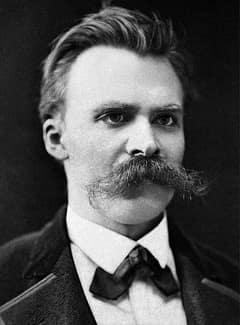
›Friedrich Nietzsche3 passages · 3 works
The Antichrist 59… uppermost!—One only needs to read any one of the Christian agitators—St Augustine, for instance,—in order to realise, in order to smell, what filthy fellows …
Beyond Good and Evil 200… “Sabbath of Sabbaths,” to use the expression of the holy rhetorician, St. Augustine, who was himself such a man.—Should, however, the contrariety and conflict …
The Gay Science 359… those prodigies of morality that make a noise, that make history,—St Augustine was one of these men. Fear of the intellect, vengeance on the intellect—Oh! …