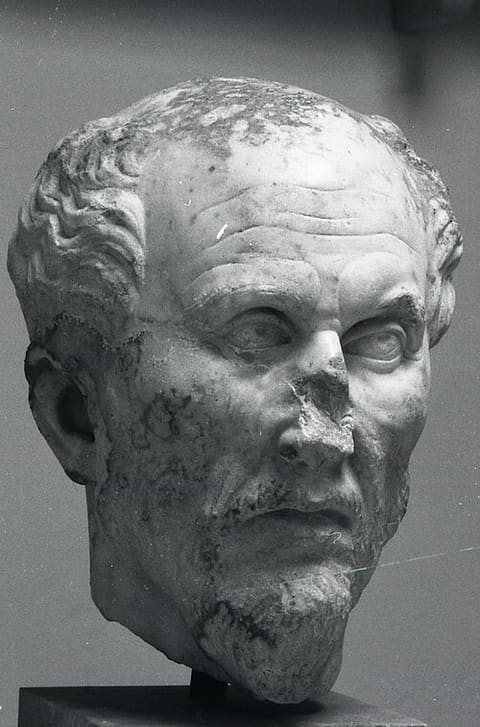
Late Antiquity · 3rd c.
Plotinus
فلوطینc. 204–270Neoplatonism
Plotinus taught that all reality flows from the One, beyond being and thought, through Intellect and Soul down to matter. The soul's task is to turn inward and return to its source.
- Central question
- How does the many come from the One, and how can the soul return to it?
- Method
- Plotinus presents his philosophy as exegesis of Plato: he raises puzzles about the soul, intellect and the One, works them out by dialectic, and treats the argument as preparation for an inward ascent that ends beyond discursive thought. How Plotinus works
to hen the Onenous Intellectpsychē Soulproodos / epistrophē processionhenōsis union
- Stated in the text 7
- Scholarly consensus 10
- Contested reading 3
Answers 19 of 20 questions · does not address 1Why some questions don’t apply
Epistemology
Sources of knowledgeReason alone · Illumination from a higher intellect
Knowledge is stable because its objects are the Forms, which are the very content of Intellect; a part of our soul never descends and always thinks there, and we know by turning inward to it. Discursive reason judges by imprints it receives from Intellect above, while sense perception is only a messenger reporting from below.
Enneads V.3.3 · Enneads IV.8.8 · Enneads V.5.1–2
Both codes describe one doctrine from different sides: our own highest intellect is undescended (reason), yet it is Intellect, a hypostasis above the individual soul, that gives discursive reason its light (illumination).
Certainty, doubt and the limits of knowledgeYes
Questioning stops in Intellect, whose knowledge is infallible because it is identical with its objects and needs no premise or proof from outside. The soul reaches this certainty by rising to Intellect, though the One beyond Intellect is beyond knowledge altogether.
Enneads V.5.1–2 · Enneads V.3.5
Certainty is a feature of Intellect's self-knowledge; the One is grasped by union, not by knowledge (V.3.13; VI.9.4).
Innate knowledgeInnate knowledge
The soul already has the intelligibles within it, since its highest part remains in Intellect; we fail to notice them because our attention is turned to the senses, and learning is a turning back to what we possess.
TruthTruth as a feature of being
Truth in the full sense is not the agreement of a thought with something outside it but Intellect's identity with the beings it thinks; it agrees with nothing but itself. Statements of discursive reason are true only derivatively.
Epistemic justificationKnowledge by presence or identity
If Intellect knew its objects through impressions received from outside, it could never be sure it had them and would have only images; so true Intellect must be its objects, and its knowledge is certain because knower and known are one. Truth there agrees not with something else but with itself. Discursive reasoning and sense depend on this, and the One beyond Intellect is reached by a presence higher than knowledge.
Enneads V.5.1–2 · Enneads V.3.5 · Enneads VI.9.4
Plotinus answers what makes knowledge secure, not what justifies a belief; human souls have this knowledge only by turning to Intellect, while their own discursive judgments are secured by "imprints" from above, which is close to `illumination` (coded for him under epi.source).
Axiology
The highest goodContemplation
Well-being belongs to the life of intellect, which the wise person can have whatever befalls the body; its summit is the soul's union with the One, reachable briefly in this life.
Enneads I.4.4 · Enneads VI.9.9–11 · On the Life of Plotinus and the Order of His Books 23
Union with the One is strictly beyond contemplation, since the One is beyond thought; v1.1 `contemplation` includes union for this reason.
The basis of moralityVirtue
Right action comes from virtue, whose aim is to become like god: civic virtues measure the passions, and higher, purificatory virtues free the soul from the body and turn it to Intellect.
The goal is assimilation to god rather than a good human character, which the codebook's `virtue` definition does not capture.
Virtue and knowledgeKnowledge plus habituation (contested reading)
At the civic level virtue is a trained measure of desire guided by reason, so one can fail through the passions; at the higher level wisdom is the contemplation of what Intellect contains.
Another reading. The higher virtues that alone make one godlike are forms of intellectual vision, and vice is the soul's ignorance of itself, so the considered view is Socratic intellectualism.
His graded virtues cut across the options; the coding records the civic level.
The state and legitimacyNot addressed (contested reading)
Not addressed. No layer states a view on the best order. The Enneads treat civic life only as the setting of the civic virtues (I.2). Porphyry (Life 12) reports a project, not a view: Plotinus asked Gallienus to refound a ruined Campanian city as Platonopolis, whose people would live under Plato's Laws; the emperor was willing, but courtiers blocked it out of jealousy or spite. The report says nothing on why that order, itself second-best in the Laws, would be best, so it is noted here, not coded.
Plotinus wrote nothing on the best political order; civic life matters to him only as the setting of the lower, civic virtues.
Another reading. O'Meara, Platonopolis (2003), reconstructs a Neoplatonic political philosophy from the civic virtues (I.2) and the Platonopolis project: political life is a first stage in assimilation to god, so "no political theory" understates what Plotinus implies.
On the Life of Plotinus and the Order of His Books 12 · Enneads I.2.1–7
Beauty and artBeauty as ascent
Bodily beauty is the shining of form through matter and calls the soul upward to the beauty of virtue, of Intellect and finally of the Good. The arts do not merely copy visible things but go back to the forming principles from which nature itself derives.
Enneads I.6.1–9 · Enneads V.8.1
V.8.1 (Pheidias made his Zeus as Zeus would look if he chose to appear) answers Plato's charge that art is a copy of a copy, without any option for that rehabilitation.
JusticeOrder of the soul
Plotinus takes over Plato's definition: civic justice is each part of the soul doing its own work in ruling and being ruled. Above it stands a purified justice, the soul's own activity turned towards Intellect, and in Intellect justice is simply its own work without parts to order. The order of the universe is also just, since providence assigns souls the lives their former deeds deserve.
Enneads I.2.1 · Enneads I.2.6–7 · Enneads III.2.13
The option fits the civic level only; Plotinus' higher justice is a self-relation of the soul to Intellect, not an order among its parts. Cosmic justice belongs with ont.cosmos and providence.
The nature of valueThe Good beyond being
The Good is the first principle, beyond being and intellect, from which all things have their being and toward which they all strive. Each thing's good is its proper activity and its turning toward what is above it. Things are not good because they are desired; they are desired because something of the Good is present in them, while the Good itself lacks nothing. Evil is matter, the absolute lack of measure and form.
Enneads I.7.1 · Enneads I.8.2–5 · Enneads V.5.12 · Enneads VI.7.18–25
Coded on the Good (to agathon). Unlike convertible-with-being, the Good is above being, and goodness in beings is a trace of it.
contested reading · open a row for the explanation and its sources
Method روش و شیوه اندیشهورزی فلسفی
Plotinus presents his philosophy as exegesis of Plato: he raises puzzles about the soul, intellect and the One, works them out by dialectic, and treats the argument as preparation for an inward ascent that ends beyond discursive thought. His treatises grew out of seminar discussion and were later arranged by his pupil Porphyry into six groups of nine.
- Posing questions
A treatise usually opens with a problem (aporia), often taken from a passage of Plato or a question raised in his school: how the soul descends into body, how the many come from the One, whether the intellect knows itself. Porphyry reports that Plotinus wrote on subjects that arose in the course of his seminars. Behind the particular problems stands one question, how the soul can return to its source, which gives the inquiry its direction.
Enneads IV.8.1 · Enneads V.1.1 · Enneads V.3.1 · On the Life of Plotinus and the Order of His Books 4–5
- Arguing and justifying
Plotinus calls dialectic the most valuable part of philosophy: not a set of rules but the capacity to say what each thing is and how it differs from others, reaching up to the Good. He argues by distinguishing senses of a term, by objections and replies within the text, and by reasoning back from the many to the prior unity they require. Such argument can lead to the One but not grasp it; the One is reached by a presence higher than knowledge, and the final instruction is to take away everything.
Enneads I.3.4–5 · Enneads VI.9.1–3 · Enneads VI.9.4 · Enneads V.3.17
- Criticising rival views
He holds that his views are not new but an interpretation of what Plato said long ago, and he reads earlier philosophers for how far they reached the truth. He examines Aristotle's and the Stoics' categories at length and finds them unfit for the intelligible world, and argues against the Stoic and Epicurean view that the soul is a body. Against the Gnostics, some of them in his own circle, he defends the goodness of the cosmos and accuses them of distorting Plato.
Enneads V.1.8 · Enneads III.7.1 · Enneads VI.1–3 · Enneads IV.7.2–8 · Enneads II.9.6
- Reason, experience and other ways of knowing
Discursive reasoning (dianoia) goes step by step from premise to conclusion, while intellect (nous) holds its objects all at once; he compares the latter to the Egyptian sages' images, each of which is a whole knowledge at a glance. Beyond both is the union with the One, reached by inward turning and purification rather than inference, which Porphyry says Plotinus attained four times while he knew him. Reason is not set aside on this view; it prepares the soul and is surpassed at the summit.
Enneads V.8.6 · Enneads I.6.9 · Enneads VI.9.9–11 · On the Life of Plotinus and the Order of His Books 23
- Language and style
The treatises are compressed and conversational, full of imagined objections ("but someone may say") and sudden returns to an earlier point. Porphyry says that Plotinus wrote out a thought once, as if copying from a book in his mind, and never revised or reread for spelling, and that his seminars mixed reading of commentaries with free discussion and questions. Porphyry later edited the fifty-four treatises and grouped them by subject into six Enneads, from ethics to the One, rather than in the order of writing.
On the Life of Plotinus and the Order of His Books 8 · On the Life of Plotinus and the Order of His Books 13–14 · On the Life of Plotinus and the Order of His Books 24–26
- Across the works
All the treatises are in one work, the Enneads, so the change is between periods of writing, which Porphyry's chronological list allows us to trace. He groups them as twenty-one written before Porphyry joined the school, twenty-four written during his six years with Plotinus in Rome, and nine from the last years, sent to him in Sicily, which he judged weaker. The middle period includes the long, closely argued treatises that Porphyry divided into several parts (on problems of the soul, on the kinds of being, on omnipresence), while several early ones are short sketches of the ascent.
On the Life of Plotinus and the Order of His Books 4–6 · Enneads VI.4–5
dialektikē, aporia, exēgēsis, dianoia, nous, epistrophē, henōsis, aphele panta
Arguments
Key terms
All key terms →- τὸ ἕνto hen
- the One · the GoodThe first principle, wholly simple and beyond being and thought, from which everything else derives without the One being lessened. It can be named only by what it is not, or as the Good.3 links to other thinkers →
- νοῦςnous
- Intellect · MindThe second level of reality, which comes from the One and turns back to contemplate it. In Intellect thinking and what is thought are one: the Forms are its contents, not objects outside it.3 links to other thinkers →
- ψυχήpsychē
- SoulThe third level, proceeding from Intellect, which gives life and order to the cosmos and to every body and is present whole throughout what it animates. Individual souls are never wholly cut off from the intelligible.1 link to other thinkers →
- πρόοδος / ἐπιστροφήproodos / epistrophē
- procession · returnEach level of reality flows from the one above without diminishing it, and becomes itself by turning back to contemplate its source.1 link to other thinkers →
- ἕνωσιςhenōsis
- unionThe soul's union with the One, reached by setting aside everything, thought included. Porphyry reports that Plotinus reached it four times while he was with him.
- ὁμοίωσις θεῷhomoiōsis theōi
- likeness to godThe goal of virtue. The civic virtues give measure to the passions; the higher, purifying virtues separate the soul from the body and make it like Intellect.1 link to other thinkers →
Relations
Open in the network →Shaped by
Works
- EnneadsOnline · 4c. 253–270
How to cite
Hekmat. "Plotinus." Draft, awaiting review; last updated 20 October 2026. https://hekmat.local/thinkers/plotinus/