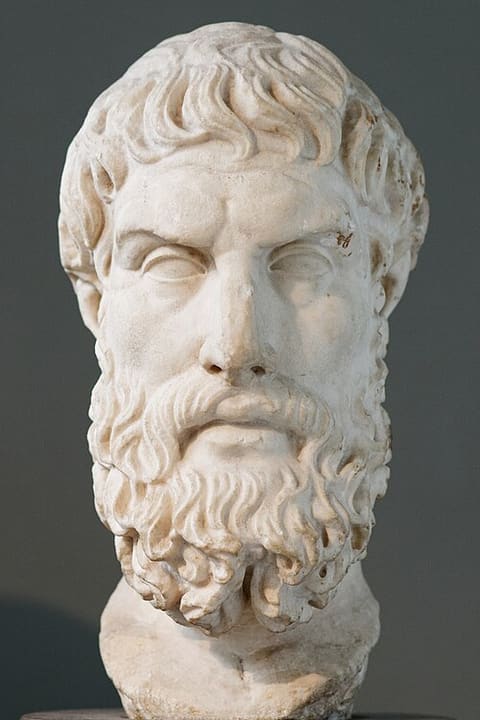
Epicurus held that everything is atoms and void, that the gods do not interfere with us, and that death is nothing to us. The good life is pleasure understood as tranquillity, lived simply among friends.
Central question
How can human beings live free of fear — of the gods, of death and of pain?
Method
Epicurus' method is set by his "canon", the rule for judging opinions: hold fast to sensations, feelings and the clear meaning of words, and accept an opinion about what cannot be seen only if the evidence confirms it or does not contradict it. How Epicurus works ↓
Nothing comes from nothing and nothing perishes into nothing, so the whole has always been as it is. It consists of bodies and empty space, and nothing else can be conceived as existing in its own right. Composite bodies are made of indivisible, unchangeable atoms, infinite in number, which move for ever through an infinite void.
Stated in the textLetter to Herodotus 38–44atomos, kenon, to pan, soma, apeironDraft — not yet reviewed
Not addressed. He never poses the problem of one character shared by many; he treats properties only as attributes of individual bodies and general notions as preconceptions.
Shape, colour, size and the other properties of a body are neither things existing by themselves nor nothing; they belong to the body and are perceived with it. Accidental features are equally real while they belong to it. Generality enters through preconceptions, which Diogenes Laertius describes as universal notions stored in the mind.
Another reading. Since only bodies and void exist in their own right and properties exist only in individual bodies, Epicurus can be coded as holding that only particulars exist.
Another reading. Since generality lies in preconceptions, universal notions held in the mind, Epicurus can be coded as locating universals in concepts.
Contested readingLetter to Herodotus 68–71; Diogenes Laertius' account of the canon (Lives X.33)symbebekota, symptomata, prolepsisDraft — not yet reviewed
The universals problem is posed in later terms; neither coding is Epicurus' own.
›God and the fundamentalGods exist but do not intervene
There are gods, and the common notion of them as immortal and blessed is evident. Because anger, favour and concern imply weakness and dependence, which do not fit blessedness, the gods neither govern the heavens nor intervene in human affairs. Impiety is not denying the popular gods but attributing to the gods what the many believe about them.
Another reading. Long and Sedley (1987, The Hellenistic Philosophers, §23) read the gods as thought-constructs, ideals formed from streams of images, not independently existing living beings; the more common realist reading takes them as real, everlasting living beings.
Stated in the textLetter to Menoeceus 123–124; Letter to Herodotus 76–77; Principal Doctrines 1theos, makarios, aphthartos, prolepsis, enargeiaDraft — not yet reviewed
Knowledge of the gods is said to be evident through preconception, not demonstrated. The bracketed note in Principal Doctrines 1 that the gods are "discernible by reason alone" is a later scholium.
›Soul and bodyMaterialism
The soul is a body of very fine particles spread through the whole frame, like breath mixed with heat, with a still finer part that accounts for thought and feeling. It perceives only while housed in the body, and when the body is broken up it is scattered. Only void is incorporeal, and void can neither act nor be acted upon, so calling the soul incorporeal is foolish.
Stated in the textLetter to Herodotus 63–67psyche, soma, leptomeres, pneuma, thermonDraft — not yet reviewed
Good and evil require sensation, and death is the end of sensation, so death is nothing to us. When the body is resolved into its elements the soul is scattered and nothing remains that could feel. Understanding this removes the longing for immortality and makes mortal life enjoyable.
Stated in the textLetter to Menoeceus 124–125; Principal Doctrines 2; Letter to Herodotus 65thanatos, anaisthesia, steresis aistheseosDraft — not yet reviewed
The sum of things has always been as it is now and always will be, since there is nothing outside it into which it could change and nothing that could enter it. Atoms and void exist from everlasting. Our world, by contrast, is one of infinitely many worlds that formed from atoms and will be dissolved again.
Stated in the textLetter to Herodotus 39–45, 73–74to pan, kosmos, apeiroi kosmoiDraft — not yet reviewed
The code applies to the universe as a whole. Each world (kosmos), including ours, has a beginning and an end, so the question's "world" must be read as the totality.
›Freedom and determinismFree, not determined
Some things happen by necessity, some by chance and some through our own agency. Necessity would destroy responsibility, while our own actions are free of any master, so praise and blame belong to them. The fate taught by the natural philosophers is worse than the myths about the gods, since it cannot be appealed to at all.
Another reading. Bobzien (2000, "Did Epicurus Discover the Free Will Problem?") argues that his concern is that our actions be up to us rather than necessitated, not freedom to choose otherwise in the modern sense, and that the swerve need not occur at each choice.
Stated in the textLetter to Menoeceus 133–134ananke, tyche, par' hemas, adespoton, heimarmeneDraft — not yet reviewed
The swerve of atoms, the physical basis usually given for this view, is not in the surviving letters; it is attested in later sources (Lucretius II.216–293; Cicero, De fato 22–23). How it secures agency is disputed.
›CausationEfficient causes only · Real contingency
Nothing comes from nothing; bodies are compounds of atoms moving through void, and celestial and other events are explained by their motions, without any god ordering them or any purpose. Necessity is not universal: some things happen by necessity, some by chance and some through us. Where the evidence allows several causes, as for eclipses, he keeps them all open.
Scholarly consensusLetters to Herodotus and Menoeceus; Lucretius and Cicero for the swerve and bivalenceatomoi, kenon, ananke, tyche, par' hemas, heimarmene, parenklisisDraft — not yet reviewed
The case against purposes in nature (eyes were not made for seeing) is fully argued only in Lucretius (IV.823–857). The swerve, which breaks the chain of necessity, and the denial that every statement about the future is already true or false, are attested in Lucretius and Cicero, not in the surviving letters. Chance is not a god and gives no good or evil (Menoeceus 134).
Epistemology
›Sources of knowledgeExperience
Sensations and feelings are the standards to which every opinion must be referred, and reason reaches what cannot be seen, such as atoms and void, only by inference from what the senses make evident. To reject sensation is to lose any standard at all, even for judging which beliefs are false.
Stated in the textLetter to Herodotus; Principal Doctrines 22–24aisthesis, pathe, prolepsis, kanon, enargeia, epibole tes dianoiasDraft — not yet reviewed
Diogenes Laertius reports three criteria, sensations, preconceptions (prolepseis) and feelings (Lives X.31). Preconceptions are formed from repeated perception, so the option still fits, but inference from signs to the non-evident is central to Epicurus in a way the option does not show.
›Certainty, doubt and the limits of knowledgeYes
What the senses and the mind directly grasp is always true; error arises only when opinion adds something that is afterwards not confirmed or is contradicted. Certainty is therefore available wherever there is clear evidence, and the sceptic who rejects sensation undermines his own judgments. About distant phenomena such as eclipses, where the evidence allows several causes, Epicurus accepts all the consistent explanations rather than claiming to know which is true.
Stated in the textLetter to Herodotus; Principal Doctrines 22–24enargeia, epimarturesis, ouk antimarturesis, doxa, pleonachos troposDraft — not yet reviewed
The certainty is of what is evident; for the non-evident it is graded, and multiple explanations (Hdt. 78–80) are a principled suspension among rival causes.
Words and concepts must have a clear primary meaning to which inquiry can refer, and that meaning comes from preconceptions, general notions stored up from repeated perceptions. Language itself began in natural responses to feelings and impressions. Nothing in Epicurus' own writings posits knowledge present before experience.
Another reading. Cicero's Epicurean spokesman Velleius calls the notion of the gods a preconception that is implanted or rather innate in all people (Cicero, De natura deorum I.43–44), which some take to show that some preconceptions are not learned.
Contested readingLetter to Herodotus; Diogenes Laertius' account of the canon (Lives X.33)prolepsis, ennoema, phoneDraft — not yet reviewed
The derivation of preconceptions from perception is stated in Diogenes Laertius' doxography, not in the letters, which is why the position is not `textual`.
›TruthCorrespondence
Presentations are true in that they are real effects of real things; images in dreams and pictures would not resemble anything if there were not actual things of that kind. Falsehood belongs to opinion: an opinion is true when it is confirmed or not contradicted by the evidence, and false when it is not confirmed or is contradicted.
Scholarly consensusLetter to Herodotus 50–52alethes, pseudos, doxa, epimarturesis, antimarturesisDraft — not yet reviewed
Confirmation and non-contradiction are tests of truth, not its definition; that an opinion is true when things are as it says is the natural reading but is inferred. The later report that "all perceptions are true" (Sextus Empiricus, Against the Professors VIII.9) uses "true" for what is real, a different sense.
›Epistemic justificationEvidence of what is given · Borne out by experience
Every opinion must be referred to standards that need no proof, or proofs would run on untested without end: the clear meaning of words, sensations and feelings, which are always true as reports. Error enters only when opinion adds something, and an opinion is true if what is evident confirms it or does not contradict it, false if it is not confirmed or is contradicted. To reject all sensations leaves no standard even for judging what is false.
Stated in the textLetter to Herodotus; Principal Doctrines 22–24; the Canon reported by Diogenes Laertius X.31–34kanōn, kritērion, enargeia, prolēpsis, epimarturēsis, ouk antimarturēsisDraft — not yet reviewed
Two levels, two codes: the criteria are self-evident and unproved (`givenness`), and opinions about what is not evident are tested against them (`experience-test`). For the non-evident, "not contradicted" is enough, which is why several explanations of the same celestial event can all be accepted (Letter to Herodotus 78–80). Preconceptions (prolēpseis) as a criterion are known from Diogenes' report, not from the letters.
Axiology
›The highest goodTranquillity and freedom from pain
The goal of every action is to be free from pain in the body and disturbance in the soul; once that is reached, nothing further is lacking. Pleasure in this sense is the beginning and end of the blessed life, and its limit is the removal of all pain. It is not the pleasure of the profligate but a calm state reached by sober reasoning and simple living.
Stated in the textLetter to Menoeceus 128–132; Principal Doctrines 3ataraxia, aponia, hedone, katastematike hedone, telosDraft — not yet reviewed
Pleasure is the first good and the starting point of every choice and avoidance, but not every pleasure is to be chosen: pleasures and pains must be measured against each other over a whole life. The virtues are inseparable from the pleasant life and valued as means to it. Justice is a compact not to harm or be harmed, binding only where it serves mutual advantage.
Stated in the textLetter to Menoeceus 129–132; Principal Doctrines 5, 31–38hedone, symmetresis, phronesis, dikaion, syntheke, sympheronDraft — not yet reviewed
Justice as a compact for mutual advantage (Principal Doctrines 31–38) has no option of its own; it is grounded in pleasure through security and freedom from fear of detection.
›Virtue and knowledgeNot addressed
Not addressed. The letters make the virtues instrumental to pleasure and derive them from prudence, but never ask whether knowing the best is enough to do it.
Prudence, sober reasoning about the grounds of every choice, is the greatest good, and all the other virtues spring from it, since one cannot live pleasantly without living prudently, honourably and justly. Epicurus does not discuss acting against one's knowledge, and his frequent call to practise the doctrines day and night may imply that knowing them is not by itself enough.
Scholarly consensusLetter to Menoeceus 132, 135phronesis, nephon logismos, arete, meleteDraft — not yet reviewed
The question presupposes that virtue is valued for itself; for Epicurus it is a means to pleasure, which none of the options captures.
›The state and legitimacyWithdrawal
Security from other people is a natural good, but the surest security is a quiet private life withdrawn from the crowd, once a tolerable degree of protection is in place. Fame and power sought for safety often fail to give it. Diogenes Laertius reports that the wise man will not take part in politics.
Stated in the textPrincipal Doctrines 6–7, 14; Diogenes Laertius on the wise man (Lives X.117–121)asphaleia, hesychia, ekchoresis ek ton pollonDraft — not yet reviewed
Political order is valued for the security it gives; justice is a compact for mutual advantage (Principal Doctrines 31–38), and laws are just only while they serve it.
›Beauty and artNot addressed
Not addressed. His surviving works do not discuss the value of art or beauty; reported remarks reject conventional literary education but fit none of the options.
Nothing in the letters or the Principal Doctrines concerns art or beauty. Diogenes Laertius quotes him urging a young pupil to steer clear of all conventional education, and reports that the wise man will talk correctly about music and poetry without composing poems.
Scholarly consensusDiogenes Laertius, Lives X.6, X.117–121Draft — not yet reviewed
There is no justice in itself: justice is an agreement, made among those able to make one, neither to harm nor be harmed. What the needs of living together show to be useful is just, so justice is the same for all in general but varies with place and circumstance, and a law that stops being useful stops being just. Injustice is bad only for its consequence, the fear of being found out.
Stated in the textPrincipal Doctrines 31–38 (Diogenes Laertius X.150–153)to tes physeos dikaion, symbolon tou sympherontos, syntheke, me blaptein mede blaptesthaiDraft — not yet reviewed
Epicurus keeps the phrase "natural justice" (PD 31) but means by it the pledge of mutual advantage, not a justice independent of agreement, so `natural-law` does not apply.
›The nature of valueGrounded in feeling
Pleasure is the first good, natural and native to us, and feeling is the rule by which every good is judged; the virtues are chosen for the pleasant life. Justice is nothing in itself but a compact of mutual advantage, the same in general for all but varying by place. Value is not a matter of opinion: desires bred by empty opinion are neither natural nor necessary, and they mislead.
Stated in the texthēdonē, pathos, kanōn, kenodoxia, sumpheronDraft — not yet reviewed
Feeling, not judgment, is the criterion: pleasure is good by nature and not by anyone's opinion, but there is no good apart from what is felt. Principal Doctrines are cited by Diogenes Laertius X section numbers (PD 29 at 149, PD 31–36 at 150–151).
* contested reading · open a row for the explanation and its sources
Method روش و شیوه اندیشهورزی فلسفی
Epicurus' method is set by his "canon", the rule for judging opinions: hold fast to sensations, feelings and the clear meaning of words, and accept an opinion about what cannot be seen only if the evidence confirms it or does not contradict it. All of it serves a practical end, freedom from fear, and he teaches it in short letters and maxims meant to be memorised.
Posing questions
Inquiry begins by fixing what each word plainly means, so that opinions and problems can be referred to something that needs no proof. The questions that matter are those whose answers remove fear: of the gods, of death and of the heavens. Natural science is undertaken for that reason, and he says that without such fears there would be no need to study it.
From what is evident he infers what is not: that nothing comes from nothing, that there are atoms and void, and so on, each step justified because the phenomena attest it or nothing evident contradicts it. An opinion that awaits confirmation is true if confirmed or not contradicted and false if contradicted or not confirmed. Where several causes agree with the phenomena, as for eclipses and other celestial events, he keeps all of them rather than choose one, since a single cause claimed without evidence brings back the fear that study was meant to remove.
Rival views are judged by whether they conflict with the evidence and by what they do to the chooser's peace of mind. The sceptic who rejects every sensation is left with no standard even for judging what is false. Popular beliefs about the gods are rejected as false suppositions, and the fate of the natural philosophers as worse than the myths. Astronomers who insist on a single cause are faulted for overlooking that the heavens are seen only at a distance. Diogenes reports that the school set dialectic aside as superfluous.
The criteria of truth are sensations, preconceptions (general notions formed from repeated perceptions) and feelings of pleasure and pain; later Epicureans added focused apprehensions of the mind. Sensation is never itself in error; error comes from the opinion we add to it. Reasoning works on this evidence and cannot overturn it, and feeling is the criterion of what to choose and avoid. The teaching must be practised as well as understood, by repetition day and night.
What survives is mostly what Diogenes Laertius copied: three letters and the Principal Doctrines. The long work On Nature is almost wholly lost. The Letter to Herodotus calls itself an epitome for those who cannot read the longer treatises and a summary for advanced students to hold in mind, and the Principal Doctrines are short maxims to be memorised. Letters to friends and pupils suit a school that lived together and studied as a community.
Letter to MenoeceusA protreptic letter on ethics, addressed to young and old alike. It gives precepts with brief reasons rather than physical proofs, and asks to be practised.Letter to Menoeceus 122
›Death is nothing to usDeath is nothing to us, and fearing it is groundless. Seeing this removes the longing for immortality and makes a mortal life enjoyable. The argument targets the fear of being dead, not of dying, and is extended by the symmetry argument (epicurus-symmetry-argument). The standard modern reply is the deprivation account (Nagel 1970, "Death"): death can be bad for someone without being experienced, by depriving them of goods they would otherwise have had.
1Good and evil require sensation.
2Death is the privation of all sensation, since when the body is dissolved into its elements nothing remains that can feel.
3So death is neither good nor evil for the one who dies; when we are, death is not present, and when death is present, we are not.
4What causes no distress when it is present causes only groundless pain when it is anticipated.
∴Death is nothing to us, and fearing it is groundless. Seeing this removes the longing for immortality and makes a mortal life enjoyable. The argument targets the fear of being dead, not of dying, and is extended by the symmetry argument (epicurus-symmetry-argument). The standard modern reply is the deprivation account (Nagel 1970, "Death"): death can be bad for someone without being experienced, by depriving them of goods they would otherwise have had.
Plato objects. The second premise is false: the soul is by nature alive and cannot admit death, so at death it departs from the body and continues to exist and perceive.
Aristotle objects. The dead are commonly thought to be affected by goods and evils they do not perceive, such as honours and dishonours and the fortunes of their descendants; Aristotle allows that such things touch them, though only slightly.
›The gods do not concern themselves with usThe gods neither move the heavens nor intervene in human affairs, so fear of divine anger is groundless; true piety is to think of the gods only what befits their immortality and blessedness.
1The common notion of a god is of a living being that is immortal and blessed.
2Trouble, anger and favour imply weakness, fear and dependence on others, which do not accord with blessedness.
3Governing the motions of the heavens, or rewarding and punishing human beings, would involve trouble, anger and favour.
4Regular celestial motions are explained by the way atoms came together when the world was formed.
∴The gods neither move the heavens nor intervene in human affairs, so fear of divine anger is groundless; true piety is to think of the gods only what befits their immortality and blessedness.
Plato objects. The Athenian of the Laws argues against those who hold that gods exist but neglect human affairs: neglect of small things would come from laziness or ignorance, which cannot belong to good and wise gods, and a skilled ruler cares for the parts as well as the whole.
cicero objects. Cotta, the Academic speaker in Cicero's On the Nature of the Gods (book I), argues that gods who neither act nor care for us deserve no worship, so Epicurus keeps the gods in name while abolishing them in fact.
›The kinds of desire and the measure of pleasureThe pleasant life is a simple and prudent one that satisfies natural and necessary desires and removes bodily pain and mental disturbance; the virtues are inseparable from it.
1Pleasure is the first good and the starting point of every choice and avoidance.
2Some desires are natural and necessary, some natural but not necessary, and some neither natural nor necessary but due to empty opinion.
3The necessary desires are necessary either for happiness, for the body's freedom from discomfort, or for life itself; desires whose frustration brings no pain are unnecessary.
4The magnitude of pleasure reaches its limit with the removal of all pain; beyond that pleasure only varies.
5Freedom from bodily pain (aponia) and from mental disturbance (ataraxia) are static (katastematic) pleasures, while joy and delight are pleasures in motion (kinetic) (Diogenes Laertius X.136, reporting Epicurus' On Choices); on the standard interpretation, the static pleasures are the goal and kinetic pleasures only vary them.
6Natural and necessary desires are easily satisfied, while empty desires are unlimited and bring more pain than pleasure.
7So pleasures and pains must be measured against one another, and some pleasures passed over and some pains accepted for the sake of the whole of life.
∴The pleasant life is a simple and prudent one that satisfies natural and necessary desires and removes bodily pain and mental disturbance; the virtues are inseparable from it.
Plato objects. The calm between pleasure and pain is neither; it seems pleasant only by contrast with the pain that preceded it. To call the absence of pain pleasure is an illusion about the nature of pleasure.
cicero objects. In On Ends (book II) Cicero argues that Epicurus equivocates on "pleasure", using it both for enjoyable motion and for the mere absence of pain, which no one else calls pleasure.
›Responsibility requires that not everything be necessaryNot everything happens by necessity: our actions are our own and free of any master. The physical basis Epicurus gave this, a slight swerve of atoms, is not in the surviving letters and is attested only in later sources (Lucretius II.216–293; Cicero, De fato 22–23).
1Some things happen by necessity, some by chance and some through our own agency.
2Praise and blame naturally attach to our own actions.
3If everything happened by necessity, nothing would be up to us and praise and blame would have no place.
∴Not everything happens by necessity: our actions are our own and free of any master. The physical basis Epicurus gave this, a slight swerve of atoms, is not in the surviving letters and is attested only in later sources (Lucretius II.216–293; Cicero, De fato 22–23).
David Hume objects. Liberty opposed to necessity is the same as chance. An action that does not proceed from the agent's character and motives cannot be praised or blamed, so responsibility requires the necessity Epicurus rejects.
cicero objects. Cicero calls the swerve a childish invention: it makes an atom move without a cause, which is the most shameful thing a natural philosopher can say (On Ends I.19).
›Atoms and voidThe whole consists of indivisible bodies moving through void, both everlasting; the sum of things has always been and will always be as it is now.
1Nothing comes into being from what is not, or anything would arise from anything.
2Nothing perishes into what is not, or everything would long since have perished.
3Bodies exist, as sensation itself attests, and void exists, since bodies must have somewhere to be and through which to move, as they plainly do.
4Nothing besides body and void can be conceived as existing in its own right.
5Composite bodies are dissolved, so if there were no limit to division everything would be destroyed into nothing; there must be indivisible bodies.
∴The whole consists of indivisible bodies moving through void, both everlasting; the sum of things has always been and will always be as it is now.
Aristotle objects. Motion does not require a void, since bodies can give way to one another, and a void would make motion impossible, because there would be no reason for a body to move or stop in one place rather than another.
›The symmetry argumentNon-existence after death is no more to be feared than non-existence before birth; it is a mirror nature holds up of the time after we die. The premises are Epicurus' own, but the explicit comparison with the time before birth is stated in later Epicurean sources, chiefly Lucretius. The modern reply (Nagel 1970) is that the two times are not symmetrical: death deprives us of future life we would otherwise have had, whereas we could not have been born much earlier and still be who we are.
1What we never experience can be neither good nor bad for us; death is nothing either to the living, for whom it is not present, or to the dead, who no longer exist.
2The endless time before we were born was nothing to us; no one is distressed that they did not exist then.
3The time after our death is like the time before our birth in every respect that matters, since in both we do not exist and feel nothing.
∴Non-existence after death is no more to be feared than non-existence before birth; it is a mirror nature holds up of the time after we die. The premises are Epicurus' own, but the explicit comparison with the time before birth is stated in later Epicurean sources, chiefly Lucretius. The modern reply (Nagel 1970) is that the two times are not symmetrical: death deprives us of future life we would otherwise have had, whereas we could not have been born much earlier and still be who we are.
Plato objects. The second premise is false if the soul existed before birth: the recollection argument concludes that our souls existed apart from bodies, with intelligence, before they took human form, so neither time is simply nothing to us.
Aristotle objects. Good and bad can touch someone who does not perceive them: the dead are thought to be affected, if only slightly, by honours and dishonours and by the fortunes of their descendants, so what is not experienced is not thereby nothing to us.
›The fourfold remedyThe four main sources of disturbance, fear of the gods, fear of death, anxious desire and dread of pain, rest on false opinions that philosophy can remove, leaving tranquillity. The first four Principal Doctrines state this core; the name "fourfold remedy" (tetrapharmakos) comes from later Epicurean sources (Philodemus), and the medical image fits Epicurus' view that philosophy which does not cure the soul's suffering is empty.
1A blessed and eternal being has no trouble and causes none, so the gods are not to be feared.
2Death is the end of sensation and so nothing to us, so death is not to be feared.
3The magnitude of pleasure reaches its limit in the removal of all pain, so the good is easy to obtain.
4Extreme pain is brief and long illness permits more pleasure than pain, so what is terrible is easy to endure.
∴The four main sources of disturbance, fear of the gods, fear of death, anxious desire and dread of pain, rest on false opinions that philosophy can remove, leaving tranquillity. The first four Principal Doctrines state this core; the name "fourfold remedy" (tetrapharmakos) comes from later Epicurean sources (Philodemus), and the medical image fits Epicurus' view that philosophy which does not cure the soul's suffering is empty.
cicero objects. In On Ends (book II) Cicero attacks the fourth remedy: severe pain can be long as well as sharp, and the formula that great pain is short and long pain light is neither true nor any comfort to someone suffering it.
Plato objects. The third remedy depends on treating the calm state between pleasure and pain as the height of pleasure; Plato argues that this state is neither pleasure nor pain and only seems pleasant by contrast with the pain before it.
›Justice is a compact for mutual advantageJustice is conventional but not arbitrary: it is whatever compacts in fact serve mutual security, the same everywhere in general and different in particulars. The wise person keeps it because injustice brings fear and so destroys the tranquillity that is the end of life.
1Natural justice is a pledge of mutual advantage, that people should neither harm nor be harmed by one another.
2Animals and peoples that cannot or will not make such compacts have neither justice nor injustice; there is no justice in itself, only agreements made in particular places and times.
3Injustice is not bad in itself but only for its consequence, the fear of being found out by those appointed to punish it.
4No one who secretly breaks the compact can be sure he will remain undiscovered, even if he has escaped many times.
5A law is just while it serves mutual advantage, and ceases to be just when, circumstances having changed, it no longer does.
∴Justice is conventional but not arbitrary: it is whatever compacts in fact serve mutual security, the same everywhere in general and different in particulars. The wise person keeps it because injustice brings fear and so destroys the tranquillity that is the end of life.
Plato objects. The Republic states the compact theory through Glaucon in order to refute it: justice is not a compromise accepted by the weak but the health of the soul, good in itself whether or not anyone is found out (plato-glaucon-challenge, plato-justice-happiest).
David Hume objects. Hume agrees that justice is artificial and grounded in its usefulness, but denies that it rests on a contract: it arises from a convention, a general sense of common interest like that of two men rowing a boat, which is not of the nature of a promise, since promises themselves depend on such conventions.
cicero objects. In On Laws (book I) Cicero argues that justice measured by advantage is no justice at all: one who thinks breaking a law profitable will break it whenever he can avoid detection, so justice must exist by nature.
›What atoms are likeAtoms are unchangeable bodies with shape, size and weight but no perceptible qualities, finite in size, with minimal parts, all moving at equal speed through the void; perceived qualities arise from their arrangement. The swerve that later sources ascribe to Epicurus, a slight deviation that lets atoms collide and keeps action free, is not in the letters.
1Every perceived quality, such as colour, heat or taste, changes, but atoms do not change, since something solid must remain when composites dissolve; so atoms have only shape, weight and size, and what goes with shape.
2Atoms differ in size, which helps explain the differences we perceive, but they do not have every size, or some would be large enough to be seen, which never happens.
3A finite body cannot contain infinitely many parts, however small, or it would be infinite in size; so division stops at atoms, and each atom has minimal parts that cannot exist separately.
4In the void nothing resists, so all atoms move at equal speed, heavy or light, as fast as thought; composite bodies differ in speed only because their atoms collide within them.
5What lies beyond perception is inferred by analogy with what is perceived and must not be contradicted by it.
∴Atoms are unchangeable bodies with shape, size and weight but no perceptible qualities, finite in size, with minimal parts, all moving at equal speed through the void; perceived qualities arise from their arrangement. The swerve that later sources ascribe to Epicurus, a slight deviation that lets atoms collide and keeps action free, is not in the letters.
Aristotle objects. A continuous magnitude cannot be composed of indivisibles, since indivisibles have no parts by which to touch, and anything with magnitude is always further divisible. Aristotle also took equal speed in a void as a reason to deny the void, since there would be no cause for one body to move faster than another; Epicurus accepts that consequence.
atoms and void · bodies and space (Hicks)All that exists is bodies and void. Compound bodies are made of indivisible atoms, unlimited in number and moving through unlimited void; nothing comes from nothing or passes into nothing.
criteria of truthThe tests of truth set out in Epicurus' Canon: sensations, preconceptions and feelings. Every belief about what is not evident has to be checked against them.
preconception · basic graspA general notion stored up from repeated perception, such as "man" or "horse", which lets us recognise things and gives words their meaning. Inquiry starts from these notions and is checked against them.
pleasureThe first good, natural to every living thing and the starting point of every choice. Its limit is the removal of all pain, so the pleasure Epicurus praises is a settled state, not a round of indulgence.1 link to other thinkers →
tranquillity · freedom from disturbanceThe untroubled mind that, with the body's freedom from pain (aponia), makes up the blessed life. It comes from clearing away false beliefs about the gods, death and desire.
what depends on us · our own agencySome things happen by necessity, some by chance and some through us. Only what comes from us is open to praise and blame, which is why Epicurus rejects the fate of the natural philosophers.
prudence · practical wisdomSober reasoning about what to choose and avoid, ranked even above philosophy. The other virtues spring from it, and it shows that a pleasant life and a just one cannot come apart.
Thinkers named, not addressed, in the texts Hekmat holds. Naming someone is not evidence of influence.
Names in their works
None in the texts held here.
Named by
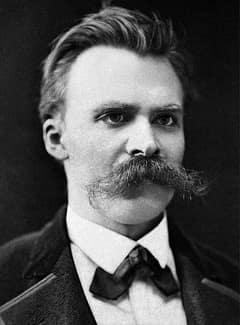
›Friedrich Nietzsche12 passages · 7 works
The Antichrist 30… and nervous energy, remains the most closely related to the above. Epicurus was a typical decadent: and I was the first to recognise him as such.—The …
Beyond Good and Evil 7… philosophers can be! I know of nothing more stinging than the joke Epicurus took the liberty of making on Plato and the Platonists; he called them …
The Birth of Tragedy Attempt.4… approaching age, of physiological weariness? And not at all—pessimism? Was Epicurus an optimist—because a sufferer?... We see it is a whole bundle of weighty …
An Enquiry concerning Human Understanding 11.2… of this bigotted jealousy, with which the present age is so much infested. Epicurus lived at Athens to an advanced age, in peace and tranquillity: Epicureans …
An Enquiry concerning Human Understanding 11.4… can justly be jealous of certain tenets of philosophy, such as those of Epicurus, which, denying a divine existence, and consequently a providence and a …