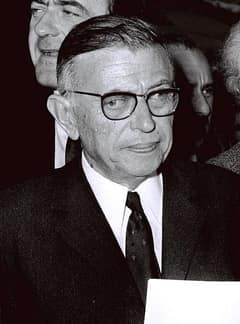
Heidegger argued that philosophy has treated Being as a kind of thing. He analysed human existence as being-in-the-world, care and being-toward-death; his later work turned to language, art and technology.
Central question
What is the meaning of Being, which the tradition since Plato has forgotten?
Method
Heidegger's early method is hermeneutic phenomenology: it lets the phenomena of everyday existence show themselves, interprets the understanding of Being already at work in them, and dismantles inherited concepts back to their sources. How Martin Heidegger works ↓
The being of beings is not itself a being, so the tradition goes astray when it answers the question of Being with a highest or most real being. The meaning of Being has to be worked out first through the being that understands Being, Dasein.
Stated in the textBeing and Time (1927); later writingsSein, Seiendes, ontologische Differenz, Seinsvergessenheit, EreignisDraft — not yet reviewed
The thesis is in Being and Time (SZ 4–6), but the phrase "ontological difference" first appears as such in the 1927 lecture course Basic Problems of Phenomenology (GA 24, §22) and in "On the Essence of Ground" (1929). After the turn Heidegger thinks Being as an epochal event of disclosure (Ereignis) rather than through Dasein's understanding, but keeps the difference between Being and beings.
›UniversalsNot addressed
Not addressed. Heidegger takes no side on whether universals exist; the related thesis that Being is not a genus answers a different question.
The universality of Being exceeds every generic universality, and the doctrine of the idea as the "look" of things is, for Heidegger, where truth turned into correctness. He treats the realism dispute as internal to that metaphysics without taking a side.
Scholarly consensusBeing and Time (1927); "Plato's Doctrine of Truth" (1940/1942)Draft — not yet reviewed
The 1915 habilitation thesis on the theory of categories and meaning then ascribed to Duns Scotus may be an earlier layer with a view on universals; not checked in this pass.
›God and the fundamentalBracketed* (contested reading)
Fundamental ontology decides nothing for or against God's existence, and this is not indifference: the divine can be thought only after the truth of Being has been thought. In the early Freiburg period he holds that philosophy must be atheistic in its method.
Across the works. The later critique of onto-theology rejects the question's framing: metaphysics grounds beings in a highest being as causa sui, a god to whom one can neither pray nor sacrifice ("The Onto-theo-logical Constitution of Metaphysics", 1957, GA 11). Heidegger instead awaits a last god outside metaphysics (Contributions, GA 65, §§253–256), and in the 1966 Spiegel interview says only a god can save us.
Contested readingEarly Freiburg lecture course (1921–1922) and Natorp report (1922); Letter on Humanism (1946)das Heilige, Gottheit, Onto-Theo-LogieDraft — not yet reviewed
The human being is Dasein, being-in-the-world, and cannot be built up from a soul, a body and a spirit put together. Being-in is not a spatial containment of one thing in another but familiar dwelling in a world.
Scholarly consensusBeing and Time (1927)Dasein, In-der-Welt-sein, Sein-bei, LeiblichkeitDraft — not yet reviewed
Being and Time sets bodiliness aside as a problem of its own (SZ 108); it is taken up chiefly in the Zollikon Seminars (1959–1969), and earlier in the 1936–37 Nietzsche course (GA 43), which holds that we do not have a body but are bodily. So the "embodied" half of the option fits less well than the rejection of the soul–body dichotomy.
›Death and immortalitySuspends judgment
Suspends judgment. The existential analysis of death is "this-worldly" and leaves undecided whether there is any being after death; that ontic question can only be asked once death's essence is understood.
Heidegger distinguishes the ontological analysis of death from biology, psychology and theology, and says it decides nothing about an afterlife. What matters is death as Dasein's ownmost possibility, not what may lie beyond it.
Stated in the textBeing and Time (1927)Sein zum Tode, diesseitige InterpretationDraft — not yet reviewed
Not addressed. Whether the universe began is an ontic question about beings as a whole that Heidegger does not address; his "world" is not the totality of beings.
Heidegger separates the ontological concept of world, the context of significance in which Dasein lives, from the ontic totality of things in nature. He leaves the beginning of nature to physics and theology.
Scholarly consensusBeing and Time (1927)Draft — not yet reviewed
›Freedom and determinismRejects the question* (contested reading)
Rejects the question. The question treats freedom as a property of the will within a causal order of present-at-hand things; Heidegger takes freedom to be the ground of truth and of Dasein's choosing itself, prior to causality.
Anxiety reveals Dasein as free for choosing itself, and authenticity is choosing to choose. Later, freedom is "letting beings be": not a human property but the openness that possesses the human being.
Another reading. Authenticity as owning one's existence can be read as a version of freedom as self-determination by what one recognises as one's own.
Contested readingBeing and Time (1927); The Essence of Human Freedom (1930; lecture course), where the reason is argued against Kant; "On the Essence of Truth" (1930/1943)Freiheit, Seinlassen, Wählen der Wahl, EntschlossenheitDraft — not yet reviewed
Possibility ranks above actuality: Dasein is its possibilities, which are neither empty logical possibility nor the contingency of what is merely present. Grounds, causes among them, spring from a freedom that is the ground of grounding, so causality is a problem within freedom, not the reverse. The later essays read the four causes as ways of being responsible for something's coming forth, and the rule of efficient causality as a mark of modern technology.
Across the works. Early, causality is derived from the freedom and possibility of Dasein (1927–1930); later, it is a destiny of being, the way modern metaphysics and technology set beings in order as calculable (1953).
Another reading. Since the question asks how causes explain "reality", a notion Heidegger restricts to one mode of being (SZ §43), the cell could be coded `rejects`, as other questions that presuppose the metaphysics he set out to overcome are.
Scholarly consensusBeing and Time (1927); On the Essence of Ground (1929); The Essence of Human Freedom (1930, lecture course); The Question Concerning Technology (1953)Möglichkeit, Grund, Freiheit, Verschulden, Ver-an-lassen, causa efficiens, Satz vom GrundDraft — not yet reviewed
›Sources of knowledgePre-theoretical understanding
Knowing is a founded mode of being-in-the-world: before any theory, Dasein already understands itself, its world and the being of what it deals with, and explicit interpretation and assertion develop that prior understanding. Theoretical observation arises when practical dealings break down or are held back.
Stated in the textBeing and Time (1927)Verstehen, Vorstruktur, Auslegung, Zuhandenheit, VorhandenheitDraft — not yet reviewed
›Certainty, doubt and the limits of knowledgeRejects the question
Rejects the question. Certainty is the modern, Cartesian form of truth, the self-assurance of a representing subject; the demand for it presupposes a worldless subject that must prove there is a world.
What is scandalous in philosophy is not that a proof of the external world is still missing but that such proofs are expected at all, since Dasein is already in a world. In modernity truth becomes the certainty of representation, and Heidegger treats that shift as a fate of metaphysics, not as a standard to meet.
Scholarly consensusBeing and Time (1927); "The Age of the World Picture" (1938)Gewissheit, Vorstellen, Skandal der Philosophie, WeltbildDraft — not yet reviewed
Dasein's certainty of its own death (SZ §52) is a distinct, existential certainty, more original than any apodictic or empirical certainty about beings.
›Innate knowledgeRejects the question* (contested reading)
Rejects the question. The a priori is the "earlier" of Being, which Dasein always already understands, not content stored in a mind before experience; the innate–acquired contrast presupposes a worldless subject.
Dasein lives in a vague, average understanding of Being before any explicit ontology, and this understanding belongs to its way of being, not to a faculty or a store of ideas. Heidegger criticises the concepts of soul, subject and consciousness on which the old question rests.
Another reading. Transcendental readings of Being and Time (e.g. Crowell) treat the understanding of Being and the existentials as a priori structures that make experience possible.
Contested readingBeing and Time (1927)Seinsverständnis, Apriori, vorontologischDraft — not yet reviewed
A statement is true because it uncovers the being as it is; that presupposes that Dasein is already in the truth, in an openness where beings can show themselves. Truth in the primary sense is unconcealment (aletheia), and correctness is derivative.
Stated in the textBeing and Time (1927); "On the Essence of Truth" (1930/1943)Unverborgenheit, aletheia, Entdecktsein, Erschlossenheit, RichtigkeitDraft — not yet reviewed
Tugendhat (Der Wahrheitsbegriff bei Husserl und Heidegger, 1967) objected that unconcealment cannot distinguish true from false; in "The End of Philosophy and the Task of Thinking" (1964) Heidegger conceded that aletheia should not simply be called truth.
›Epistemic justificationRejects the question
Rejects the question. The question takes knowing to be a subject's holding beliefs that need grounds; Being and Time treats knowing as a founded mode of being-in-the-world and holds that the demand for such proofs comes from a worldless subject, so justification of beliefs cannot be the basic question.
The scandal of philosophy is not that a proof of the external world is lacking but that such proofs are expected again and again. When an assertion is borne out, what is shown is not an agreement between a mental content and a thing but the entity itself showing itself just as the assertion uncovered it; and that is possible only because Dasein is already disclosing, already in the truth. Correctness, and with it every warrant for statements, rests on a prior openness that is not itself justified.
Scholarly consensusBeing and Time (1927); "On the Essence of Truth" (1930/1943)Ausweisung, Bewährung, Entdecktsein, Erschlossenheit, In-der-Welt-seinDraft — not yet reviewed
§44a gives an account of how an assertion is borne out (the entity shows itself in its selfsameness), close in structure to Husserl's fulfilment and so to `givenness`; it is not coded because Heidegger presents it as derivative of disclosedness, not as what grounds knowledge.
Axiology
›The highest goodRejects the question
Rejects the question. Thinking in terms of goods and values is subjectivism: to call something a value is to make it an object of human estimation, which Heidegger counts as part of the metaphysics to be overcome.
Heidegger refuses value-thinking, including the highest values, because it reduces what is to what counts for a valuing subject; Nietzsche's revaluation is its completion, not its overcoming. Authenticity in Being and Time is not offered as a moral ideal.
Scholarly consensusLetter on Humanism (1946); "Nietzsche's Word 'God Is Dead'" (1943)Wert, Wertdenken, SubjektivismusDraft — not yet reviewed
Rejects the question. Ethics as a discipline belongs to the metaphysical division of philosophy; Heidegger holds that thinking the truth of Being is a more original "ethics", dwelling (ethos), and gives no criterion of right action.
Asked when he would write an ethics, Heidegger answers that ethos means abode, and that thinking which thinks the truth of Being as the human abode is already original ethics. Conscience and guilt in Being and Time are existential structures prior to any morality.
Scholarly consensusBeing and Time (1927); Letter on Humanism (1946)ethos, Aufenthalt, ursprüngliche Ethik, SchuldigseinDraft — not yet reviewed
The critical camp is Levinas (Totality and Infinity, 1961), who objects to the priority of ontology over ethics.
›Virtue and knowledgeNot addressed
Not addressed. Heidegger does not ask whether virtue is knowledge; his readings of Aristotle's practical wisdom (phronesis) answer a question about Dasein's self-understanding.
In the 1924–25 lectures on Plato's Sophist Heidegger reads phronesis as Dasein's insight into its own situation, close to conscience, but he does not take a position on akrasia or the Socratic thesis.
Scholarly consensusPlato's Sophist (1924–1925; lecture course, edited from notes and transcripts); Letter on Humanism (1946)Draft — not yet reviewed
›The state and legitimacyRejects the question* (contested reading)
Rejects the question. After the war Heidegger treats every modern political form, democracy included, as an expression of technological will to mastery and denies that philosophy can supply a better order. Coded `rejects` rather than `abstains`: his doubt about democracy (1966) rests on the thesis that no political form as such answers the age, not on suspended judgment between forms; either mode is defensible.
Nationalism and internationalism alike are forms of metaphysical subjectivism, and the essence of technology, not any regime, rules the present age. Heidegger names no best order, and in the 1966 Spiegel interview (published 1976) said he was not convinced that democracy is the system suited to the technological age.
Across the works. Heidegger was elected rector of Freiburg University on 21 April 1933, joined the NSDAP on 1 May 1933, gave the Rectoral Address on 27 May 1933 (GA 16:107–117), and resigned the rectorate in April 1934; he remained a party member until 1945. His appeal to students of 3 November 1933 (GA 16) presents the Führer as the German reality and its law. No option describes this. A dedicated, sourced treatment should include the 1935 lecture course Introduction to Metaphysics (GA 40) and the Black Notebooks (GA 94–96, published 2014).
Another reading. Pöggeler ("Den Führer führen?", 1985) reads the Rectoral Address, which ends by quoting Plato's Republic, as an aspiration for philosophy to lead the leaders.
Contested readingLetter on Humanism (1946); "The Question Concerning Technology" (1953); Spiegel interview (1966, published 1976)Gestell, Subjektivismus, polisDraft — not yet reviewed
The mode is coded for the postwar writings; the 1933–1934 texts are cited for the development. This cell should be reviewed with particular care.
›Beauty and artArt as disclosure of truth
The work of art opens up a world and sets it against the earth; in it the truth of beings sets itself to work. Art is a way truth happens, not an object of aesthetic experience or taste.
Stated in the textThe Origin of the Work of Art (1935–1936)Werk, Welt, Erde, ins-Werk-setzen der Wahrheit, ÄsthetikDraft — not yet reviewed
Own position. Dikē, before any moral or legal sense of justice, is the jointure (Fug) of being, the order by which what is present abides in presencing, and adikia is what is out of joint.
Heidegger does not offer a theory of justice in the moral or juridical sense, which he takes to be derivative. Reading Anaximander and the Antigone chorus, he thinks dikē from being: it is the fitting order (Fug) that gives each being its while of presence, and the overwhelming order to which human violence-doing (technē) is exposed. Justice as a virtue or as a legal order belongs to the metaphysics he means to get behind.
Scholarly consensusIntroduction to Metaphysics (1935, published 1953); "Anaximander's Saying" (1946, in Holzwege 1950)Dikē, Fug, Un-Fug, Adikia, das Seiende, Anwesen, technēDraft — not yet reviewed
The mode could be `rejects`: Heidegger refuses the moral and juridical sense of the question and answers a different one, about being. It is coded `answers` with an own position because he says what dikē is. His lectures on justice (Gerechtigkeit) in Nietzsche (1939–1940) interpret Nietzsche, not his own view.
›The nature of valueRejects the question
Rejects the question. To ask whether values are found or made already treats beings as objects for a valuing subject; Heidegger counts both objective and created values as subjectivism and refuses value-thinking.
Being and Time treats values as determinations attached to things whose ontological basis is left unclear, resting on mere presence. Later, to call something a value is to make it an object of human estimation and so to rob it of its worth; thinking against values does not preach that nothing matters but brings the truth of being before thought. Nietzsche's revaluation, which makes values conditions posited by will to power, completes this metaphysics rather than overcoming it.
Scholarly consensusBeing and Time (1927); "Nietzsche's Word 'God Is Dead'" (1943); Letter on Humanism (1946)Wert, Wertdenken, Subjektivismus, Wertsetzung, Lichtung des SeinsDraft — not yet reviewed
* contested reading · open a row for the explanation and its sources
Method روش و شیوه اندیشهورزی فلسفی
Heidegger's early method is hermeneutic phenomenology: it lets the phenomena of everyday existence show themselves, interprets the understanding of Being already at work in them, and dismantles inherited concepts back to their sources. After the turn of the 1930s he leaves the language of method and system for a thinking that listens to the history of Being, to early Greek words and to poets.
Posing questions
Heidegger begins by asking how a question is to be asked. Being and Time analyses the question of the meaning of Being into what is asked about, what is interrogated and what is to be found out, and concludes that the questioner, Dasein, must be interrogated first. A genuine metaphysical question puts the questioner into question, as the 1929 lecture argues by asking about the nothing. Later he treats questioning itself as the way of thinking, closing The Question Concerning Technology by calling it the piety of thought.
Being and Time does not deduce or prove; it exhibits. Phenomenology means letting what shows itself be seen from itself, and its descriptions are interpretations that make explicit an understanding we already have. This interpretation moves in a circle between the whole and its parts, which is to be entered rightly rather than avoided. Concepts are given as "formal indications" that the reader must fill in from their own existence, and an interpretation must at times go against everyday self-understanding to reach what it conceals.
Heidegger meets the tradition by "destruction" (Destruktion): he dismantles the concepts it hands down, such as substance, subject and presence, to recover the experiences of Being they came from and to show what they cover over. He reads earlier philosophers for what they leave unthought, as in his accounts of Plato's doctrine of truth and of Nietzsche as the last metaphysician, and holds that an elucidation must add something of its own to the text. Readers called this violence; he answered the charge in the preface to the second edition of his Kant book.
Heidegger does not rank reason, sense and intuition as faculties; he holds that the division itself belongs to a metaphysics of the subject. Before any theory there is a practical, circumspective understanding of things in use, and moods such as anxiety disclose the world as a whole. Later he sets a meditative thinking that listens and thanks against calculative thinking, and gives poetry a place beside thinking as a way in which Being comes to language.
Being and Time is a treatise in numbered sections, with a technical vocabulary built from ordinary German words and hyphenated compounds (being-in-the-world, being-toward-death) and a plan it never completed. The later writings are lectures, essays and conversations that proceed by etymology and by circling a few words, often Greek ones such as alētheia and physis, and they avoid the systematic treatise. He held that the language of metaphysics could not say what he was trying to think, and gave this as a reason the treatise's missing division was withheld.
›The priority of the question of BeingThe question of the meaning of Being has both ontological and ontical priority, and must be worked out first through an existential analysis of Dasein.
1Three prejudices hold that the question of Being need not be asked, since Being is the most universal concept, indefinable and self-evident (§1, SZ 2–4).
2But the universality of Being is not that of a genus; indefinability shows only that Being is not a being; and self-evidence shows that we live in an understanding of Being whose meaning is still veiled (§1, SZ 3–4).
3Every science investigates a region of beings and presupposes an understanding of their being; ontology clarifies these basic concepts, so it is prior to the sciences (§3, SZ 9–11).
4Ontology itself remains naive and blind unless it first clarifies the meaning of Being in general (§3, SZ 11).
5The being that asks the question, Dasein, is distinguished by the fact that in its being it understands Being (§4, SZ 12–13).
∴The question of the meaning of Being has both ontological and ontical priority, and must be worked out first through an existential analysis of Dasein.
G. W. F. Hegel objects. (Applied; Hegel predates Heidegger, and Heidegger already lists Hegel's indeterminate immediate among the prejudices at SZ 3, so the objection is answered in the text it targets.) Pure being, taken by itself, is the emptiest and most indeterminate thought and passes over into nothing; it gains content only in the development of the categories toward the concept, so the question of Being has no special priority.
›Being-toward-death and Dasein's wholenessAuthentic being-toward-death makes Dasein's being-a-whole possible and shows existence to be finite; it opens the way to temporality as the meaning of care.
1As long as Dasein exists, something of it is still outstanding, so it seems that Dasein can never be grasped as a whole (§46, SZ 235–237).
2The deaths of others do not give us death as it is for the one who dies; no one can take another's dying away (§47, SZ 237–241).
3Death is Dasein's ownmost, non-relational, certain and yet indefinite possibility, which cannot be outstripped (§§50, 52, SZ 250–251, 258–259).
4Everyday Dasein flees this possibility into the anonymous "one dies", which tranquillises it and turns death into an event that happens to others (§51, SZ 252–255).
5Anticipation of death discloses it as possibility, individualises Dasein and frees it for its finite possibilities as a whole (§53, SZ 260–267).
∴Authentic being-toward-death makes Dasein's being-a-whole possible and shows existence to be finite; it opens the way to temporality as the meaning of care.
sartre objects. Death is not my ownmost possibility but the nihilation of all my possibilities; it comes to me from outside, as absurd as birth, and turns my life over to the judgment of others.
being-there · existenceHeidegger's word for the human being: the entity whose own being is an issue for it and which always has some understanding of being. Its essence lies in its existence.
being · beingsBeing is not itself a being: it is that on the basis of which beings are understood as beings. Heidegger later calls this the ontological difference and charges metaphysics with forgetting it.3 links to other thinkers →
being-in-the-worldDasein's basic state is not a subject facing objects but one involvement with a world of things, others and tasks; "in" means dwelling and familiarity, not being inside a container.2 links to other thinkers →
readiness-to-hand · presence-at-handThings first show up as equipment ready to hand in use, like a hammer in hammering; bare objects present at hand, with properties to observe, appear when use breaks down or we stand back to look.
careThe unified being of Dasein: ahead of itself in projecting possibilities, already in a world it has been thrown into, and alongside the things it deals with.
being-toward-deathDeath is Dasein's ownmost possibility, certain yet indefinite as to when, and not to be outstripped. Running ahead toward it frees one from what "they" say and makes an authentic whole possible.
unconcealment · aletheiaTruth at root is not the agreement of a statement with a thing but beings' coming out of concealment; statements can be correct only within such disclosure. Heidegger hears it in the Greek alētheia.2 links to other thinkers →
enframingThe essence of modern technology: a way of revealing that challenges everything, nature and people included, to stand ready as resource (Bestand) for further ordering.