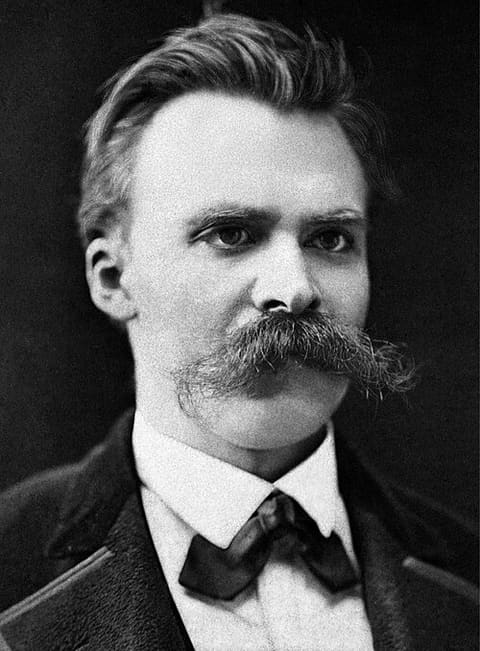
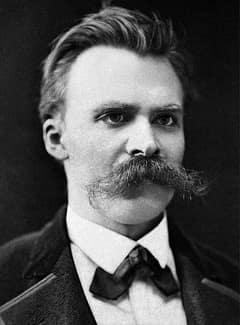
Nietzsche attacked the "true world" of Plato and Christianity as a denial of life. He traced morality to its origins and called for new values and the affirmation of life, including its eternal recurrence.
Central question
After the death of God, how can values be created and life affirmed?
Method
Nietzsche philosophises by diagnosis and experiment: he asks where values come from and what they are worth for life, and answers with genealogies, psychological observations and trial perspectives rather than a system. How Friedrich Nietzsche works ↓
There is no true world of being behind the apparent one; being is an empty fiction and the senses lie only when reason turns their testimony of change into permanence. With the true world, the apparent world as its contrast is abolished too.
Stated in the textTwilight of the Idols (1889)Werden, wahre Welt, scheinbare Welt, Wille zur MachtDraft — not yet reviewed
Whether the will to power is a metaphysics of all reality depends heavily on the Nachlass; the published case (Beyond Good and Evil 36) is framed as a hypothesis. Heidegger reads it as the last metaphysics; Clark and Leiter deny that it is a cosmology.
›UniversalsNominalism
Every concept arises by equating unequal things and overlooking differences; logic itself grew from the useful habit of treating the similar as the same. There are no forms or natures corresponding to general words.
Scholarly consensusOn Truth and Lies (1873); Gay Science (1882)Gleichsetzen des Nicht-Gleichen, BegriffDraft — not yet reviewed
Nietzsche also denies that there are stable particular things, so the "only particulars exist" half of the option fits loosely.
›God and the fundamentalRejected
God is dead: belief in the Christian God has become unbelievable, and the values that rested on it are losing their authority. Nietzsche refutes the belief historically, by showing how it arose, rather than by disproof, and in his own voice rejects the Christian concept of God as hostile to life.
Stated in the textDaybreak (1881); Gay Science (1882/1887); The Antichrist (1888)Gott ist tot, Nihilismus, historische WiderlegungDraft — not yet reviewed
GS 125 is spoken by the madman; `textual` rests on GS 343 and the Antichrist.
›Soul and bodyMaterialism* (contested reading)
Zarathustra says that he is body through and through, and that soul is only a word for something about the body. In his own voice Nietzsche treats the soul as a society of drives and affects rather than a simple, immortal atom.
Another reading. Nietzsche also rejects materialistic atomism (BGE 12), and many read the "great reason" of the body as dissolving the soul–body dichotomy rather than reducing one side to the other.
Contested readingZarathustra I (1883); Beyond Good and Evil (1886)Leib, große Vernunft, Seelen-Atomistik, Gesellschaftsbau der TriebeDraft — not yet reviewed
Personal immortality is a great lie that devalues this life by placing its centre of gravity in a beyond. Eternal recurrence is the return of this same life, not the survival of a soul.
›The cosmosEternal and unproduced* (contested reading)
The world as a whole is eternal chaos, without purpose or creator, and if eternal recurrence is meant cosmologically it has no beginning and no end. Whether the recurrence is a cosmology at all is disputed.
Another reading. The published texts present recurrence as a thought-experiment and test of affirmation (GS 341), not a cosmological claim; the cosmological proofs are in the Nachlass. On this reading Nietzsche has no position on the world's beginning.
Contested readingGay Science (1882); Zarathustra III (1884)ewige Wiederkunft, ChaosDraft — not yet reviewed
Free will in the metaphysical sense would require being causa sui, which is a self-contradiction; the doctrine was invented by priests to make people accountable and punishable. "Unfree will" is equally a mythology: in real life there are only strong and weak wills.
Another reading. Gemes and Richardson (both 2009) find a positive, non-metaphysical freedom in the "sovereign individual" who has the right to make promises (GM II.2): freedom as an achieved unity of drives.
Stated in the textBeyond Good and Evil (1886); Twilight of the Idols (1889)causa sui, Irrtum vom freien Willen, starker und schwacher WilleDraft — not yet reviewed
Not hard determinism: BGE 21 rejects "unfree will" too, and BGE 19 treats willing as a multiplicity of drives. The stance is backed by Leiter (Nietzsche on Morality, 2002), who reads him as a fatalist; the causa sui critique is the argument for it.
›CausationNecessity from the mind* (contested reading)
Cause and effect are conventional fictions for designating and communicating, not explanations; we describe better than earlier ages but explain no more. The belief in causes comes from the belief that our will causes our acts, and purposes are our invention. Yet he can also say that there are only necessities, with no laws, no commander and no chance, and that each person is a piece of fate.
Another reading. Leiter (Nietzsche on Morality, 2002) reads him as a naturalist who explains people causally by their type-facts; on that reading BGE 21 rejects only the reification of cause and effect, not causal explanation.
Contested readingGay Science (1882); Beyond Good and Evil (1886); Twilight of the Idols (1888)Ursache und Wirkung, Fiktion, Beschreibung, Notwendigkeit, Irrtum der falschen Ursächlichkeit, FatumDraft — not yet reviewed
The option fits the fictions of BGE 21 and the derivation of causality from the will; it does not fit his affirmations of necessity without law (GS 109; BGE 22), which he offers in turn as interpretation.
Epistemology
›Sources of knowledgePerspectival
There is only a perspectival seeing and knowing: every claim to knowledge is an interpretation shaped by the drives, needs and history of the knower. The more perspectives we bring to bear on a thing, the more complete our "objectivity" becomes, but there is no view from nowhere.
Stated in the textGenealogy of Morals (1887); Gay Science V (1887)Perspektivismus, Interpretation, AffektDraft — not yet reviewed
›Certainty, doubt and the limits of knowledgeFallibilist* (contested reading)
Immediate certainty is a contradiction in terms, and convictions endanger truth more than lies do. Nietzsche keeps a rigorous, experimental knowing that is always provisional and never unconditional.
Across the works. The early essay "On Truth and Lies" (1873, unpublished) treats all truths as forgotten illusions, which reads as a radical scepticism about knowledge.
Another reading. Postmodern readings take the attack on truth to reject the question of certainty altogether, not to answer it with a fallibilism.
Contested readingHuman, All Too Human (1878); Beyond Good and Evil (1886); Gay Science (1882/1887)unmittelbare Gewissheit, Überzeugung, VersuchDraft — not yet reviewed
›Innate knowledgeA priori structures, not contents* (contested reading)
The intellect inherited from the species a set of useful errors, such as enduring things, equal things and cause and effect, which now precede and shape every individual's experience. These forms are conditions of life, not knowledge: Kant's synthetic a priori judgments must be believed, though they may be false.
Another reading. Because the forms are acquired by the species and could have been otherwise, naturalist readings deny that Nietzsche admits any a priori structure in Kant's sense.
Contested readingGay Science (1882); Beyond Good and Evil (1886)Grundirrtümer, Lebensbedingung, synthetische Urteile a prioriDraft — not yet reviewed
Rejects the question. In the late texts Nietzsche replaces the question of what truth is with the question of what the will to truth is worth; truth as agreement with a world in itself is a fiction.
Once the "true world" is abolished, the idea of truth as correspondence to things as they are in themselves goes with it. The unconditional will to truth turns out to be a moral faith whose value must be questioned.
Across the works. The early, unpublished "On Truth and Lies" (1873, §1) gives a rival definition: truths are worn metaphors whose origin has been forgotten. No option expresses it.
Across the works. Clark (Nietzsche on Truth and Philosophy, 1990) reads a development: Nietzsche holds a falsification thesis through Beyond Good and Evil and drops it from the Genealogy on, keeping an ordinary, minimal correspondence notion of truth and rejecting only metaphysical truth.
Contested readingBeyond Good and Evil (1886); Genealogy of Morals III (1887); Twilight of the Idols (1889)Wille zur Wahrheit, wahre WeltDraft — not yet reviewed
Codebook gap: no option fits Nietzsche's account of truth (no pragmatist or error-theory option), so the late texts' questioning of truth's value is coded `rejects` as the best available coding. `perspectival` is coded under epi.source (GM III.12).
›Epistemic justificationNature, custom or life, not reasons* (contested reading)
Our basic beliefs, that there are enduring things, equal things, substances, free will, were errors that proved useful, and their strength comes from their age and their being conditions of life, not from their truth; the falseness of a judgment is no objection to it. But life is no argument: being needed does not make a belief true. Against this Nietzsche sets an intellectual conscience that demands reasons for and against, and an "objectivity" that consists in commanding many perspectives and affects, not in a view from nowhere.
Across the works. Clark (Nietzsche on Truth and Philosophy, 1990) argues that Nietzsche gives up the thesis that our basic beliefs falsify reality from the Genealogy on and keeps ordinary standards of evidence, so the late texts (GM III.12) answer the question with disciplined, many-sided inquiry rather than with life's needs.
Contested readingGay Science I–III (1882); Beyond Good and Evil (1886); Genealogy of Morals III (1887)intellektuelles Gewissen, Irrtum, Lebensbedingung, Objektivität, PerspektiveDraft — not yet reviewed
`naturalised` catches the explanation of why beliefs are held, which Nietzsche shares with Hume in outline but not in reasons (rule 6: Hume appeals to custom, Nietzsche to the preservation and growth of life). His positive norms, the intellectual conscience (GS 2) and perspectival objectivity (GM III.12), have no option; together they would be a candidate own position if the development reading is adopted.
Life is what must always overcome itself, and the highest value is the creation of new values, a task for higher types rather than a good for all. A good common to everyone is a contradiction, since what is common has little value, and peoples have had a thousand goals, not one.
Another reading. No highest good: since what is good for one type harms another and there is no common good (BGE 43), the summum bonum belongs to the morality Nietzsche wants to revalue, and he offers none.
Contested readingZarathustra (1883–1885); Beyond Good and Evil (1886)Selbstüberwindung, Rangordnung, GemeingutDraft — not yet reviewed
The perfectionist reading (Hurka, "Nietzsche: Perfectionist", 2007) takes self-overcoming and the creation of values as the value by which Nietzsche ranks types and ways of life, which grounds the stance. It answers the question as posed, the highest good for a human being, while denying that one good holds for all; the rival reading takes that denial as a refusal of the question.
›The basis of moralityNo unconditional foundation
Moral values have no unconditional foundation: they arose from the needs and ressentiment of particular types of people and serve particular forms of life. The value of these values must itself be questioned and, where it harms life, revalued.
Stated in the textBeyond Good and Evil (1886); Genealogy of Morals (1887)Umwertung aller Werte, Herren-Moral, Sklaven-Moral, RessentimentDraft — not yet reviewed
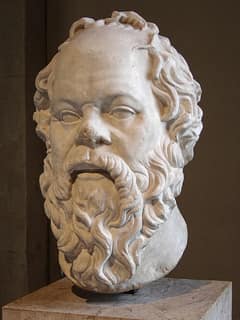
Socrates' equation of reason, virtue and happiness was a symptom of decadence: virtue that has to prove itself by reasons is already in decline. Healthy virtue is instinct, one's own invention and need, not knowledge.
Stated in the textBirth of Tragedy (1872); Twilight of the Idols (1889)Instinkt, Décadence, theoretischer MenschDraft — not yet reviewed
›The state and legitimacyRule by the wise* (contested reading)
Every enhancement of the human type has been the work of an aristocratic society that believes in order of rank; genuine philosophers are commanders and legislators of values. Nietzsche praises the caste order of the Law of Manu, in which the most spiritual are highest, and Zarathustra calls the modern state the coldest of monsters.
Another reading. Kaufmann's apolitical reading: Nietzsche's concern is the solitary individual's self-cultivation against the state and the herd, not a political order.
Contested readingZarathustra I (1883); Beyond Good and Evil (1886); The Antichrist (1888)Rangordnung, Pathos der Distanz, große Politik, der neue GötzeDraft — not yet reviewed
The primary coding follows the aristocratic-politics camp against Kaufmann (Detwiler, Nietzsche and the Politics of Aristocratic Radicalism, 1990). Codebook gap: order of rank and "aristocratic radicalism" (Brandes' phrase, which Nietzsche accepted in a letter to Brandes of 2 December 1887) have no option of their own. `philosopher-rule` fits only the spiritual hierarchy of BGE 211 and Antichrist 57, not Plato's rule of knowledge of the Good.
›Beauty and artArt as disclosure of truth* (contested reading)
In The Birth of Tragedy, Dionysian art, above all music and tragedy, discloses the primordial unity behind individuation, and existence is justified only as an aesthetic phenomenon. Later Nietzsche drops the metaphysics and values art as a stimulant to life and a good will to appearance.
Across the works. From Human, All Too Human onward art no longer reveals the truth of being; it is the great stimulant of life and a cult of the untrue that makes existence bearable (GS 107; TI Skirmishes 24). The 1886 "Attempt at a Self-Criticism" distances the book from its own metaphysics. No option fits this later view, which also rejects Kant's disinterestedness (GM III.6).
Contested readingBirth of Tragedy (1872)das Dionysische, das Apollinische, Stimulans des LebensDraft — not yet reviewed
Own position. There is no right or wrong in itself; justice begins as exchange and settlement between powers of roughly equal strength, is maintained by the stronger against resentment, and in its highest form is the active, objective eye that gives equality to equals and inequality to unequals.
Nietzsche asks where justice comes from, not what it is in itself. It begins where neither side can win outright and both come to terms, so exchange is its original character; law is then imposed by the stronger to curb the reactive feelings, and only after law is there right and wrong. Justice at its height is not resentment but the active, noble power to judge fairly even one's injurer. The modern doctrine of equality is the end of justice.
Across the works. Human, All Too Human I.92 (1878) derives justice from exchange between near equals and from prudent self-preservation, close to the Epicurean compact; the Genealogy keeps the origin but adds law imposed by the stronger and justice as an active, noble power that ends in mercy (II.10–11).
Across the works. Twilight (Skirmishes 48) names the true speech of justice as equality to equals and inequality to unequals, the principle of proportion turned against modern equality.
Contested readingHuman, All Too Human I (1878); Genealogy II (1887); Twilight of the Idols (1888)Gerechtigkeit, Billigkeit, Tausch, Gläubiger und Schuldner, Ressentiment, Pathos der DistanzDraft — not yet reviewed
A genealogy of justice rather than a definition: `convention-of-advantage` fits the origin only, and `proportional-equality` only the first clause of its definition, without correction.
›The nature of valuePosited by valuation* (contested reading)
Nothing has value in itself, by its nature; whatever has value was given it, and moral judgments interpret phenomena rather than report moral facts. Values arise in the needs of particular types of life, as "good" first named the noble's sense of themselves, so the value of these values must be put in question. Genuine philosophers create values. Yet he ranks values by whether they serve ascending or declining life.
Another reading. Nietzsche is an anti-realist about value: there are no objective values, and his own evaluations are expressions of his taste (Leiter, Nietzsche on Morality, 2002).
Another reading. Will to power gives a standard of value that holds whatever anyone esteems, so Nietzsche is not a thoroughgoing anti-realist (Richardson, Nietzsche's System, 1996; Reginster, The Affirmation of Life, 2006).
Contested readingWerthe, Umwerthung aller Werthe, Werthschätzung, Pathos der Distanz, Wille zur MachtDraft — not yet reviewed
"Created" and "revalued" are his own words; the dispute is whether life or power is itself a measure beyond valuation. Twilight, "The Problem of Socrates" 2, says the value of life cannot be estimated.
* contested reading · open a row for the explanation and its sources
Method روش و شیوه اندیشهورزی فلسفی
Nietzsche philosophises by diagnosis and experiment: he asks where values come from and what they are worth for life, and answers with genealogies, psychological observations and trial perspectives rather than a system. The form of his writing (aphorism, polemic, the poetic speeches of Zarathustra) is part of the method, and it changes markedly between his early, middle and late books.
Posing questions
Nietzsche replaces "what is good?" with "what is the value of our values, and under what conditions did they arise?". He reads a philosophy as a confession of its author and a symptom of the drives and kind of life behind it, so he asks who needs a belief and what it does for them, not only whether it is true. He turns the same question on the will to truth itself. Questions are often put as suspicions or provocations, under a deliberate "perhaps".
His main instrument is genealogy: a historical and psychological account of how a value or concept came about, which shows that what seemed given was made, by particular types for particular needs. He supports such accounts with philology (the history of words for good and bad), physiology and the observation of motives, and prefers the hypothesis that explains most with the fewest principles. Other arguments are thought experiments, such as the eternal recurrence, offered as a test of whether one could affirm one's life as it is.
Nietzsche answers a rival view less by refuting it than by tracing it to the needs it serves (Socratic reason to decadence, the morality of pity to resentment) and then judging it by whether it enhances or diminishes life. He attacks the philosophers' faith in opposite values, in reason as a guarantee and in a "true world" behind appearances. He turns the same suspicion on his own earlier positions, most openly in the prefaces he added to his books in 1886.
Nietzsche distrusts a pure, disembodied reason: thinking is an activity of the drives and the body, and there is only a perspectival seeing and knowing. The more eyes brought to bear on one thing, the fuller our "objectivity". He rehabilitates the senses, prizes the historical sense and psychology, and treats the philosopher's own experience of illness, recovery and solitude as material for knowledge.
He writes in aphorisms and short sections that ask for slow, ruminating reading; the third essay of the Genealogy is presented as a commentary on a single aphorism. He uses irony, hyperbole and masks, holding that everything profound loves a mask, and in Thus Spoke Zarathustra he speaks through a prophet's parables and songs. Twilight of the Idols "philosophises with a hammer", sounding out idols to hear that they are hollow.
Human, Daybreak, The Gay ScienceThe free-spirit books (1878–1882) turn to aphorism, psychological observation and "historical philosophising": a chemistry of moral and aesthetic concepts, with life treated as an experiment of the one who seeks knowledge.Human I.1–2 · The Gay Science 324
›The genealogy of slave moralityMoral values have a history in the needs of particular types and in ressentiment, so their claim to unconditional authority cannot be taken for granted. The genealogy does not refute them; it calls the value of these values into question.
1The word "good" was first coined by the noble and powerful for themselves and their actions; "bad" (schlecht) was an afterthought for the low and common (GM I.2, 4–5).
2A priestly caste, powerless to act, turned its hatred into a revaluation of values in which only the wretched and suffering are good and the powerful are evil (GM I.7).
3The slave revolt in morality begins when ressentiment becomes creative; its "good" is defined by negation from a prior "evil", the noble man seen through the eyes of the weak (GM I.10–11).
4The fiction of a subject separate from its deeds allows the weak to present their weakness as a freely chosen merit and to blame the strong for being strong (GM I.13).
5Modern morality of pity, humility and equality is the victorious heir of this revolt (GM I.9; BGE 202).
6Caveat against the genetic fallacy, the standard objection, which Nietzsche states himself. A morality's origin, even in error, does not settle its value (GS 345), and a thing's origin differs from the purposes it later serves (GM II.12).
∴Moral values have a history in the needs of particular types and in ressentiment, so their claim to unconditional authority cannot be taken for granted. The genealogy does not refute them; it calls the value of these values into question.
Martin Heidegger objects. Revaluing values still thinks in terms of values, positing them as conditions of the will to power; Nietzsche's counter-movement completes metaphysics instead of overcoming it.
›Free will as causa suiThere is no free will in the sense responsibility requires; but "unfree will" is equally a mythology, and in real life there are only strong and weak wills.
1Freedom of the will in the metaphysical sense means bearing ultimate responsibility for one's actions, discharging God, world, ancestors, chance and society of it (BGE 21).
2Ultimate responsibility would require being the cause of oneself (causa sui).
3Causa sui is a self-contradiction, like pulling oneself out of the swamp of nothingness by one's own hair (BGE 21).
4The doctrine of the will was invented so that people could be held accountable, judged and punished (TI Four Great Errors 7).
∴There is no free will in the sense responsibility requires; but "unfree will" is equally a mythology, and in real life there are only strong and weak wills.
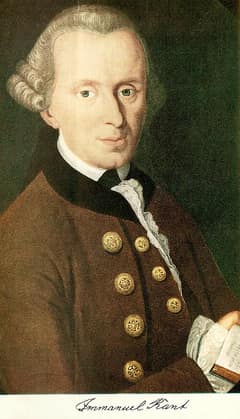
Immanuel Kant objects. (Applied; Kant predates Nietzsche.) Freedom is not a theoretical claim about causes but a presupposition of practical reason: every being that cannot act except under the idea of freedom is, for that very reason, free in a practical respect.
will to powerThe drive of every living thing to grow, extend itself and command, which Nietzsche proposes, as an experiment, as the basic character of life and of the world. Self-preservation is only one of its effects.1 link to other thinkers →
eternal recurrence · eternal returnThe thought that this life will return, the same in every detail, countless times. It is offered as a test: could one will that, and so affirm one's life without reserve?
overman · supermanThe goal Zarathustra sets after the death of God: a human type that overcomes humanity as it now is and creates its own values. Man is a rope stretched between animal and overman.
God is deadBelief in the Christian God has become unbelievable, and the morality and meaning built on it begin to give way. The madman's announcement is a diagnosis whose consequences are not yet understood.
resentmentThe vengeful feeling of the powerless, which turns creative when it invents values: the slave revolt in morality calls the strong "evil" and itself "good".
revaluation of all valuesThe task of questioning the value of values themselves and overturning the Christian moral ranking, which Nietzsche holds denies life.
perspectivismThere is only perspectival seeing and knowing; the more eyes and affects we bring to a thing, the fuller our grasp of it. A pure, will-less knower is a fiction.1 link to other thinkers →
the Dionysian · the ApollonianTwo drives in art: the Apollonian of image, measure and individual form, the Dionysian of intoxication and dissolution into the whole. Greek tragedy is born from their union.
Thinkers named, not addressed, in the texts Hekmat holds. Naming someone is not evidence of influence.
Names in their works
›Arthur Schopenhauer76 passages · 9 works
The Antichrist 7… and on whose shield the device The Denial of Life was inscribed. Schopenhauer was right in this respect: by means of pity, life is denied and made more …
Beyond Good and Evil 16… certainties”; for instance, “I think,” or as the superstition of Schopenhauer puts it, “I will”; as though cognition here got hold of its object purely …
The Birth of Tragedy Attempt.5… of disposition" obtains expression and formulation, against which Schopenhauer never grew tired of hurling beforehand his angriest imprecations and …
The Antichrist 23… one a sage in the Orient: the Brahmins understood it thus, so did Plato, and so does every disciple of esoteric wisdom. If for example it give anyone …
Beyond Good and Evil P… the most dangerous of errors hitherto has been a dogmatist error—namely, Plato’s invention of Pure Spirit and the Good in Itself. But now when it has been …
The Birth of Tragedy Attempt.4… tragic and were pessimists? What if it was madness itself, to use a word of Plato's, which brought the greatest blessings upon Hellas? And what if, on the …
The Antichrist 20… think of that Athenian who also declared war upon pure “scientificality,” Socrates, who made a morality out of personal egoism even in the realm of problems). …
Beyond Good and Evil P… a malady attack that finest product of antiquity, Plato? Had the wicked Socrates really corrupted him? Was Socrates after all a corrupter of youths, and …
The Birth of Tragedy 12… was neither Dionysus nor Apollo, but an altogether new-born demon, called Socrates. This is the new antithesis: the Dionysian and the Socratic, and the …
The Antichrist 10… innocently.... Whence came all the rejoicing with which the appearance of Kant was greeted by the scholastic world of Germany, three-quarters of which …
Beyond Good and Evil 5… confidence and self-ridicule. The spectacle of the Tartuffery of old Kant, equally stiff and decent, with which he entices us into the dialectic byways …
The Birth of Tragedy Attempt.6… strange and new valuations, which ran fundamentally counter to the spirit of Kant and Schopenhauer, as well as to their taste! What, forsooth, were …
The Antichrist 54… standpoint convert the convinced man into the fanatic—Savonarola, Luther Rousseau, Robespierre, Saint-Simon,—these are the reverse type of the strong spirit …
Beyond Good and Evil 245… hope—the same light in which Europe was bathed when it dreamed with Rousseau, when it danced round the Tree of Liberty of the Revolution, and finally …
The Birth of Tragedy 3… this could be believed only by an age which sought to picture to itself Rousseau's Émile also as an artist, and imagined it had found in Homer such an …
Beyond Good and Evil 5… Or, still more so, the hocus-pocus in mathematical form, by means of which Spinoza has, as it were, clad his philosophy in mail and mask—in fact, the “love of …
Daybreak 497… have the best reason for speaking of “genius” in men—for example, Plato, Spinoza, and Goethe—whose minds appear to be but loosely linked to their character …
The Gay Science 37… impulses did not at all participate—the principal motive in the soul of Spinoza, who felt himself divine, as a knowing being:—it is consequently owing to …
Beyond Good and Evil 204… Schopenhauer on the most modern Germany: by his unintelligent rage against Hegel, he has succeeded in severing the whole of the last generation of Germans …
Daybreak P.3… at the back of the famous fundamental principle of dialectics with which Hegel secured the victory of the German spirit over Europe—“contradiction moves the …
The Gay Science 99… the art peculiarly his own. Richard Wagner allowed himself to be misled by Hegel's influence till the middle of his life; and he did the same again when later …
The Birth of Tragedy 6… tones of Olympus must have sounded forth, which, in an age as late as Aristotle's, when music was infinitely more developed, transported people to drunken …
Daybreak 246… Aristotle and Marriage.—Insanity makes its appearance in the children of great geniuses, and stupidity in those of the most virtuous—so says Aristotle. Did he …
The Gay Science 29… Adventitious Liars.—When people began to combat the unity of Aristotle in France, and consequently also to defend it, there was once more to be seen that which …
The Antichrist 30… and nervous energy, remains the most closely related to the above. Epicurus was a typical decadent: and I was the first to recognise him as such.—The …
Beyond Good and Evil 7… philosophers can be! I know of nothing more stinging than the joke Epicurus took the liberty of making on Plato and the Platonists; he called them …
The Birth of Tragedy Attempt.4… approaching age, of physiological weariness? And not at all—pessimism? Was Epicurus an optimist—because a sufferer?... We see it is a whole bundle of weighty …
Beyond Good and Evil 204… an extent our modern world diverges from the whole style of the world of Heraclitus, Plato, Empedocles, and whatever else all the royal and magnificent …
The Birth of Tragedy 11… Century with its birth of tragedy, its Mysteries, its Pythagoras and Heraclitus, indeed as if the art-works of that great period did not at all exist, …
On the Genealogy of Morals II.16… unexpected and sensational lucky shots in the game of the “big baby” of Heracleitus, whether he be called Zeus or Chance—he awakens on his behalf the …
The Antichrist 14… this as it may, he is certainly the most interesting! As regards animals, Descartes was the first, with really admirable daring, to venture the thought that …
Beyond Good and Evil 54… What does all modern philosophy mainly do? Since Descartes—and indeed more in defiance of him than on the basis of his procedure—an attentat has been made on …
The Birth of Tragedy 12… and remove every doubt as to the reality of the myth: as in the case of Descartes, who could only prove the reality of the empiric world by an appeal to the …
Beyond Good and Evil 28… as the buffoon and satyr are foreign to him in body and conscience, so Aristophanes and Petronius are untranslatable for him. Everything ponderous, viscous, …
The Birth of Tragedy 13… but cannot suppress their amazement that Socrates should appear in Aristophanes as the first and head sophist, as the mirror and epitome of all …
Human I.125… does his clay, with the same unconcern, therefore, which Æschylus and Aristophanes possessed, and by which in later times the great artists of the …
The Antichrist 10… Kant’s success is merely a theologian’s success. Like Luther, and like Leibniz, Kant was one brake the more upon the already squeaky wheel of German …
Beyond Good and Evil 207… neither does he destroy. “je ne méprise presque rien”—he says, with Leibniz: let us not overlook nor undervalue the presque! Neither is he a model man; …
The Gay Science 354… thus required two centuries to overtake the hint thrown out in advance by Leibnitz). For we could in fact think, feel, will, and recollect, we could likewise …
Daybreak 168… in Pericles, its doctor in Hippocrates, and its natural philosopher in Democritus: this culture which deserves to be called by the name of its teachers, the …
Human I.15… No Internal and External in the World.—As Democritus transferred the concepts "above" and "below" to endless space where they have no sense, so philosophers in …
Twilight of the Idols Reason.5… to the seductive powers of their concept of Being. Among others there was Democritus in his discovery of the atom. “Reason” in language!—oh what a deceptive …
The Antichrist 58… pre-existent form of which Epicurus had waged war. One has only to read Lucretius in order to understand what Epicurus combated, not Paganism, but …
The Birth of Tragedy 1… Apollonian and the Dionysian. In dreams, according to the conception of Lucretius, the glorious divine figures first appeared to the souls of men, in dreams …
Daybreak 72… found its finest echo in the mouth of one of his disciples, the Roman Lucretius, a poet of a gloomy, though afterwards enlightened, temperament. Alas! his …
›Augustine of Hippo3 passages · 3 works
The Antichrist 59… uppermost!—One only needs to read any one of the Christian agitators—St Augustine, for instance,—in order to realise, in order to smell, what filthy fellows …
Beyond Good and Evil 200… “Sabbath of Sabbaths,” to use the expression of the holy rhetorician, St. Augustine, who was himself such a man.—Should, however, the contrariety and conflict …
The Gay Science 359… those prodigies of morality that make a noise, that make history,—St Augustine was one of these men. Fear of the intellect, vengeance on the intellect—Oh! …
›F. W. J. Schelling3 passages · 2 works
Beyond Good and Evil 11… “finding” and “inventing”! Above all a faculty for the “transcendental”; Schelling christened it, intellectual intuition, and thereby gratified the most …
Daybreak 190… a moment upon Schiller, Wilhelm von Humboldt, Schleiermacher, Hegel, and Schelling; let us read their correspondence and mingle for a time with the large …
Beyond Good and Evil 252… against Hume that Kant uprose and raised himself; it was Locke of whom Schelling rightly said, “je méprise Locke”; in the struggle against the English …
›David Hume3 passages · 2 works
Beyond Good and Evil 252… Bacon represents an attack on the philosophical spirit generally, Hobbes, Hume, and Locke, an abasement, and a depreciation of the idea of a “philosopher” …
The Gay Science 357… the notion of causality. Not that he at all doubted its legitimacy, like Hume: on the contrary, he began cautiously to define the domain within which this …
The Gay Science 370… of life than had been characteristic of the eighteenth century, the age of Hume, Kant, Condillac, and the sensualists: so that the tragic view of things …
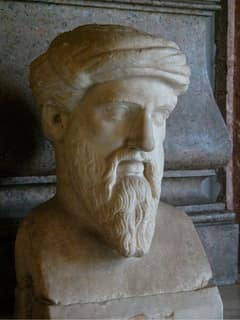
›Pythagoras3 passages · 3 works
The Birth of Tragedy 11… never been a Sixth Century with its birth of tragedy, its Mysteries, its Pythagoras and Heraclitus, indeed as if the art-works of that great period did not at …
The Gay Science 351… of the spirit the superb arrogance of assuming the name "wise"—the modesty of such monsters of pride and self-glorification as Pythagoras and Plato.— …
Human I.261… a law-giver is a sublimated form of tyranny. Parmenides also made laws. Pythagoras and Empedocles probably did the same; Anaximander founded a city. Plato …
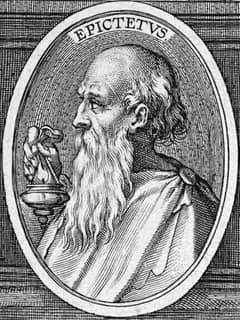
›Epictetus3 passages · 2 works
Daybreak 131… have changed! The greatest marvels of the morality of antiquity, such as Epictetus, knew nothing of the glorification, now so common, of the spirit of …
The Gay Science 122… now read the moral books of the ancients, for example those of Seneca and Epictetus, we feel a pleasurable superiority, and are full of secret insight and …
Daybreak 546… Slave and Idealist.—The followers of Epictetus would doubtless not be to the taste of those who are now striving after the ideal. The constant tension of his …
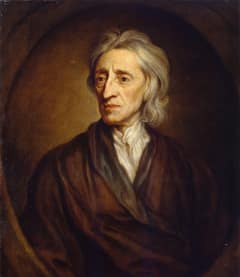
›John Locke2 passages
Beyond Good and Evil 20… also the spell of physiological valuations and racial conditions.—So much by way of rejecting Locke’s superficiality with regard to the origin of ideas. …
Beyond Good and Evil 252… an attack on the philosophical spirit generally, Hobbes, Hume, and Locke, an abasement, and a depreciation of the idea of a “philosopher” for more …
›Johann Gottlieb Fichte2 passages · 2 works
Beyond Good and Evil 244… them. Jean Paul knew what he was doing when he declared himself incensed at Fichte’s lying but patriotic flatteries and exaggerations—but it is probable that …
Daybreak 353… should be shivered in fragments”—so cries the eminent and grandiloquent Fichte.—Yes, certainly; but we must have it first.—What he really means, however, …
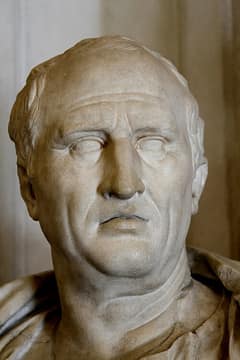
›Cicero2 passages · 2 works
Beyond Good and Evil 247… as it is comprised in one breath. Such periods as occur in Demosthenes and Cicero, swelling twice and sinking twice, and all in one breath, were pleasures to …
Twilight of the Idols Skirmishes.47… inherited is imperfect, it is simply a beginning. In Athens at the time of Cicero—who expresses his surprise at the fact—the men and youths were by far …
›Friedrich Nietzsche (self)1 passage
The Gay Science P.2… ——But let us leave Herr Nietzsche; what does it matter to people that Herr Nietzsche has got well again?... A psychologist knows few questions so attractive as …
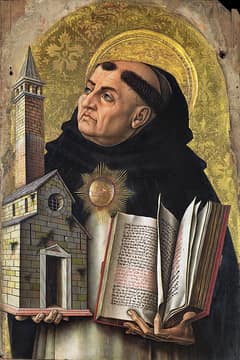
›Thomas Aquinas1 passage
On the Genealogy of Morals I.15… by an authority who in such matters is not to be disparaged, Thomas of Aquinas, the great teacher and saint. “Beati in regno celesti” says he, as gently as …
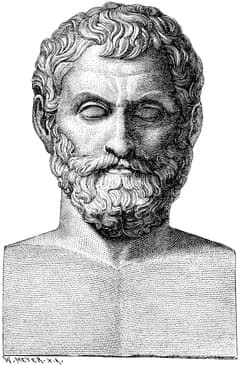
›Thales1 passage
Human I.261… number are badly transmitted; it seems to me that all philosophers, from Thales to Democritus, are remarkably difficult to recognise, but whoever succeeds …
›Parmenides1 passage
Human I.261… of his law-giving; and to be a law-giver is a sublimated form of tyranny. Parmenides also made laws. Pythagoras and Empedocles probably did the same; …
›Diogenes Laertius1 passage
Schopenhauer as Educator 8… of Ritter, Brandis and Zeller? I, at any rate, would rather read Diogenes Laertius than Zeller, because at least the spirit of the old philosophers lives …