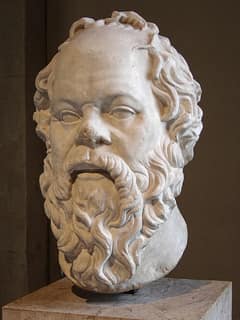
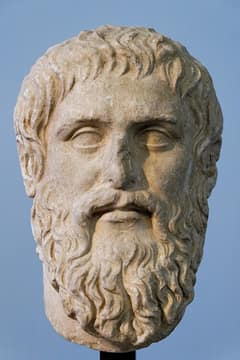
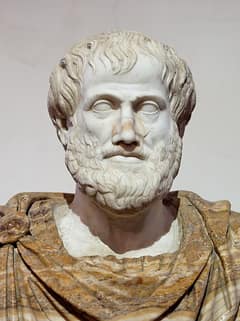
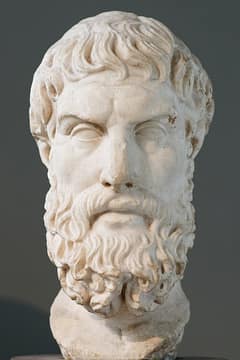
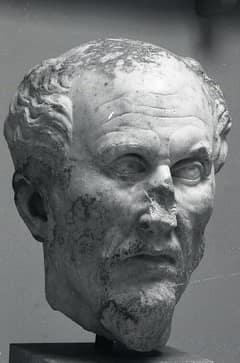
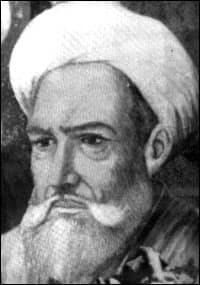
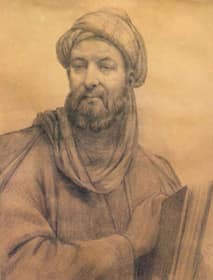
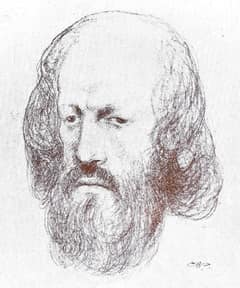
Socrates — Death is either a dreamless nothingness or a migration of the soul, and he does not claim to know which; either way it is no evil to the good man.
Edmund Husserl — Husserl separates the human person, who belongs to the world and dies, from the transcendental ego. The published works suspend the question; the late manuscripts treat the ego's birth and death as limit problems without affirming or denying personal survival.
Martin Heidegger — The existential analysis of death is "this-worldly" and leaves undecided whether there is any being after death; that ontic question can only be asked once death's essence is understood.
In order of birth. Open a row for the reading, its confidence and the passages. * contested reading.
›Socratesc. 470–399 BCESuspends judgment
Suspends judgment. Death is either a dreamless nothingness or a migration of the soul, and he does not claim to know which; either way it is no evil to the good man.
At his trial Socrates says that fearing death is pretending to know what no one knows. He sets out two possibilities, unconscious nothingness or a journey of the soul to another place, argues that each would be a gain, and ends by saying that only the god knows whether he or his judges go to the better lot. The suspension is deliberate and is offered as an instance of his human wisdom.
Another reading. In the Gorgias Socrates tells a myth of judgment after death that he says he offers as the truth (523a–527a), and the Crito closes with the laws of Hades; some read the Apology's disjunction as caution before a jury, not his settled view.
Another reading. The Socrates of the Phaedo argues at length that the soul is immortal (102a–107b); most assign those arguments to Plato.
Scholarly consensusPlato, early dialogues (Apology); contrast Gorgias and the middle-period PhaedoDraft — not yet reviewed
The individual soul existed before birth and survives death. The Phaedo argues this from opposites, from recollection, from the soul's affinity with the Forms and from its essential share in life; the Phaedrus argues from the soul's being a self-mover. The myths of judgement assume that the same soul carries its character into its next life.
Consensus attaches to the thesis, not the proofs: whether Plato thought the Phaedo's arguments sound is debated, and Socrates himself asks for their first assumptions to be examined further (107b). Phaedrus 245c psyche pasa can mean "every soul" (Fowler) or "all soul" taken collectively. Whether the whole tripartite soul is immortal or only reason is unclear: Republic 611b–612a hints that the true soul is simpler, and Timaeus 69c–d calls the lower parts mortal.
Since the soul is the form of the body, it perishes with the body, with the possible exception of intellect. De Anima III.5 says that the intellect which makes all things is separable, unaffected and unmixed, and that this alone is immortal and eternal; it adds that we do not remember, since the intellect that is affected perishes. On the reading coded here something intellectual survives without memory or character, but whose intellect it is, and what we fail to remember, are the most disputed questions in the treatise.
Another reading. Alexander of Aphrodisias, and among modern scholars Caston (1999), identify the productive intellect with God, not a part of the human soul; on this reading the human soul is wholly mortal and nothing of the individual survives.
Another reading. Aquinas read the productive intellect as a power of each individual soul, so each human intellect, and the soul whose form it is, survives death.
Contested readingDe Anima I.4, II.2, III.5nous poietikos, nous pathetikos, choristos, athanatos, aidiosDraft — not yet reviewed
Good and evil require sensation, and death is the end of sensation, so death is nothing to us. When the body is resolved into its elements the soul is scattered and nothing remains that could feel. Understanding this removes the longing for immortality and makes mortal life enjoyable.
Stated in the textLetter to Menoeceus 124–125; Principal Doctrines 2; Letter to Herodotus 65thanatos, anaisthesia, steresis aistheseosDraft — not yet reviewed
The soul is immortal because it is incorporeal and akin to the divine; individual souls remain distinct even in the intelligible world, though they pass through other lives.
Stated in the textathanasia, psycheDraft — not yet reviewed
The purified soul in the intelligible keeps no memory of its earthly life (IV.4.1), which brings him near the `intellect-only` option for the person with memory and character.
›al-Farabic. 872–950The soul is immortal* (contested reading)
Only souls whose intellect has been perfected survive the body, each distinct, and they join the company of like souls in a happiness that grows as others arrive. Souls of the ignorant cities perish; souls that knew the good and did evil survive in misery.
Across the works. Ibn Rushd and Ibn Tufayl report that in his lost commentary on the Nicomachean Ethics he called survival after death and conjunction with the Active Intellect old wives' tales, and held the only happiness to be political, in this life (Long Commentary on De Anima III, comment 36; check).
Contested readingVirtuous Citysaʿāda, baqāʾ, al-mudun al-jāhilaDraft — not yet reviewed
Immortality is conditional on intellectual perfection. Whether the Ethics report reflects a later view or a different register is disputed; Pines (1979) took it as a later, sceptical position.
The rational soul does not perish with the body, because it does not depend on the body for its existence; each soul survives as an individual and is happy or miserable according to the perfection it reached.
Stated in the textmaʿād, saʿāda, shaqāwaDraft — not yet reviewed
In the Healing he accepts bodily resurrection on the authority of revealed law without demonstrating it (Metaphysics IX.7). Al-Ghazali charged the philosophers with denying it and counted that unbelief (Incoherence, Discussion 20).
The soul survives death and meets reward or punishment at once; at the resurrection it is returned to a body. Denying bodily resurrection, as the philosophers do, is unbelief.
Stated in the textRevival, Book 40; Incoherence, Discussion 20maʿād, ḥashr, ākhira, al-mawtDraft — not yet reviewed
The material and agent intellects are eternal, and humanity's grasp of the theoretical intelligibles is everlasting in the species; what is individual in a person, the cogitative power and memory, perishes with the body.
Another reading. In works addressed to all, he affirms that souls survive and are rewarded or punished and that all religions agree on it, while leaving its manner open (Incoherence of the Incoherence, on resurrection; Exposition, last chapter); read with these, he does not deny personal survival.
Contested readingLong Commentary on De Animaal-ʿaql al-hayūlānī, al-quwwa al-mufakkira, baqāʾDraft — not yet reviewed
Taylor ("Personal Immortality in Averroes' Mature Philosophical Psychology", 1998) argues that the Long Commentary leaves no room for personal immortality. The Latin condemnations of 1270 and 1277 took the unity of the intellect as his doctrine.
The managing light does not perish with the body, since a light has no contrary and nothing in it can corrupt. After death pure souls join the world of lights; souls not yet pure live among suspended images, where they meet pleasures and pains that match what they became.
Scholarly consensusal-muthul al-muʿallaqa, ʿālam al-mithāl, maʿādDraft — not yet reviewed
The rational soul survives the body. In the Abstract he also affirms the bodily resurrection taught by revelation, arguing that God can bring back what perished, and the Beginning and the End describes the soul's return and its reward or punishment as the soul's own states.
Scholarly consensusmaʿād, maʿād jismānī, iʿāda al-maʿdūmDraft — not yet reviewed
The human soul is incorruptible because it has an operation of its own and is a subsistent form; separated, it is not a complete person, and the resurrection of the body completes it.
Stated in the textanima separata, incorruptibilis, resurrectioDraft — not yet reviewed
The individual soul survives death, and the person is raised soul and body: the soul gives itself a body formed by its imaginative power and shaped by the traits it acquired, and this body is the same person's body, since a body's identity lies in its soul.
Scholarly consensusal-maʿād al-jismānī, badan mithālī, khayālDraft — not yet reviewed
The mind is a substance distinct from the body and is not destroyed by the body's corruption, which gives grounds for hope in an afterlife; he claims no more, since only God's power could annihilate it.
Scholarly consensusmens, immortalitas, substantia incorruptibilisDraft — not yet reviewed
Metaphysical and moral arguments for immortality fail, and the analogy of nature, the only sound guide here, strongly suggests that the soul ends with the body; only revelation could teach otherwise.
Scholarly consensusanalogy of nature, revelationDraft — not yet reviewed
Immortality cannot be proved: the Paralogisms refute the rational proofs, including Mendelssohn's argument from the soul's simplicity. It is postulated because the complete fitness of the will to the moral law can be approached only in an endless progress.
Stated in the textCritical periodPostulat, Heiligkeit, unendlicher ProgressusDraft — not yet reviewed
›G. W. F. Hegel1770–1831The soul is immortal* (contested reading)
In the lectures on religion, immortality is treated as a present quality of spirit: the soul as thinking and free is of infinite worth and eternal now, not only after death. Whether this affirms personal survival was disputed by Hegel's first readers.
Another reading. Feuerbach, whose Thoughts on Death and Immortality (1830) founds the Left reading, and the Left Hegelians after him read Hegel's eternal life as the present life of spirit and his system as excluding personal survival.
Contested readingLectures on the Philosophy of Religion, 1827 lectures (lecture course; transcripts, ed. Jaeschke)Unsterblichkeit, unendlicher Wert, ewiges LebenDraft — not yet reviewed
The primary reading is the Right Hegelians', e.g. Göschel (1835), who defended personal immortality on Hegelian grounds. The published system says little; the death of the individual living thing (Enc. §§375–376) marks the passage from nature to spirit. The lecture texts are compiled from transcripts.
Personal immortality is a great lie that devalues this life by placing its centre of gravity in a beyond. Eternal recurrence is the return of this same life, not the survival of a soul.
Suspends judgment. Husserl separates the human person, who belongs to the world and dies, from the transcendental ego. The published works suspend the question; the late manuscripts treat the ego's birth and death as limit problems without affirming or denying personal survival.
Phenomenology describes how the soul is constituted as part of the world, and suspends claims about its fate. Late manuscripts argue that the transcendental ego cannot experience its own beginning or end, which bears on, but does not answer, personal survival.
Across the works. In the late manuscripts the transcendental ego, as the field in which every beginning and end is constituted, cannot itself be thought to begin or end. This concerns the transcendental ego, not the human person, and no option expresses it.
Contested readingIdeas I (1913); research manuscripts (1920s–1930s; Hua XI appendices, Hua XLII)Draft — not yet reviewed
Suspends judgment. The existential analysis of death is "this-worldly" and leaves undecided whether there is any being after death; that ontic question can only be asked once death's essence is understood.
Heidegger distinguishes the ontological analysis of death from biology, psychology and theology, and says it decides nothing about an afterlife. What matters is death as Dasein's ownmost possibility, not what may lie beyond it.
Stated in the textBeing and Time (1927)Sein zum Tode, diesseitige InterpretationDraft — not yet reviewed
Hekmat. "Is death the end of individual existence, or is some survival or continuation possible?." Draft, awaiting review; last updated 20 October 2026. https://hekmat.local/questions/ont-immortality/