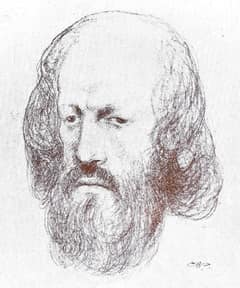
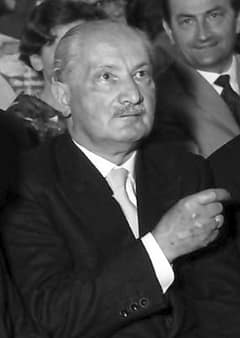
Mir Findiriski — The heavens and the world beneath them form one ordered whole in which every form below has its original above; knowledge can climb from the lower form to the higher and find it one with its source.
Rejects the question
G. W. F. Hegel — The alternative of a first moment or an infinite past is an antinomy of the understanding, which fixes finite and infinite apart; creation is the Idea's eternal self-determination, not an event in time.
Suspends judgment
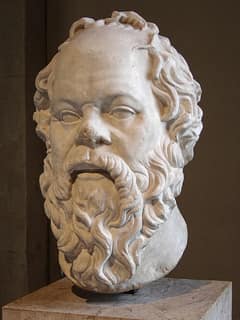
Socrates — He kept away from inquiry into the heavens and, on Xenophon's report, held that how the cosmos came to be is beyond human discovery.
In order of birth. Open a row for the reading, its confidence and the passages. * contested reading.
›Socratesc. 470–399 BCESuspends judgment
Suspends judgment. He kept away from inquiry into the heavens and, on Xenophon's report, held that how the cosmos came to be is beyond human discovery.
Plato's Socrates denies the comic picture of him as a student of the heavens and says he has nothing to do with such matters, though he does not scorn those who know them. Xenophon reports that he refused to discuss how the cosmos arose and wondered that others did not see such things cannot be discovered by human beings. Aristophanes' Clouds shows the opposite, a Socrates who studies the sky, which the Apology treats as caricature.
Another reading. Xenophon's report that such questions are undiscoverable by human beings could be coded as a verdict that reason cannot settle them, though Socrates gives no arguments on either side.
The Phaedo (96a–99d) has Socrates recall an early interest in natural science that ended in disappointment with Anaxagoras; whether this is history or Plato's construction is disputed.
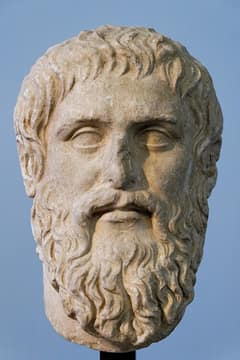
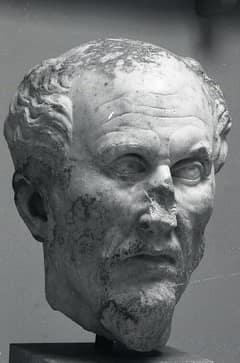
›Platoc. 428–348 BCEOrdered by a craftsman* (contested reading)
The cosmos is visible and bodily, so it has come into existence, and whatever comes into existence has a cause: a good craftsman brought a disorderly motion into order after the pattern of the eternal Forms, making time, a moving image of eternity, together with the heavens. Read at its word, the account gives the ordered world a beginning from pre-existing disorder, with no creation from nothing. Whether it is meant literally is the central dispute, and Timaeus himself calls it only a likely account (29c–d).
Another reading. Didactic reading: the account is a teaching device, like a geometer's construction; the world is everlasting and "generated" only in being caused and dependent. This was the view of the early Academy (Speusippus and Xenocrates, according to the ancient commentators), of most later Platonists including Plotinus and Proclus, and of Cornford (1937).
The main code follows the literal reading of Aristotle (De Caelo I.10, 279b32–280a11, rejecting the didactic defence), of the Middle Platonists Plutarch and Atticus, and of Vlastos (1939) among modern scholars.
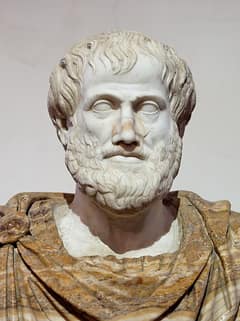
The world had no beginning and will have no end. Any first change would need a prior change to bring it about, and time cannot have a first instant, since every now is the end of a past and the start of a future. The heavens are ungenerated and indestructible, and Aristotle explicitly criticises those who say the world was generated but will last forever.
Stated in the textPhysics VIII.1; De Caelo I.10–12aidios, kinesis, chronos, nyn, ouranos, agenetosDraft — not yet reviewed
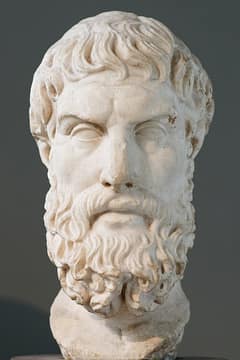
The sum of things has always been as it is now and always will be, since there is nothing outside it into which it could change and nothing that could enter it. Atoms and void exist from everlasting. Our world, by contrast, is one of infinitely many worlds that formed from atoms and will be dissolved again.
Stated in the textLetter to Herodotus 39–45, 73–74to pan, kosmos, apeiroi kosmoiDraft — not yet reviewed
The code applies to the universe as a whole. Each world (kosmos), including ours, has a beginning and an end, so the question's "world" must be read as the totality.
The cosmos has no beginning in time and will never end, yet it is not self-standing: it is eternally produced from the higher principles, as light from a source, without deliberation or a decision to make it.
Stated in the textkosmos, proodos, aidiosDraft — not yet reviewed
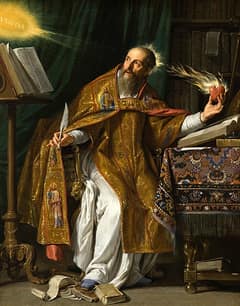
›Augustine of Hippo354–430Created from nothing, with time
God made the world from nothing, and made time with it, so the world was made not in time but with time; to ask what God did before is to misunderstand eternity.
Stated in the textcreatio ex nihilo, cum tempore, aeternitasDraft — not yet reviewed
The world proceeds from the First by necessary emanation, without beginning: from the First's self-thinking comes the first intellect, and from each intellect the next and a heavenly sphere, down to the Active Intellect and the matter below the moon.
Scholarly consensusfayḍ, al-sabab al-awwal, al-thawānīDraft — not yet reviewed
His lost treatise against Philoponus defended the eternity of the heavens (Mahdi, 1967). The Harmonization of the Two Sages, which reads Aristotle as holding the world made by God, is of disputed authorship (Rashed, 2009).
The world has no first moment, yet it exists only because the First eternally necessitates it; to be caused does not require coming after nothing in time, only being posterior in essence.
Stated in the textibdāʿ, ḥudūth dhātī, qidamDraft — not yet reviewed
›al-Ghazali1058–1111Created from nothing, with time
The world came to be after not being, by God's eternal will, which chose the time of its origin; time is created with it. An eternal past would require infinitely many completed revolutions of the heavens, which is absurd.
Scholarly consensusModeration in Belief (own kalām); Incoherence, Discussion 1 (polemic)ḥudūth al-ʿālam, al-irāda al-qadīma, zamānDraft — not yet reviewed
The First Discussion shows only that the philosophers fail to demonstrate eternity; the positive proof is in Moderation in Belief. The Conclusion counts the world's eternity among the three doctrines that are unbelief.
The world has neither beginning nor end, yet it is made: its existence depends at every moment on the First, which brings it about perpetually. The dispute with the theologians over whether the world is eternal or originated is close to a dispute over names.
Scholarly consensusḥudūth dāʾim, qidam, ikhtirāʿDraft — not yet reviewed
The world has no beginning in time. The Light of Lights is eternal and its illumination never ceases, so the lights and the heavens that depend on it are eternal too, and the motions of the heavens have no first moment.
Scholarly consensusqidam, ishrāq, ḥarakāt al-aflākDraft — not yet reviewed
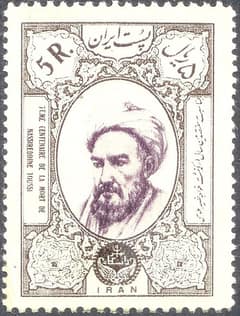
›Nasir al-Din Tusi1201–1274Created from nothing, with time* (contested reading)
In the Abstract, God is an agent who acts by choice, and the world, every body in it, is originated in time. As commentator on the Pointers he expounds and defends Ibn Sina's eternal production of the world, without saying it is his own view.
Another reading. Read from the Commentary and his philosophical correspondence, his considered view stays Ibn Sina's: the world proceeds eternally from the First, and the Abstract's origination is the theologians' register.
Contested readingThe Abstract of Belief (kalām); the Commentary on the Pointers (exposition of Ibn Sina)ḥudūth, qidam, mukhtār, mūjibDraft — not yet reviewed
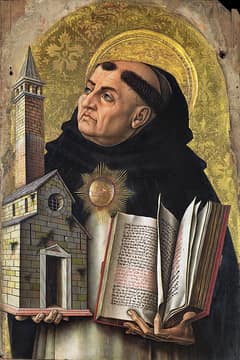
›Thomas Aquinasc. 1225–1274Created from nothing, with time
The world was created from nothing and began, with time; this is held by faith alone, since its beginning depends on God's free will and cannot be demonstrated, any more than its eternity can.
Stated in the textaeternitas mundi, creatio, sola fide teneturDraft — not yet reviewed
His distinctive thesis answers a different question, what reason can show: reason cannot settle whether the world began (`undecidable` for reason alone). He holds this against the Latin Averroists, who took eternity as demonstrated, and against Bonaventure (In II Sent. d.1), who took the beginning as demonstrable.
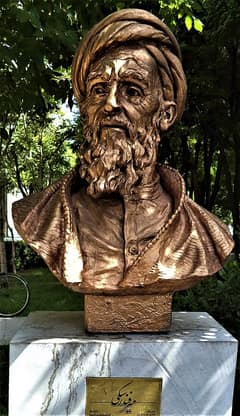
Own position. The heavens and the world beneath them form one ordered whole in which every form below has its original above; knowledge can climb from the lower form to the higher and find it one with its source.
The ode opens with the beauty and order of the heavens and says that whatever is above has a form below it. The lower form, if it climbs the ladder of knowledge, is found to be one with its origin, something outward understanding cannot see, not even that of al-Farabi or Ibn Sina. He says nothing of whether the world had a beginning.
Scholarly consensuscharkh, ṣūrat, nardibān-i maʿrifat, aṣlDraft — not yet reviewed
The options for this question concern the world's origin, which the ode leaves aside; it answers the question of order. Whether "above" means the celestial spheres, the separate intellects or the Platonic Forms is disputed (see ont.universals).
Divine giving of existence has no beginning, but the natural world, being in constant substantial motion, is renewed at every instant: each of its parts, and so the whole, is preceded in time by its own non-existence. Sadra presents this as proving that the world is originated, as revelation teaches, without positing a first moment of time.
Scholarly consensusḥudūth zamānī, al-ḥaraka al-jawhariyya, tajaddudDraft — not yet reviewed
Neither option holds the view: the world as a whole has no first moment, yet nothing in it is eternal, and Sadra presents this as vindicating the theologians' origination of the world (so `created-in-time` is the nearest rival code). A candidate for the own-position option in codebook 1.2.0.
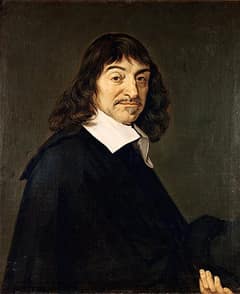
›René Descartes1596–1650Created from nothing, with time
There is no doubt the world was created at the start with all its perfection, as faith teaches; Descartes nonetheless explains it as if it had developed from a chaos by the laws of motion, without claiming that this is how it happened.
Stated in the textcreatio, hypothesis, leges naturaeDraft — not yet reviewed
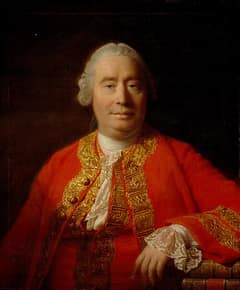
Whether the world began cannot be settled, because it is a unique effect and we have experience of no other worlds; rival cosmogonies are equally unsupported, and a priori anything may produce anything.
Scholarly consensussingular effect, experience, cosmogonyDraft — not yet reviewed
For Hume it is undecidable by experience, the only judge of matters of fact, rather than by reason in the sense of the codebook's other examples. The Dialogues VI–VIII citations are Philo's speeches.
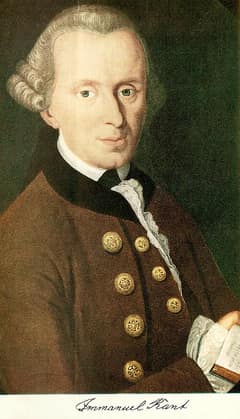
Reason proves both that the world has a beginning in time and that it has none; the first antinomy arises because the world is treated as a whole given in itself. Since the world as a whole is never given in experience, both theses are false of it, and the regress of conditions is only a task.
Stated in the textCritical periodAntinomie, Weltganzes, regressus in indefinitumDraft — not yet reviewed
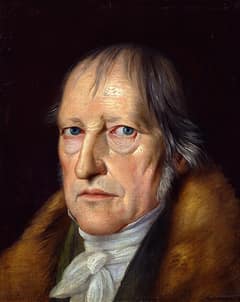
›G. W. F. Hegel1770–1831Rejects the question* (contested reading)
Rejects the question. The alternative of a first moment or an infinite past is an antinomy of the understanding, which fixes finite and infinite apart; creation is the Idea's eternal self-determination, not an event in time.
Kant was right that reason meets antinomies, but they are found in every concept, not only four, and are resolved by grasping the unity of their opposed determinations. Nature is the Idea in the form of otherness, and the world is created eternally rather than at a moment.
Another reading. Hegel's eternal creation can be coded as a world without a first moment that eternally depends on the Idea.
Contested readingEncyclopaedia (1830)Antinomie, Verstand, Idee in ihrem AndersseinDraft — not yet reviewed
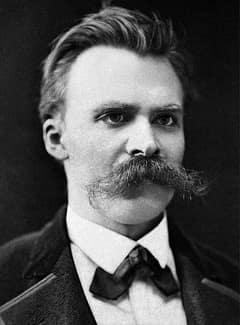
›Friedrich Nietzsche1844–1900Eternal and unproduced* (contested reading)
The world as a whole is eternal chaos, without purpose or creator, and if eternal recurrence is meant cosmologically it has no beginning and no end. Whether the recurrence is a cosmology at all is disputed.
Another reading. The published texts present recurrence as a thought-experiment and test of affirmation (GS 341), not a cosmological claim; the cosmological proofs are in the Nachlass. On this reading Nietzsche has no position on the world's beginning.
Contested readingGay Science (1882); Zarathustra III (1884)ewige Wiederkunft, ChaosDraft — not yet reviewed
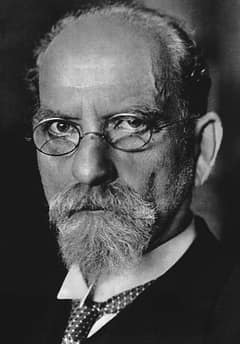
Not addressed. Whether the world had a beginning is a question for the natural sciences or metaphysics, whose theses the epochē suspends; no layer answers it.
The epochē puts out of action all sciences of the natural world together with their results. Husserl's interest is the world as the correlate of consciousness and as the pregiven life-world, not its origin in time.
Scholarly consensusIdeas I (1913); Crisis (written 1936–1937; Part III first published 1954)Draft — not yet reviewed
Not addressed. Whether the universe began is an ontic question about beings as a whole that Heidegger does not address; his "world" is not the totality of beings.
Heidegger separates the ontological concept of world, the context of significance in which Dasein lives, from the ontic totality of things in nature. He leaves the beginning of nature to physics and theology.
Scholarly consensusBeing and Time (1927)Draft — not yet reviewed
Hekmat. "How are the origin, structure and order of the world explained?." Draft, awaiting review; last updated 20 October 2026. https://hekmat.local/questions/ont-cosmos/