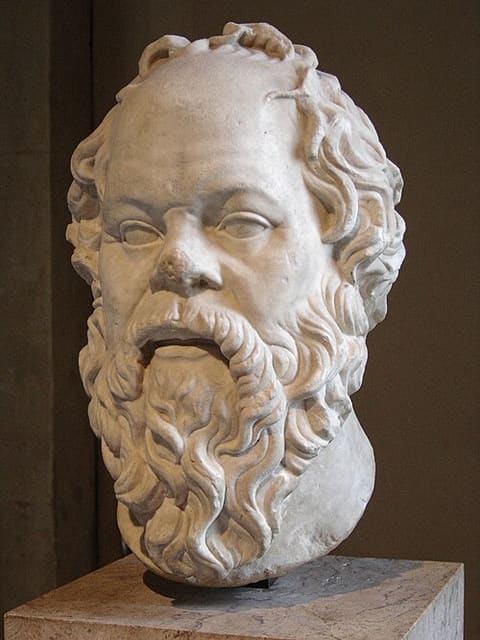
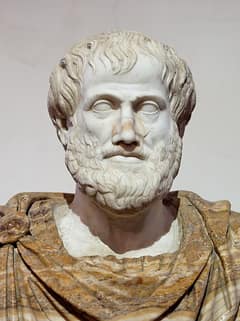
Socrates wrote nothing. He questioned Athenians about justice, courage and piety, showing that their confident definitions failed, and held that the unexamined life is not worth living. He was executed in 399 BCE.
Central question
How should one live, and can virtue be known and taught?
Method
Socrates, as Plato's early dialogues present him, examines people who claim to know by question and answer (the elenchus), while disavowing any wisdom of his own beyond knowing that he does not know. How Socrates works ↓
Known only through others — chiefly Plato's early dialogues, Xenophon and Aristophanes. Separating the historical Socrates from Plato's character is the "Socratic problem".
Scholarly consensus 14
Contested reading 6
5 arguments0 works42 quotations checked word for word0 of 25 positions and arguments reviewed by an expert
Not addressed. He turned away from inquiry into nature, and Aristotle reports that he did not separate the universals he sought; no account of what ultimately exists survives.
Plato's Socrates denies that he has anything to do with inquiry into the heavens and what lies beneath the earth, and Xenophon says he would not discuss the nature of the universe. Aristotle reports that he concerned himself with ethics and sought universal definitions there, but did not make universals exist apart. The Forms of the Phaedo and Republic are usually assigned to Plato.
Another reading. Unitarian readers take the Socrates of the middle dialogues as the same figure, and his account in the Phaedo of turning from natural science to the hypothesis of Forms (96a–100a) as his own path.
Socrates seeks the one character by which all pious acts are pious and uses it as a standard for judging cases. Aristotle reports that he sought universal definitions but did not make universals separate; separation was the step his successors took.
Another reading. R. E. Allen (1970) reads the Euthyphro's form as an early version of the theory of Forms, existing independently of its instances.
Contested readingAristotle's testimony (Metaphysics M.4, M.9); Plato, early dialogues (Euthyphro)eidos, idea, ti esti, ousia, pathosDraft — not yet reviewed
The Euthyphro alone leaves open where the form exists; this coding rests on Aristotle's testimony, which developmentalists accept and agnostics about the historical Socrates do not.
›God and the fundamentalDemonstrable by reason* (contested reading)
Xenophon has Socrates argue from the fitness of the human body and the world for human life to a wise and caring maker, the earliest surviving argument from design attributed to a Greek philosopher. Plato's Socrates is equally pious, says he believes in the gods more than his accusers do, and follows the god of Delphi and his divine sign, but offers no proof that gods exist. He doubts the poets' stories of gods at war with one another.
Another reading. On the evidence of Plato's early dialogues alone, Socrates' belief rests on the oracle, the divine sign and piety, not on argument, and whether reason can establish the divine is never raised; many doubt the design argument is Socratic rather than Xenophon's own.
Another reading. Sedley (2007, Creationism and Its Critics in Antiquity) takes Xenophon's report seriously and credits Socrates with pioneering the argument from design.
Contested readingXenophon, Memorabilia I.4 and IV.3; contrast Plato, early dialogues (Apology, Euthyphro)theos, daimonion, eusebeia, pronoiaDraft — not yet reviewed
The divine is plural in every layer (the gods, the god of Delphi, the daimonion), and Xenophon's argument is for the gods' providential care, not for a single first principle.
›Soul and bodyNot addressed
Not addressed. He urges care of the soul as an ethical task but gives no account of what the soul is or how it relates to the body.
Socrates tells the Athenians to care for their souls more than their bodies or wealth, and in the Crito speaks of the part of us that justice benefits and injustice ruins, "whatever it is". That phrase leaves the soul's nature open. The arguments that the soul is separate from and akin to the Forms come from the Phaedo, usually counted as Plato's.
Another reading. If the Socrates of the Phaedo is counted, the soul is a separate thing that the philosopher tries to free from the body (Phaedo 64c–67d, 78b–80b).
Scholarly consensusPlato, early dialogues (Apology, Crito)psyche, epimeleia tes psychesDraft — not yet reviewed
Suspends judgment. Death is either a dreamless nothingness or a migration of the soul, and he does not claim to know which; either way it is no evil to the good man.
At his trial Socrates says that fearing death is pretending to know what no one knows. He sets out two possibilities, unconscious nothingness or a journey of the soul to another place, argues that each would be a gain, and ends by saying that only the god knows whether he or his judges go to the better lot. The suspension is deliberate and is offered as an instance of his human wisdom.
Another reading. In the Gorgias Socrates tells a myth of judgment after death that he says he offers as the truth (523a–527a), and the Crito closes with the laws of Hades; some read the Apology's disjunction as caution before a jury, not his settled view.
Another reading. The Socrates of the Phaedo argues at length that the soul is immortal (102a–107b); most assign those arguments to Plato.
Scholarly consensusPlato, early dialogues (Apology); contrast Gorgias and the middle-period PhaedoDraft — not yet reviewed
Suspends judgment. He kept away from inquiry into the heavens and, on Xenophon's report, held that how the cosmos came to be is beyond human discovery.
Plato's Socrates denies the comic picture of him as a student of the heavens and says he has nothing to do with such matters, though he does not scorn those who know them. Xenophon reports that he refused to discuss how the cosmos arose and wondered that others did not see such things cannot be discovered by human beings. Aristophanes' Clouds shows the opposite, a Socrates who studies the sky, which the Apology treats as caricature.
Another reading. Xenophon's report that such questions are undiscoverable by human beings could be coded as a verdict that reason cannot settle them, though Socrates gives no arguments on either side.
The Phaedo (96a–99d) has Socrates recall an early interest in natural science that ended in disappointment with Anaxagoras; whether this is history or Plato's construction is disputed.
›Freedom and determinismNot addressed
Not addressed. Whether choices are causally determined is never asked; his thesis that wrongdoing is involuntary concerns knowledge, not freedom.
Socrates holds that no one does wrong willingly, so a wrongdoer needs teaching rather than punishment; he says this of himself at his trial. This bears on responsibility, but it rests on the claim that everyone wants the good and errs from ignorance, not on any view about causes and choice. The intellectualist thesis is coded under virtue and knowledge.
Scholarly consensusPlato, early dialogues (Apology, Protagoras, Gorgias)hekon, akon, amathiaDraft — not yet reviewed
The option `voluntary-action` is Aristotle's theory; Socrates makes all wrongdoing involuntary, which none of the options captures.
›CausationEnds govern explanation* (contested reading)
Xenophon's Socrates argues that the parts of living bodies, such as eyelids that shield the eyes, show design rather than chance, so he explains them by their purpose. In the Phaedo, Plato's Socrates recalls hoping natural science would show why each thing is best as it is, and faults Anaxagoras for citing air and water, which are only conditions of the real cause. Both authors also show him declining to ask by what necessities the heavens came about.
Another reading. Read from the Apology and Memorabilia I.1, he refuses to inquire by what necessities heavenly things come about and thinks such matters beyond human discovery, so he abstains on natural causation; the design argument then belongs to his piety (coded under ont.god) and the Phaedo's search for the best to Plato. On that reading the mode is `abstains`.
Contested readingXenophon, Memorabilia I.4 and IV.3; Plato, Phaedo 96a–99d (middle dialogue); contrast Plato, Apology and Xenophon, Memorabilia I.1aitia, to beltiston, gnome, tyche, anankeDraft — not yet reviewed
Coded under the coding rule from the layer that states a view (Xenophon's design argument), as ont.god is. Whether the Phaedo's account of his early interest in natural science is history or Plato's construction is disputed, as noted under ont.cosmos.
Epistemology
›Sources of knowledgeNot addressed
Not addressed. No surviving layer gives Socrates a theory of where knowledge comes from; he disclaims wisdom rather than explaining its origin.
The Socrates of the early dialogues examines whether others know, and finds that neither they nor he know what virtue or piety is, but he never says what the ultimate source of knowledge would be. Aristotle reports that Socrates confined his inquiries to ethics and the search for definitions. The theory of recollection, which would answer the question, appears first in the Meno and is usually credited to Plato.
Another reading. Unitarian and literary readers, who take the Socrates of all Plato's dialogues as one character, credit him with recollection (Meno 81c–86b) and so with knowledge by reason; developmentalists such as Vlastos (1991) assign recollection to Plato.
Scholarly consensusPlato, early dialogues (Apology); Aristotle's testimony (Metaphysics A.6)Draft — not yet reviewed
›Certainty, doubt and the limits of knowledgeProfessed ignorance
Socrates says that he knows nothing fine and good, and that his only advantage is not thinking he knows what he does not. He reads the oracle as saying that human wisdom is worth little. Yet he also claims a few moral certainties, such as that doing wrong is evil and shameful, and holds that examining oneself and others is the best thing a human being can do.
Another reading. The sceptical Academy read the disavowal as full suspension of judgment: Arcesilaus is said to have denied that anything can be known, not even what Socrates had left himself (Cicero, Academica I.44–45).
Scholarly consensusPlato, early dialogues (Apology, Meno 71a–b); Xenophon's Socrates disclaims knowledge far less and instructs his companions directlyeironeia, aporia, anthropine sophia, elenchosDraft — not yet reviewed
How the disavowal fits with the moral claims he does make is the central dispute. Vlastos (1985, "Socrates' Disavowal of Knowledge") distinguishes certain knowledge, which he disclaims, from fallible "elenctic" knowledge, which he allows; the option's "narrow practical certainties" covers this only roughly.
›Innate knowledgeNot addressed
Not addressed. The early dialogues say nothing about knowledge present in the soul before experience; the doctrine first appears in the Meno.
In the early dialogues Socrates searches for definitions by questioning, without explaining how the answers could already be in the questioner. The Meno meets this puzzle with recollection, the soul having always possessed the truth, and that dialogue marks the point where most readers see Plato's own theory begin.
Another reading. If the Socrates of the Meno is counted, he holds that learning is recollection of what the soul already possesses (Meno 81c–86b).
Scholarly consensusPlato, early dialogues; the Meno is transitionalDraft — not yet reviewed
Not addressed. No account of what truth is survives in any layer of the testimony.
Socrates asks what piety, courage or justice is, and tests answers for consistency, but he does not ask what truth itself is or what makes a statement true. Aristotle reports that he dealt with ethics, not with nature or first principles.
Scholarly consensusPlato, early dialogues; Aristotle's testimony (Metaphysics A.6)Draft — not yet reviewed
›Epistemic justificationAn account of why* (contested reading)
Socrates disclaims knowledge of the most important things, yet he holds some theses firmly, and what entitles him to them is that they have survived examination: he follows only the argument that seems best when he reflects, and what has been shown stays fastened by reasons "of steel and adamant" until someone undoes them. An expertise must be able to give an account of the nature and cause of what it deals with; a knack that cannot is no art.
Another reading. Vlastos ("Socrates' Disavowal of Knowledge", 1985) separates certain knowledge, which Socrates disclaims, from "elenctic" knowledge of theses that have survived refutation, which he allows; on this reading the account he can defend is exactly what warrants his moral claims.
Another reading. Benson (Socratic Wisdom, 2000) reads Socrates as holding that knowing anything about a virtue requires first knowing its definition, which he lacks, so his firm theses are not knowledge on his own standard and he offers no account of what would justify them.
Contested readingPlato, early dialogues (Crito, Gorgias, Apology); Xenophon, Memorabilia IV.6logos, elenchos, logon didonai, technēDraft — not yet reviewed
`account` is coded from what Socrates relies on, not from a theory he states; the option's demand that the account say why fits the Gorgias on technē better than the elenchus, which tests consistency. Xenophon's Socrates argues from what is most widely agreed (Memorabilia IV.6.15), a different, more dialectical warrant. The theory of a belief "tied down" by reasoning about the cause is the Meno's and is coded for Plato.
Axiology
›The highest goodFlourishing through virtue
What matters is not living but living well, and living well is the same as living justly. The good person is happy and the unjust person wretched, so doing wrong is worse than suffering it. Care for the soul's excellence comes before care for body, wealth or reputation.
Another reading. In the Protagoras (351b–358d) Socrates argues from the premise that pleasure is the good. Irwin (1977, Plato's Moral Theory) takes this as Socrates' own view; most readers take it as an assumption granted for the sake of argument against the many.
Scholarly consensusPlato, early dialogues (Apology, Crito, Gorgias)eudaimonia, arete, eu zen, dikaiosyneDraft — not yet reviewed
Whether virtue is sufficient for happiness, identical with it, or only its dominant part is disputed: Vlastos (1991) holds virtue sufficient but allows minor non-moral goods; Brickhouse and Smith (1994, Plato's Socrates) deny sufficiency. All three readings fall within this option.
›The basis of moralityKnowledge of the good
Right action follows from knowing what is good and bad: everyone pursues what they think good, and wrongdoing comes from false belief, not from being overcome. Doing wrong harms the soul of the wrongdoer, so one must never do wrong, not even in return. Rightness is not made by the gods' approval: the gods love the holy because it is holy.
Another reading. Xenophon's Socrates identifies the just with the lawful in conversation with Hippias (Memorabilia IV.4.12–13); no option names this.
Scholarly consensusPlato, early dialogues (Protagoras, Crito, Euthyphro); contrast Xenophon, Memorabilia IV.4episteme, sophia, to agathon, adikein, to hosionDraft — not yet reviewed
Virtue is a kind of knowledge or wisdom, and no one who knows what is best will act otherwise. What the many call being overcome by pleasure is really ignorance about the relative size of goods and evils. Plato, Xenophon and Aristotle agree in attributing this intellectualism to Socrates, which makes it the best-attested of his doctrines.
Scholarly consensusPlato, early dialogues (Protagoras, Meno 87b–89a); Xenophon, Memorabilia III.9; Aristotle's testimony (Nicomachean Ethics VI.13, VII.2)arete, episteme, sophia, akrasia, metretike techneDraft — not yet reviewed
Whether Socrates allows non-rational desires any motivating force is disputed (Penner's strict intellectualism against Brickhouse and Smith, Socratic Moral Psychology, 2010); both sides keep the thesis that virtue is knowledge. The Meno itself ends by suggesting that virtue comes by divine dispensation as true opinion (99e–100b).
›The state and legitimacyRule by the wise* (contested reading)
Socrates holds that in matters of right and wrong one should follow the one who knows, not the many, and Xenophon reports that he called rulers only those who know how to rule. He claims to practise the true political art by aiming at what is best, not what pleases. Yet he kept out of public life, served when his turn came, and refused to break the laws to save himself.
Another reading. The Apology stresses withdrawal: his divine sign kept him out of politics, and a just man who wants to survive must live as a private citizen (31c–32a).
Another reading. Kraut (1984, Socrates and the State) reads the expertise principle as a criticism of democratic practice that stops short of any constitutional proposal, and the Crito as leaving room for justified disobedience.
Contested readingPlato, early dialogues (Crito, Gorgias, Apology); Xenophon, Memorabilia I.2 and III.9politike techne, ho epistamenos, idioteueinDraft — not yet reviewed
Socrates never describes a best constitution; the code records the principle that those who know should rule. `withdrawal` is defined in Epicurean terms that do not fit his respect for the laws (Crito 50a–54d).
›Beauty and artNot addressed
Not addressed. No layer gives a view on whether art and beauty lead toward truth or away from it; the Apology says only that poets lack knowledge of what they say.
Examining the poets, Socrates found that they could not explain their own poems and composed by nature and inspiration, like seers who say fine things without knowing them. This is a claim about poets' knowledge, not about the value of poetry or beauty. Xenophon's conversations with a painter and a sculptor (Memorabilia III.10) and on beauty as fitness for use (III.8) fit none of the options.
Another reading. If the Socrates of Republic II–III and X is counted, imitative poetry is suspect and must be controlled; most assign that critique to Plato.
Own position. Justice is the good of the soul, which injustice ruins, so one must never do injustice or harm anyone, not even in return for a wrong, and must keep just agreements, the agreement with the laws included.
The Socrates of the early dialogues never reaches a definition of justice, but he holds firm principles about it. The part of us that justice benefits and injustice ruins matters more than the body; doing wrong is the greatest evil and worse than suffering it; and since the good cannot harm, it is never just to harm anyone, so wrong may not be returned for wrong. In the Crito the same principle binds him to keep his agreement with the laws.
Another reading. Xenophon's Socrates identifies the just with the lawful, and counts as law the unwritten laws the gods laid down, which are observed alike in every country (Memorabilia IV.4.12–25); on this layer he holds a justice by nature behind written law.
Another reading. Readers who take Plato's Socrates as one figure across the dialogues, with the early works written to lead into the Republic (Kahn, Plato and the Socratic Dialogue, 1996), credit him with the Republic's account of justice as the order of the soul.
No shared option fits: the principles concern how justice binds the agent, not what grounds it in the soul's structure, in a law of nature or in an agreement. Vlastos (Socrates: Ironist and Moral Philosopher, 1991, ch. 7) reads the ban on retaliation as Socrates' break with the traditional morality of helping friends and harming enemies.
›The nature of valueOwn position
Own position. The holy and the just are what they are whether or not gods or people approve of them; what they are is what inquiry seeks, and on such matters only the one who knows, not the many, is to be heeded.
Socrates leads Euthyphro to agree that the holy is loved by the gods because it is holy, not holy because it is loved, so being approved cannot be what makes it holy. In the Crito he says that on the just, the noble and the good one must heed the one who knows and the truth itself, not the many. In the Gorgias everyone wants what is really good, not what merely seems best. What the good is, he does not claim to know.
Another reading. Euthyphro 5d and 6d–e already speak of one form (idea) by which all holy things are holy, so the dialogue can be read as an early version of the theory of Forms (R. E. Allen, Plato's "Euthyphro" and the Earlier Theory of Forms, 1970).
Scholarly consensusPlato, early dialogues (Euthyphro, Crito, Gorgias)to hosion, theophiles, to agathon, hoi polloi, ho epaiōnDraft — not yet reviewed
Coded on what Socrates says of the holy, the just and the good, not on "value". The early dialogues affirm that these do not depend on approval, but give no account of what grounds them; the Good beyond being is Plato's, so no shared option fits.
* contested reading · open a row for the explanation and its sources
Method روش و شیوه اندیشهورزی فلسفی
Socrates, as Plato's early dialogues present him, examines people who claim to know by question and answer (the elenchus), while disavowing any wisdom of his own beyond knowing that he does not know. Since he wrote nothing, his method is known only through Plato, Xenophon and Aristotle, who do not describe it in the same way.
Posing questions
In Plato's early dialogues Socrates asks "What is it?" of a virtue or a value (piety, courage, temperance) and asks for the one character by which all its cases are what they are, not for examples. He puts the question to someone who professes to know, often because that person is about to act on the knowledge, as Euthyphro is about to prosecute his father. Plato's Apology traces the practice to the Delphic oracle: Socrates set out to test the god's saying that no one was wiser, and kept examining others as a service to the god. Xenophon and Aristotle also report that he asked what each thing is.
The elenchus gets the interlocutor to state a thesis, secures his agreement to further premises, and shows that these premises, taken with the thesis, lead to its denial; the thesis is then given up or revised, and the inquiry often ends in perplexity (aporia). Socrates counts only the interlocutor's own assent as a witness, not the opinion of the many. Aristotle credits him with two things, inductive arguments (from similar cases) and seeking universal definitions; whether the elenchus can prove a thesis true or only shows that a set of beliefs is inconsistent is disputed.
Rival views are examined in the person who holds them: the politicians, poets and craftsmen of the Apology, the sophists and orators of the Protagoras and Gorgias. The test is consistency and the ability to give an account, so a reputation for wisdom counts for nothing if its holder cannot defend what he says. Socrates presents being refuted as a benefit, since a false belief about how to live is the greatest harm, and turns the same examination on himself.
Plato's Socrates relies on argument: he says he follows only the reasoning that seems best on reflection. Against this stands his disavowal of knowledge, which Aristotle reads as a habit of disowning esteemed qualities (irony) and Plato's Theaetetus casts as the barren midwife who delivers others' thoughts. He also speaks of a divine sign that holds him back and of commands from the god through oracles and dreams; in Plato's account these do not replace argument but frame the mission within which he argues.
Socrates wrote nothing and taught in conversation in public places, so his manner is known only as others wrote it down. Plato's dialogues give the ironic questioner whose partners end in perplexity, like the numbness of the torpedo-fish; Xenophon's Memorabilia gives a practical adviser who often states his own views; Aristophanes' Clouds caricatures him as a sophist and student of nature; and Aristotle reports him briefly as a moral inquirer who sought definitions. Aristotle also notes that he asked questions but did not answer them.
There are no works of his own to compare; the variation is between witnesses and between Plato's dialogues. In the early dialogues the elenchus ends in aporia; in the Meno the aporia becomes the start of joint inquiry, and from there Plato's Socrates goes on to hypotheses, recollection and the Forms, which Aristotle says Socrates himself did not separate. Xenophon's Socrates questions less and advises more, so the picture of the method depends on which witness is followed.
elenchos, exetazein, ti esti, aporia, eirōneia, maieutikē, daimonion, epaktikoi logoi
Arguments
›No one does wrong willinglyWrongdoing comes from ignorance, not from knowing the better and choosing the worse; no one does wrong willingly, and one who knows the good will do it.
1Everyone wants good things, and does whatever they do for the sake of what they take to be good.
2Whoever gets bad things is harmed by them, and those who are harmed are miserable.
3No one wants to be miserable.
4So no one who knows that something is bad for him pursues it; whoever pursues what is bad does so believing it good.
5What the many call being overcome by pleasure is choosing the lesser good over the greater, which is an error of measurement and so a lack of knowledge.
∴Wrongdoing comes from ignorance, not from knowing the better and choosing the worse; no one does wrong willingly, and one who knows the good will do it.
Aristotle objects. The thesis plainly conflicts with what we observe: people act against what they believe best. Aristotle allows that the akratic's knowledge is in a sense not active at the moment of acting, but holds that weakness of will is real and not mere ignorance.
Plato objects. The Republic's Socrates argues that the same person can at once desire to drink and refuse to, and that anger can fight against appetite, as when Leontius looks at the corpses against his own judgment; the soul has parts that can oppose reason, so knowing the best is not enough.
›The holy and the god-loved (Euthyphro)The holy is not the same as what the gods love. Being loved by the gods is something that happens to the holy, not what the holy is; the definition gives an affection (pathos), not the essence (ousia), and the inquiry must begin again.
1Euthyphro proposes that the holy is what all the gods love.
2Euthyphro agrees that the gods love the holy because it is holy, and that it is not holy because they love it.
3What is god-loved is god-loved because the gods love it, as anything carried is carried because someone carries it.
4If the holy and the god-loved were the same, then either the holy would be holy because it is loved, or the god-loved would be loved because it is god-loved; both contradict what was agreed.
∴The holy is not the same as what the gods love. Being loved by the gods is something that happens to the holy, not what the holy is; the definition gives an affection (pathos), not the essence (ousia), and the inquiry must begin again.
›Why Socrates must not escape (Crito)To escape would be to do wrong and to break a just agreement, so Socrates must stay and accept the sentence. The last three premises are spoken by the personified Laws; whether Socrates endorses all of them is debated (Weiss 1998, Socrates Dissatisfied).
1One must never do wrong, not even in return for wrong suffered.
2One must do what one has agreed to do, provided it is just.
3Escaping against the city's decision would, as far as one man can, destroy the laws, since a city cannot stand if private persons annul the verdicts of its courts.
4The laws stand to the citizen as parent and nurturer, so the citizen must either persuade the city that it is wrong or do what it commands.
5By staying in Athens for seventy years when he was free to leave, Socrates agreed by his acts to live by its laws.
∴To escape would be to do wrong and to break a just agreement, so Socrates must stay and accept the sentence. The last three premises are spoken by the personified Laws; whether Socrates endorses all of them is debated (Weiss 1998, Socrates Dissatisfied).
David Hume objects. In "Of the Original Contract" (1748) Hume cites the Crito as the only ancient passage that grounds obedience in a promise, and says Socrates builds a Tory conclusion of passive obedience on a Whig foundation of contract. Tacit consent by residence is no real consent for those who cannot afford to leave; the duty of allegiance rests on its usefulness, not on a promise.
Plato objects. In Plato's own Apology Socrates tells the jury that if they released him on condition that he stop philosophising he would obey the god rather than them, which seems to conflict with the Crito's rule to persuade or obey.
›Death is no evil (Apology)Death is not an evil, and those who fear it as the greatest evil think they know what they do not; which lot is better, death or life, is known only to the god.
1Death is one of two things, either a state of nothingness with no perception, or a change and migration of the soul to another place.
2If it is nothingness, it is like a dreamless sleep, and few days and nights of anyone's life are better than such a night, so death would be a gain.
3If it is migration, one will meet the true judges and the famous dead and spend one's time examining them, which would be the greatest good.
4No evil can come to a good man either in life or after death.
∴Death is not an evil, and those who fear it as the greatest evil think they know what they do not; which lot is better, death or life, is known only to the god.
Epicurus objects. Good and evil require sensation, and death is the end of sensation; so an unconscious state can be neither a loss nor a gain. Death is not a blessing like dreamless sleep but simply nothing to us.
Plato objects. The disjunction leaves out a migration to a bad lot. In the Gorgias Socrates' own myth sends the unjust to punishment after death and the incurable to suffer for ever, so death is a gain only for the good, as the Apology's final premise concedes.
›Rhetoric and sophistry are flattery, not crafts (Gorgias)Rhetoric as practised, and sophistry with it, are not crafts but kinds of flattery, semblances of a part of politics that gratify the soul without improving it. Philosophy differs from sophistry as knowledge aimed at the good of the soul differs from a knack aimed at its pleasure, which is why Socrates claims to be almost alone in practising the true art of statesmanship. (The later Sophist, without Socrates as the leading speaker, defines the sophist through a series of divisions instead: paid hunter of the young, merchant of learning, contestant in disputation.)
1A craft aims at the best condition of its object and can give an account of the nature of what it treats and the cause of what it does.
2A knack, gained by experience and guesswork, aims at what pleases and can give no such account.
3Body and soul each have a real good condition and a merely apparent one. The crafts that care for the body are gymnastic and medicine; those that care for the soul are legislation and justice, the two parts of politics.
4Flattery slips into each craft's place and imitates it by aiming at pleasure. Cosmetics imitates gymnastic, cookery imitates medicine, sophistry imitates legislation, and rhetoric imitates justice.
5Judged by pleasure, before boys or men as foolish as boys, the cook would beat the doctor; so a crowd's preference for the orator shows nothing about who knows what is good.
∴Rhetoric as practised, and sophistry with it, are not crafts but kinds of flattery, semblances of a part of politics that gratify the soul without improving it. Philosophy differs from sophistry as knowledge aimed at the good of the soul differs from a knack aimed at its pleasure, which is why Socrates claims to be almost alone in practising the true art of statesmanship. (The later Sophist, without Socrates as the leading speaker, defines the sophist through a series of divisions instead: paid hunter of the young, merchant of learning, contestant in disputation.)
protagoras objects. In Plato's Protagoras the sophist claims to teach exactly the political craft Socrates says sophistry only imitates: good judgement in managing one's household and city, so as to make men good citizens. In his Great Speech he argues that civic virtue is taught by everyone, so a teacher who does it a little better than others is worth his fee.
Aristotle objects. The opening of Aristotle's Rhetoric answers the Gorgias directly: rhetoric is the counterpart (antistrophos) of dialectic, not of cookery. It is a craft with a method, the study of the available means of persuasion, and its proofs are a kind of demonstration. Abuse of it no more condemns it than abuse of strength or health condemns them.
refutation · cross-examinationTesting someone's claim to know by questioning them until their answer clashes with other things they believe. It exposes ignorance rather than proving a thesis, and Socrates presents it as a service to the person examined.1 link to other thinkers →
What is it? · the definitional questionThe question Socrates puts about a virtue: not examples of piety or courage, but the one character by which every instance is what it is. Aristotle credits him with seeking universal definitions without setting them apart from things.1 link to other thinkers →
virtue · excellenceThe excellence that makes a human life go well. Socrates argues that it is a kind of knowledge of good and bad, so that no one who knows the good does wrong willingly.1 link to other thinkers →
care of the soulThe task Socrates presses on every Athenian: to care for wisdom, truth and the state of one's soul before money, reputation or the body.
the divine signA voice Socrates says he has heard since childhood. It only ever holds him back from an action, never urges him on, and he gives it as the reason he kept out of politics.
human wisdomThe only wisdom Socrates claims: not supposing he knows what he does not know. He reads the oracle's verdict that no one is wiser as saying that this is the most a human being can have.
Thinkers named, not addressed, in the texts Hekmat holds. Naming someone is not evidence of influence.
Names in their works
None in the texts held here.
Named by
›Plato206 passages · 13 works
Apology 18b… childhood, and accused me without any truth, saying, “There is a certain Socrates, a wise man, a ponderer over the things in the air and one who has …
Cratylus 383a… Here is Socrates; shall we take him as a partner in our discussion? …
Crito 53c… and justice and lawful things and the laws are the most precious things to men? And do you not think that the conduct of Socrates would seem most disgraceful? …
The Antichrist 20… think of that Athenian who also declared war upon pure “scientificality,” Socrates, who made a morality out of personal egoism even in the realm of problems). …
Beyond Good and Evil P… a malady attack that finest product of antiquity, Plato? Had the wicked Socrates really corrupted him? Was Socrates after all a corrupter of youths, and …
The Birth of Tragedy 12… was neither Dionysus nor Apollo, but an altogether new-born demon, called Socrates. This is the new antithesis: the Dionysian and the Socratic, and the …
Nicomachean Ethics 1116b… some particular form of danger is taken for a sort of Courage; hence arose Socrates’ notion that Courage is Knowledge. This type of bravery is displayed in …
Nicomachean Ethics 1127b… of ostentation. These also mostly disown qualities held in high esteem, as Socrates used to do. Those who disclaim merely trifling or obvious distinctions are …
Nicomachean Ethics 1144b… Hence some people maintain that all the virtues are forms of Prudence; and Socrates’ line of enquiry was right in one way though wrong in another; he was …
An Enquiry concerning Human Understanding 11.2… penal statutes. For, except the banishment of Protagoras, and the death of Socrates, which last event proceeded partly from other motives, there are scarcely …
An Enquiry concerning the Principles of Morals 7.17… Who admires not Socrates; his perpetual serenity and contentment, amidst the greatest poverty and domestic vexations; his resolute contempt of riches, and his …
A Treatise of Human Nature Intro.7… betwixt the origins of these sciences; and that reckoning from THALES to SOCRATES, the space of time is nearly equal to that betwixt, my Lord Bacon and some …