Entries · Relation
Socrates and Plato
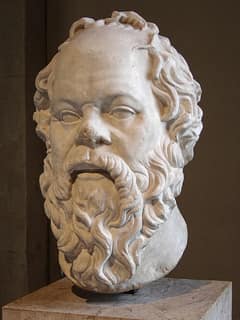
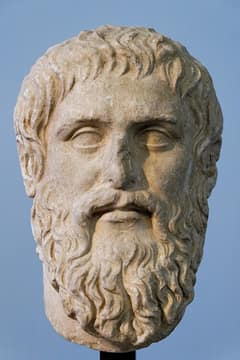
Plato was Socrates' companion and became his chief portraitist, which makes it hard to tell where Socrates' thought ends and Plato's begins.
Scope. This entry covers the historical relation between Socrates and Plato, the Socratic problem of recovering Socrates from the testimony of Plato, Xenophon, Aristophanes and Aristotle, and the main points where Plato continues or departs from the Socrates of the early dialogues. It does not survey the other Socratic writers and schools, or reconstruct Socrates' philosophy in its own right.
Historical relation and the evidence
Socrates (c. 470–399 BCE) wrote nothing. Plato, born in 428/427 into a prominent Athenian family, was about twenty-eight when Socrates was executed. Plato names himself only three times in his dialogues, each time in connection with the trial and death: present in court (Apology 34a), among the friends offering to guarantee a fine of thirty minae (Apology 38b), and absent through illness on the last day (Phaedo 59b). Xenophon mentions Plato once, as someone for whose sake Socrates took an interest in Plato’s brother Glaucon (Memorabilia III.6.1). The Seventh Letter, whose authenticity is disputed, presents the treatment of Socrates first by the Thirty and then by the restored democracy as what turned Plato away from politics (Seventh Letter 324b–326b). Later biography adds that Plato burned his tragedies after hearing Socrates (Lives of the Eminent Philosophers III.5), an anecdote with no early support. How long and how closely the two associated is not reliably recorded. Plato’s own Socrates denies ever having been anyone’s teacher (Apology 33a), so “teacher” and “student” describe the later tradition better than the relation Plato depicts.
The Socratic problem
Every source for Socrates had an interest in how he was seen, and the sources disagree.
Aristophanes’ Clouds (423 BCE, revised later) shows Socrates heading a school that studies the heavens and teaches how to make the weaker argument stronger. Plato’s Socrates names this comedy as the root of the old prejudice against him (Apology 19c) and denies both natural speculation and teaching for pay (Apology 19b–20c). Xenophon’s Memorabilia, written partly in reply to the charges (Memorabilia I.1), gives a pious and practically useful adviser who avoided speculating about the cosmos (Memorabilia I.1.11–16) and never stopped asking what each thing is, such as piety or justice (Memorabilia IV.6.1). Plato’s dialogues give the richest portrait, but the doctrines of their Socrates change from one group of dialogues to another.
Aristotle came to Athens three decades after the execution and is not an eyewitness, but he alone separates Socrates from Plato in doctrine. Socrates, he says, dealt with ethics rather than nature as a whole, sought the universal there, and was the first to fix thought on definitions (Metaphysics A.6, 987b1–4). Two things may justly be credited to him, inductive arguments and universal definition, but he did not make universals or definitions separate; his successors did (Metaphysics M.4, 1078b17–32). Aristotle also reports that Socrates took courage to be knowledge (Nicomachean Ethics III.8, 1116b3–5) and denied that anyone acts against what they know to be best (Nicomachean Ethics VII.2, 1145b21–27). He classes “Socratic conversations” as an imitative literary genre, like mime (Poetics 1, 1447b9–11), which is a reminder that the dialogues are compositions, not transcripts.
The usual solution combines these witnesses with a chronology of the dialogues. Stylometry, the statistical study of Plato’s prose style, securely isolates a late group close to the Laws, including the Sophist, Statesman, Philebus and Timaeus, but does not by itself separate early from middle works. The “early” group is identified largely by content: its Socrates questions, disavows knowledge and seeks definitions, and is then taken to be close to the historical figure, which makes the reconstruction partly circular. The middle dialogues are taken to use Socrates as a mouthpiece for Plato’s own theories of Forms, recollection and the soul.
Where Plato takes up Socrates
On the developmentalist reading, Plato’s early dialogues preserve a recognisable Socratic core. Their method is the elenchus, the refutation of those who claim to know, which the Apology traces to the oracle’s saying that no one was wiser than Socrates. His wisdom, it turns out, lies in not supposing he knows what he does not (Apology 21a–23b; method). Their ethics puts care for the soul above wealth and reputation (Apology 29d–30b) and holds that the unexamined life is not worth living (Apology 38a). They ask for definitions: Euthyphro is pressed for the one form by which all pious things are pious (Euthyphro 6d–e). And they are intellectualist: no one does wrong willingly, since everyone wants what is good and errs only from ignorance (Protagoras 352a–358d), and virtue is a kind of knowledge (Meno 87b–89a; axi.virtue-knowledge).
Where Plato departs
The middle dialogues keep Socrates as speaker but change what he holds. Definitions now answer to Forms that exist by themselves and are known by a soul that saw them before birth (Meno 81c–86b; Phaedo 72e–77a). This is the step Aristotle calls separation (ont.universals). The Socrates who disclaimed knowledge now describes a dialectic that rises to an unhypothetical first principle, the Good (Republic 531d–534e; epi.certainty). The soul acquires parts that can conflict, so knowing the best no longer suffices for doing it, and the lower parts must be trained by habit (Republic 436a–441c). And the Socrates who kept out of politics, warned off by his divine sign (Apology 31c–32a), designs a city ruled by philosophers (Republic 473c–e).
Plato also marks the shift within the dialogues. In the Phaedo Socrates tells how he turned from natural philosophy, disappointed by Anaxagoras, to a “second sailing” by way of accounts and hypotheses (Phaedo 96a–100a), a passage read both as Socratic history and as Plato’s own route to the Forms. In the late dialogues Socrates recedes: an Eleatic visitor leads the Sophist (Sophist 216a–b) and Statesman, Timaeus speaks in the Timaeus, and Socrates is absent from the Laws.
Contested readings
Can the historical Socrates be recovered? Developmentalists, of whom Gregory Vlastos is the best-known modern example, combine Aristotle’s testimony with the dating of the dialogues to reconstruct a distinct Socratic philosophy from the early works. Unitarian and literary readers answer that every dialogue is Plato’s composition in a genre that licensed invention. Charles Kahn (Plato and the Socratic Dialogue, 1996) reads the “early” dialogues as proleptic, written to prepare readers for doctrines the middle dialogues set out, so their order reflects purpose more than development. Agnostics, such as Louis-André Dorion (2011), hold that the sources cannot be reconciled and the problem has no solution. Many readers still find that the early dialogues and Aristotle agree on enough (definitions, the disavowal of knowledge, intellectualism, no separation) to support a minimal Socratic profile, though not a full doctrine.
Is Aristotle an independent witness? One view has Aristotle drawing on Academic tradition about Socrates as well as the dialogues. Another holds that he read the early dialogues as Socratic and the middle ones as Platonic, so that using his testimony to sort the dialogues is circular. Defenders reply that his distinction is too specific to be a mere inference from dramatic setting, though it cannot be shown to rest on anything beyond Plato’s texts.
How much is Xenophon worth? An older view dismissed Xenophon as too unphilosophical to understand Socrates; more recent work treats his Socrates as a deliberate portrait with its own philosophical interests. Xenophon consulted Socrates before joining Cyrus’ expedition (Anabasis III.1.5–7) and was away from Athens at the time of the trial, which limits his authority on it; his agreement with Plato on the search for definitions is usually counted as independent evidence.
Forms in the early dialogues. The Euthyphro already speaks of a form (eidos, idea) that is the same in all pious acts. Some read this as the theory of Forms in embryo; others as an unseparated universal of the kind Aristotle attributes to Socrates. Nothing in the Euthyphro requires the Form to exist apart from its instances, which is consistent with Aristotle’s report.
Is the Apology a record? Some take the Apology as close to what Socrates said, since many hearers were alive when it appeared; others treat it as Plato’s defence of Socrates written after the event. Xenophon’s Apology differs in tone and argument. A common view is that the Apology preserves the substance of the defence, while its wording and arrangement are Plato’s.
Primary passages
- Apology PlatoApology 34aApology 38bApology 33aApology 19cApology 19b–20cApology 21a–23bApology 29d–30bApology 38aApology 31c–32a
- Phaedo PlatoPhaedo 59bPhaedo 72e–77aPhaedo 96a–100a
- Memorabilia XenophonMemorabilia III.6.1Memorabilia I.1Memorabilia I.1.11–16Memorabilia IV.6.1
- Seventh Letter PlatoSeventh Letter 324b–326b
- Lives of the Eminent Philosophers Diogenes LaertiusLives of the Eminent Philosophers III.5
- Clouds AristophanesClouds
- Metaphysics AristotleMetaphysics A.6, 987b1–4Metaphysics M.4, 1078b17–32
- Nicomachean Ethics AristotleNicomachean Ethics III.8, 1116b3–5Nicomachean Ethics VII.2, 1145b21–27
- Poetics AristotlePoetics 1, 1447b9–11
- Euthyphro PlatoEuthyphro 6d–e
- Protagoras PlatoProtagoras 352a–358d
- Meno PlatoMeno 87b–89aMeno 81c–86b
- Republic PlatoRepublic 531d–534eRepublic 436a–441cRepublic 473c–e
- Sophist PlatoSophist 216a–b
- Timaeus PlatoTimaeus
- Laws PlatoLaws
- Anabasis XenophonAnabasis III.1.5–7
Further reading
- Socrates Stanford Encyclopedia of Philosophy
- Socrates Internet Encyclopedia of Philosophy
- Xenophon Internet Encyclopedia of Philosophy
- Plato Stanford Encyclopedia of Philosophy
- Plato's Ethics: An Overview Stanford Encyclopedia of Philosophy
Related
How to cite
Hekmat. "Socrates and Plato." First drafted 19 October 2026; revised 20 October 2026. https://hekmat.local/entries/socrates-and-plato/
BibTeX
@incollection{hekmat-socrates-and-plato,
  title = {Socrates and Plato},
  booktitle = {Hekmat},
  year = {2026},
  note = {First drafted 2026-10-19, revised 2026-10-20},
  url = {https://hekmat.local/entries/socrates-and-plato/}
}History: first drafted 2026-10-19; revised 2026-10-20. Drafted with AI assistance from the primary texts; status draft.