Entries · Relation
Plato and Aristotle
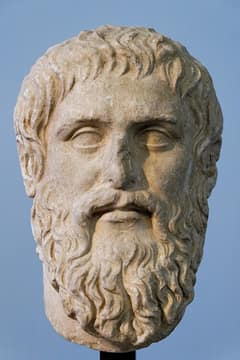
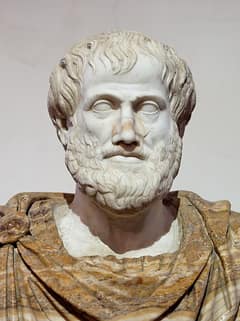
Twenty years in Plato's Academy made Aristotle Plato's most searching critic; he kept Plato's questions and the priority of form, but placed form inside the things it shapes.
Scope. This entry covers the historical relation between Plato and Aristotle, the passages in which Aristotle reports on or argues against Plato, and their contrasting answers on knowledge, being, soul, the good and the city. It leaves aside the doctrines of the Old Academy except where Aristotle's testimony depends on them, and treats the later tradition of harmonising the two only in outline.
Historical relation and the evidence
Aristotle came from Stagira to Athens in 367 BCE, aged about seventeen, and joined Plato’s Academy, where he stayed for some twenty years until Plato’s death in 348/347. The chronology rests mainly on Diogenes Laertius (Lives of the Eminent Philosophers V.1–11), who wrote about five centuries later and mixes datable fact with anecdote. The school passed to Plato’s nephew Speusippus. Aristotle left Athens, worked at Assos and on Lesbos, tutored the young Alexander in Macedon, and returned in 335 to teach in the Lyceum.
His Academic years are known mostly from lost works that survive in fragments: dialogues in Plato’s manner, such as the Eudemus on the soul; an exhortation to philosophy, the Protrepticus; and a treatise On Ideas whose arguments reach us through Alexander of Aphrodisias’ commentary on the Metaphysics. The surviving treatises are later lecture material, so Aristotle’s critique of Plato survives in its mature, compressed form.
Aristotle is also Plato’s main external witness. He reports doctrines absent from the dialogues, such as the derivation of the Forms from the One and the “great and small” (Metaphysics A.6, 987b18–988a17), and once mentions Plato’s “unwritten teachings” (Physics IV.2, 209b11–17). How far these reports can be trusted is itself disputed (see Contested readings).
Where Aristotle takes up Plato
In the survey of earlier thought in Metaphysics A, Plato follows the Pythagoreans in most things but adds something of his own. Having accepted from Cratylus that sensibles are always in flux, and from Socrates that ethical inquiry seeks definitions, he concluded that definitions must be of some other kind of thing than sensibles, and called these Forms (Metaphysics A.6, 987a29–b10). The same genealogy recurs in Metaphysics M.4, 1078b9–32, which adds that Socrates did not separate universals and his successors did (see Socrates and Plato).
The sustained critique follows in Metaphysics A.9, 990a33–993a10, repeated with variations in M.4–5. Aristotle still writes “we” of the Platonists here (Metaphysics 990b8–11). The arguments for Forms, he says, either fail or prove too much: the argument from the sciences and the one-over-many would yield Forms of artefacts and negations, which Platonists deny, while the more exact arguments yield Forms of relatives or the “third man” (Metaphysics 990b8–17; cf. Sophistical Refutations 22, 178b36–179a10). Even if Forms existed they would explain nothing about sensibles, causing neither their motion nor their change; to call them patterns in which things share is to use “empty words and poetic metaphors” (Metaphysics 991a8–b9, at 991a20–22).
Two further passages name the target. In the ethics Aristotle hesitates to attack the Form of the Good, because friends introduced the Forms, but holds that truth must be honoured above friends (Nicomachean Ethics I.6, 1096a11–17). He then argues that good is said in as many ways as being and so cannot be one common Form, and that a separate Good would be neither achievable nor useful in action (Nicomachean Ethics 1096a17–1097a14). In the Politics he examines the Republic’s communal arrangements and the Laws by name (Politics II.1–6, 1260b27–1266a30).
Aristotle also credits Plato, praising him for asking whether an argument proceeds from first principles or towards them (Nicomachean Ethics I.4, 1095a30–b3), and he accepts that the soul is the “place of forms”, provided this means only the thinking soul, and its forms only potentially (De Anima III.4, 429a27–29).
Knowledge and its source
Both hold that strict knowledge is of what is universal and cannot be otherwise. They divide over where its objects are and how we come to grasp them (epi.source, epi.innate).
For Plato the knowable is the Forms, and learning is the recollection, by a soul that saw them before birth, of what it already knew (Meno 81c–86b; Phaedo 72e–77a). Perception at most reminds. Aristotle names the Meno’s puzzle about learning at the opening of the Posterior Analytics and answers it by distinguishing ways of knowing (Posterior Analytics I.1, 71a29–b8). At the close of the same work he calls innate knowledge of first principles absurd, since we would possess the most exact knowledge without noticing it. Principles are reached instead along a path from perception through memory and experience until the universal comes to rest in the soul (Posterior Analytics II.19, 99b25–100b5). Before it thinks, the intellect is like a tablet on which nothing is yet written (De Anima III.4, 429b29–430a2).
The contrast is narrower than the slogans suggest: Aristotle keeps an intellect (nous) that grasps principles, and Plato lets perception occasion recollection. But on whether anything is known before experience, their answers are opposed.
Being and universals
Plato posits one Form wherever many things share a name; the Form exists by itself, and the many have their character by participating in it (Republic 596a–b; Phaedo 100b–101c). Aristotle agrees that there are universals, defined as what is by nature predicated of many (De Interpretatione 7, 17a38–b1), but denies that any of them exists apart. In the Categories the primary substances are individuals, this man or this horse, and if they did not exist nothing else would (Categories 5, 2a11–2b6). In Metaphysics Z the question becomes what makes something a substance, and the answer is form or essence; yet no universal is a substance (Metaphysics Z.13, 1038b8–1039a3). How both can hold, and so whether Aristotelian form is universal or particular, is the central crux of Metaphysics Z, and commentators remain divided on it. Separate Forms, meanwhile, are idle in explaining generation, since a man begets a man (Metaphysics Z.8, 1033b19–1034a8).
Form thus keeps the explanatory priority Plato gave it, but is brought inside the composite (ont.universals). Plato had already raised the regress that Aristotle presses, while insisting that without Forms thought would have nothing to fix on (Parmenides 132a–b; Parmenides 135b–c). At the summit of reality both place something separate and good, but with different roles (ont.ultimate). Plato’s Good is the source of the Forms’ being and intelligibility (Republic 507b–509c). Aristotle’s first mover is pure actuality, thought thinking itself, which moves as an object of love moves (Metaphysics Λ.6–9, 1071b3–1075a10). He asks whether the good of the universe is separate or lies in its order, and answers that it is both, as an army’s good lies in its order and in its general (Metaphysics Λ.10, 1075a11–15).
Soul
In the Phaedo the soul is akin to the invisible and unchanging Forms and can exist apart from the body (Phaedo 78b–80b); in the Republic it has three parts, reason, spirit and appetite (Republic 436a–441c). Aristotle defines the soul as the first actuality of a natural body that has life potentially, so that asking whether soul and body are one is as idle as asking it of wax and its shape (De Anima II.1, 412a3–413a10, at 412b6–9). He criticises the Timaeus for making the world-soul a magnitude (De Anima I.3, 406b26–407b11) and finds the tripartite division arbitrary (De Anima III.9, 432a22–b7).
Yet they converge. Aristotle leaves open that some part of soul, the intellect, is separable because it is the actuality of no bodily organ (De Anima 413a3–7), and describes the productive intellect as alone immortal and eternal, though without memory (De Anima III.5, 430a17–25). Plato’s later texts likewise make the lower parts mortal (Timaeus 69c–d). What divides them is whether anything personal survives (ont.soul-body, ont.immortality).
The good and the virtues
For Plato the Form of the Good is the greatest object of study, and without it justice and the rest are of no benefit (Republic 505a–b). Aristotle replaces a single Good with the human good, found by asking what the human function is: activity of the soul in accordance with virtue (Nicomachean Ethics I.7, 1097b22–1098a20). Character virtue comes from habituation (Nicomachean Ethics II.1, 1103a14–b25), but the Republic had already trained spirit and appetite by music and gymnastics (Republic II–III, 376e–412b). The sharper disagreement is with Socrates: Aristotle rejects the denial of weakness of will as contrary to the appearances, yet concedes that what passion overcomes is not knowledge in the full sense (Nicomachean Ethics VII.2–3, 1145b21–1147b19).
At the top the two are close. Aristotle ranks the contemplative life first and urges us to “make ourselves immortal” as far as we can (Nicomachean Ethics X.7–8, 1177a12–1179a32), which echoes Plato’s call to become like god as far as possible (Theaetetus 176a–b). How the contemplative ideal relates to the life of practical virtue is disputed for both (axi.highest-good, axi.virtue-knowledge).
The city and the arts
Plato’s best city is ruled by philosophers (Republic 473c–e) and prizes unity above all (Republic 462a–e). Aristotle replies that a city pushed towards unity becomes a household and then an individual, and that common property is neglected property (Politics II.1–5, 1260b27–1264b25). The constitution he recommends for most cities is a polity, mixing oligarchy and democracy around a large middle class (Politics IV.8–9, 1293b22–1294b41). Here he is nearer the late Plato, whose Laws already mixes monarchy and democracy (Laws 693d–e; axi.legitimacy).
On the arts the contrast is clearer. In Republic X imitative poetry stands third from the truth and feeds the irrational part of the soul (Republic 595a–608b). For Aristotle imitation is natural to humans and a source of learning (Poetics 4, 1448b4–19), and poetry is more philosophical than history because it speaks of universals (Poetics 9, 1451a36–b11; axi.art).
Contested readings
Aristotle as witness. One camp, associated with Harold Cherniss, holds that Aristotle reports Plato through his own categories and for polemical ends, so his testimony about unwritten doctrines and separation reveals more about Aristotle than about Plato. The opposite camp, notably the Tübingen school, takes the reports of an oral teaching on the One and the great-and-small as proof that the dialogues do not contain Plato’s whole doctrine. A common middle course treats Aristotle, after twenty years in the Academy, as the best external witness available, but seeks corroboration for each report, since he restates everything in his own vocabulary.
Did Plato separate the Forms? The adjective chōriston, as a technical term, is Aristotle’s; but Plato’s Parmenides already asks whether Socrates sets the Forms themselves apart (chōris) from the things that share in them (Parmenides 130b). One reading holds that Plato is committed to separation, understood as existence independent of particulars, by Forms that are eternal while particulars perish, and by the Timaeus’ insistence that a Form enters into nothing else (Timaeus 51b–52b). Another, argued by Gail Fine (“Separation”, 1984), finds no clear assertion of separation in Aristotle’s sense in the middle dialogues, which say only that Forms are not identical with sensibles. Many readers grant that the texts commit Plato to Forms that would exist even without particulars, which is all Aristotle’s charge needs; whether that makes participation unintelligible is the harder question.
The third man and the Parmenides. Since Plato states the regress himself (Parmenides 132a–b), readers disagree about what he made of it: that he saw it as fatal and revised the theory, that he rejected one of its premises (for instance that a Form is an instance of itself), or that the Parmenides is a dialectical exercise for the young. Parmenides 135b–c suggests that he kept the Forms and thought the objections answerable, but he never says which premise he would give up.
Development or constancy in Aristotle. Developmental readings, following Werner Jaeger, trace a path from Platonism in the lost dialogues to empirical research in the treatises; unitarian readings find the treatises broadly consistent and the fragments too thin to show a trajectory. The fragments show that Aristotle once wrote in Plato’s genre; few now think the treatises can be dated securely enough to carry the full developmental story.
Harmony or opposition. Late ancient Neoplatonists, from Porphyry to Simplicius, read Aristotle as agreeing with Plato on fundamentals; most modern readers stress opposition, though Lloyd Gerson (Aristotle and Other Platonists, 2005) has revived a version of the harmonist case. Harmonists can point to Aristotle working within Plato’s questions and keeping the priority of form; critics reply that reconciling separate Forms with immanent forms means reading Aristotle against his explicit statements.
Reception
The harmonising reading shaped the curriculum of the late ancient schools, which read Aristotle first and Plato second, and through them the Arabic tradition: a treatise on the agreement of the two sages circulated under al-Farabi’s name, and Arabic philosophers often met Plotinus under Aristotle’s name (see Aristotle through the Islamic world). The medieval Latin West knew Aristotle far better than Plato, of whom it had chiefly Calcidius’ partial Latin Timaeus, joined in the twelfth century by Henricus Aristippus’ Latin Meno and Phaedo. The balance shifted in fifteenth-century Italy, where Gemistus Plethon’s tract on the differences between the two (1439) opened a long controversy and Marsilio Ficino’s Latin Plato (1484) made the dialogues widely available.
Primary passages
- Lives of the Eminent Philosophers Diogenes LaertiusLives of the Eminent Philosophers V.1–11
- Commentary on Aristotle's Metaphysics Alexander of Aphrodisiascommentary on the Metaphysics
- Metaphysics AristotleMetaphysics A.6, 987b18–988a17Metaphysics A.6, 987a29–b10Metaphysics M.4, 1078b9–32Metaphysics A.9, 990a33–993a10Metaphysics 990b8–11Metaphysics 990b8–17Metaphysics 991a8–b9Metaphysics Z.13, 1038b8–1039a3Metaphysics Z.8, 1033b19–1034a8Metaphysics Λ.6–9, 1071b3–1075a10Metaphysics Λ.10, 1075a11–15
- Physics AristotlePhysics IV.2, 209b11–17
- Sophistical Refutations AristotleSophistical Refutations 22, 178b36–179a10
- Nicomachean Ethics AristotleNicomachean Ethics I.6, 1096a11–17Nicomachean Ethics 1096a17–1097a14Nicomachean Ethics I.4, 1095a30–b3Nicomachean Ethics I.7, 1097b22–1098a20Nicomachean Ethics II.1, 1103a14–b25Nicomachean Ethics VII.2–3, 1145b21–1147b19Nicomachean Ethics X.7–8, 1177a12–1179a32
- Politics AristotlePolitics II.1–6, 1260b27–1266a30Politics II.1–5, 1260b27–1264b25Politics IV.8–9, 1293b22–1294b41
- On the Soul AristotleDe Anima III.4, 429a27–29De Anima III.4, 429b29–430a2De Anima II.1, 412a3–413a10De Anima I.3, 406b26–407b11De Anima III.9, 432a22–b7De Anima 413a3–7De Anima III.5, 430a17–25
- Meno PlatoMeno 81c–86b
- Phaedo PlatoPhaedo 72e–77aPhaedo 100b–101cPhaedo 78b–80b
- Posterior Analytics AristotlePosterior Analytics I.1, 71a29–b8Posterior Analytics II.19, 99b25–100b5
- Republic PlatoRepublic 596a–bRepublic 507b–509cRepublic 436a–441cRepublic 505a–bRepublic II–III, 376e–412bRepublic 473c–eRepublic 462a–eRepublic 595a–608b
- De Interpretatione AristotleDe Interpretatione 7, 17a38–b1
- Categories AristotleCategories 5, 2a11–2b6
- Parmenides PlatoParmenides 132a–bParmenides 135b–cParmenides 130b
- Timaeus PlatoTimaeus 69c–dTimaeus 51b–52b
- Theaetetus PlatoTheaetetus 176a–b
- Laws PlatoLaws 693d–e
- Poetics AristotlePoetics 4, 1448b4–19Poetics 9, 1451a36–b11
Further reading
- Plato Stanford Encyclopedia of Philosophy
- Aristotle Stanford Encyclopedia of Philosophy
- Aristotle's Metaphysics Stanford Encyclopedia of Philosophy
- Plato's Middle Period Metaphysics and Epistemology Stanford Encyclopedia of Philosophy
- Plato's Parmenides Stanford Encyclopedia of Philosophy
- Aristotle Internet Encyclopedia of Philosophy
Related
How to cite
Hekmat. "Plato and Aristotle." First drafted 19 October 2026; revised 20 October 2026. https://hekmat.local/entries/plato-and-aristotle/
BibTeX
@incollection{hekmat-plato-and-aristotle,
  title = {Plato and Aristotle},
  booktitle = {Hekmat},
  year = {2026},
  note = {First drafted 2026-10-19, revised 2026-10-20},
  url = {https://hekmat.local/entries/plato-and-aristotle/}
}History: first drafted 2026-10-19; revised 2026-10-20. Drafted with AI assistance from the primary texts; status draft.